Only about one-third of the daily required water is being supplied to around 3,800 taps in Dhankuta Bazaar, and the issue of water quality remains longstanding.
We use Google Cloud Translation Services. Google requires we provide the following disclaimer relating to use of this service:
This service may contain translations powered by Google. Google disclaims all warranties related to the translations, expressed or implied, including any warranties of accuracy, reliability, and any implied warranties of merchantability, fitness for a particular purpose, and noninfringement.
Consumers in Dhankuta Bazaar have been struggling with both the supply and quality of drinking water for years. In the dry season, when water sources dry up, supply cannot meet demand, while in the monsoon, the problem of muddy, sediment-laden water coming through the taps has become routine.
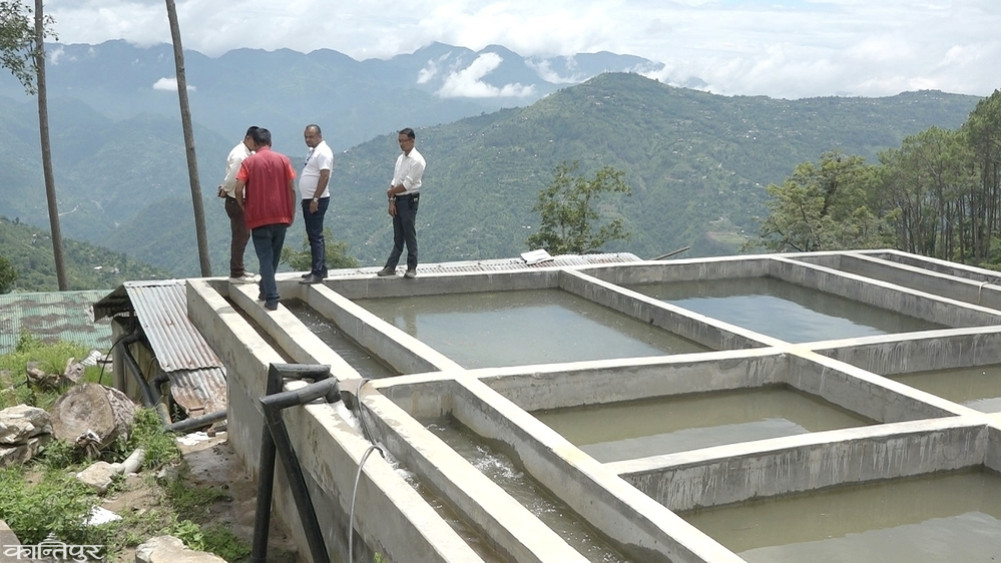
As consumer complaints increased, an on-site inspection of the water system from the source to the consumers’ taps was conducted under the leadership of the Dhankuta Municipality Water Supply and Sanitation Consumer Committee. Member of the House of Representatives Rajendra Kumar Rai, Chief of the District Coordination Committee Niren Tamang, Mayor of Dhankuta Municipality Chintan Tamang, representatives from political parties, local government, organizations, journalists, and security agencies gathered information about the condition of the sources, lifting system, pipelines, reserve tanks, filtration, and distribution systems.
Consumers from wards 3 to 8 of Dhankuta Municipality have been complaining that they do not receive enough clean water even after paying for it. Dil Maya Shrestha of Dhankuta-7 said she has to pay fees even for insufficient and muddy water. “Sometimes water doesn’t come for a week, and when it does, it’s so muddy it’s unusable,” she said.
According to Tulsa Limbu of Dhankuta-5, the same problem recurs not only in the dry season but also during the monsoon. “The tap water looks even dirtier than river water,” she said. Consumers in Dhankuta Bazaar pay a minimum of 300 rupees for 8 units (8,000 liters) of water. However, they complain that for most of the monsoon, only muddy, sediment-laden water is supplied, and in the dry season, they do not get enough water to meet demand.
Muddy Water at the Source During Monsoon
In Dhankuta Bazaar, water is collected and distributed from sources such as Lungdang, Mudhe, Chharchhare, Teendobhane, and Aitbare. Water is also pumped from the Nibuwa and Tankhuwa streams using lifting technology and delivered to main tanks in places like School Danda, Laharebar, Kagate, and Chuliban for distribution.
However, because water is collected directly from the streams and connected straight to the pipelines, the amount of soil and sediment in the water increases during the monsoon. Mayor Chintan Tamang of Dhankuta Municipality said that the lack of an effective filtration system with sufficient capacity makes it difficult to fully purify the water.
According to him, the old filtration system, dilapidated pipelines, and tanks make it challenging to provide consumers with clean, pure, and sufficient water. “It is also the municipality’s responsibility to provide residents with clean and sufficient water. We conducted the inspection to understand where the problems lie,” he said.
Consumers also complain that pollution from waste flowing from upper areas like Hile contaminates the water sources. “Since water is collected from the streams, purification becomes problematic during the monsoon,” Mayor Tamang said, “The municipality and the water consumer committee are working together to address this.”
Meeting Demand in the Dry Season Is Difficult
In the dry season, the problem is directly linked to the water sources. The committee says that as the volume of water in underground sources decreases and some sources dry up, it is impossible to meet demand. Currently, about 4,656,000 liters of water are needed daily for 3,895 households in Dhankuta Bazaar. However, only about 1,600,000 liters are being supplied daily.
Arjun Charahang, secretary of the Dhankuta Municipality Water Supply and Sanitation Consumer Committee, said that supply is also affected when there are problems with the motors and other equipment used to pump water from the Nibuwa and Tankhuwa streams.
New Filtration System Raises Hopes
To solve the problem of muddy water during the monsoon, a sedimentation tank and roughing filter are being constructed at Laharebar. According to Secretary Charahang, the structure, being built at a cost of about 8 million rupees by the Federal Water Supply and Sewerage Management Office, Dhankuta, is in its final stage.
The new system will have the capacity to settle and filter muddy water at a rate of 10 liters per second. “Once both systems are operational, the problems with supply and quality will be somewhat reduced,” he said.
According to him, after the 2015 earthquake, the old filtration system was damaged, and since it cannot be operated effectively now, there are problems purifying the sediment-laden water that comes during the monsoon.
Increasing the Capacity of Pumps and Equipment
Work is underway to replace old pumps and equipment in the lifting system to increase water supply.
After the capacity of pump sets installed at Nibuwa Khola, Thoka, and Chihandanda decreased, the Federal Water Supply and Sewerage Management Office provided two pumps with a capacity of 60 horsepower. Secretary Charahang said those pumps are in the process of being installed. According to him, once the new pumps are operational, the capacity to draw water will increase and supply management is expected to improve.
Member of the House of Representatives Rajendra Kumar Rai said that after consumer complaints, an on-site inspection was conducted from the source to the taps. According to him, although there is no shortage of sources during the monsoon, there are problems with quality and distribution management. “After consumers complained about the supply system and quality, I personally went out to monitor,” he said, “We will immediately move forward with tasks that can be improved right away. For tasks that take time, we will make plans and implement them gradually.”
He said that the Federal Water Supply Office, the municipality, and the consumer committee will work together to manage sources, purification, pipeline improvements, and to organize the distribution system.
The drinking water problem in Dhankuta Bazaar is not new. The issues of insufficient water in the dry season and unclean water during the monsoon have been recurring for years. Efforts are now underway to conserve sources, improve the lifting system, install new pumps, construct sedimentation and filtration structures, and improve the distribution system.
Currently, about 1.6 million liters of water are being distributed daily to around 3,800 taps in Dhankuta Bazaar, while the daily requirement is 4,656,000 liters. Since only about one-third of the demand is being supplied, it is clear that finding additional sources, conserving existing ones, establishing a purification system with sufficient capacity, and expanding the distribution infrastructure are essential for a long-term solution.
According to Arjun Charahang, secretary of the Dhankuta Municipality Water Supply and Sanitation Consumer Committee, the search for alternative sources that can be operated long-term has also begun.