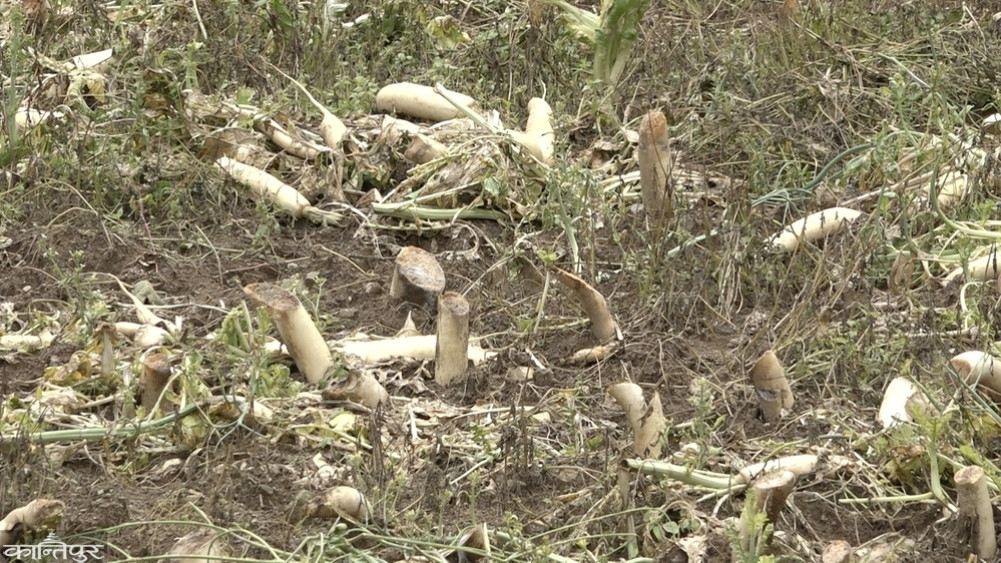
Farmers in Chhatharjorpati complain after radishes rot in their fields: 'What can we do if we don't tell them? The government nearby doesn't care, the government far away doesn't see it'
We use Google Cloud Translation Services. Google requires we provide the following disclaimer relating to use of this service:
This service may contain translations powered by Google. Google disclaims all warranties related to the translations, expressed or implied, including any warranties of accuracy, reliability, and any implied warranties of merchantability, fitness for a particular purpose, and noninfringement.
Kishore Subba, a farmer from Jorpati, Chhathar Jorpati Rural Municipality-2, Dhankuta, had cultivated radishes on an area of 25 ropanis this year. He had expected good income after a good harvest, but was disappointed when the price dropped to Rs 6 per kg when he sent the radishes to the market. Since the cost of seeds, fertilizers, tillage, irrigation, labor and transportation could not be covered by selling them at that price, he rotted thousands of kilos of radishes in the field.
He says that he has not been able to earn a single rupee from radish cultivation this year. Now he is preparing to clear the field where the radishes rotted and plant cabbage.
'I did not earn a single rupee from radish cultivation, now I will clear the field and plant cabbage,' said Subba, 'It is very painful to have to throw away vegetables grown after spending time, effort and money like this. There is production, but there is no way to sell it.' According to him, due to the lack of market certainty, Chhathar Jorpati farmers are forced to destroy some or the other crop in the field every year.
The situation of Ambika Subedi, another farmer from Jorpati, is no different. She says that the cost of production has not been met, and now she has to spend more to clear the fields to plant new crops. Subedi, who has been clearing the fields with a harvester after the radishes did not sell, is now preparing to plant cabbage.
'Selling radishes for Rs 6 a kilo is not enough to pay for the seeds, fertilizer, labor, and tractor rent,' she said. 'Since the wages of the people who uproot, wash, and carry the radishes are not being paid, there is no other option but to leave them to rot in the fields. Since the wages are not being paid, what should we do if they do not rot?'
Chhathar Jorpati Rural Municipality of Dhankuta is one of the major areas in Koshi Province for fresh vegetable production. About five thousand farmer families here have been producing vegetables including radishes, cabbage, cauliflower, potatoes, peas, squash, and carrots. According to the Agricultural Knowledge Center Dhankuta, fresh vegetables worth about four billion rupees are produced here annually. 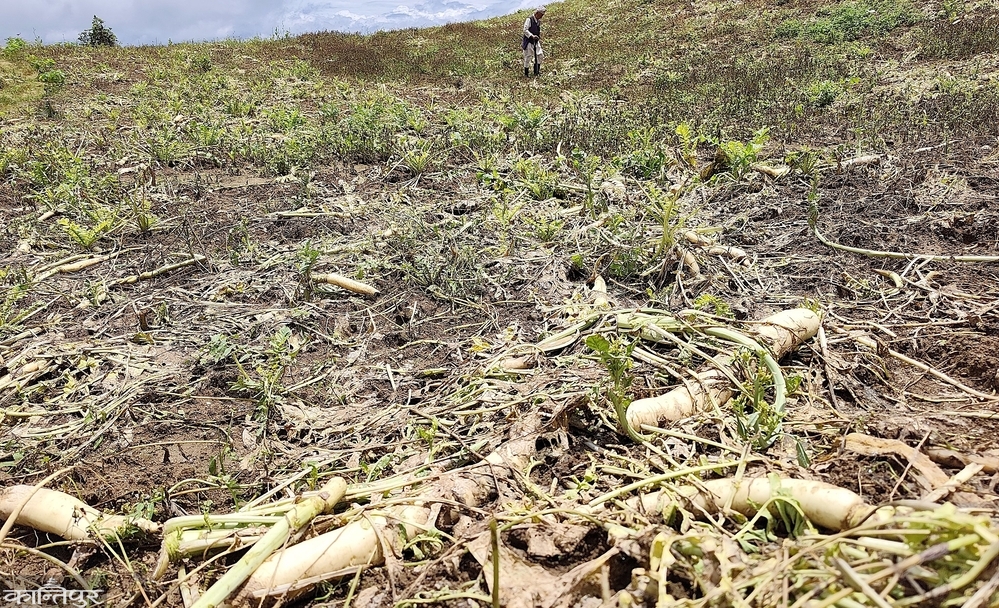
Even though production is increasing every year, farmers have not been able to get a fair price due to the lack of a reliable market. As a result, every year some vegetable crop rots or is destroyed in the field.
For the past two years, the cabbage produced by Chhatharjorpati farmers had to be destroyed in the field after it was not sold even for Rs 3 per kg. This year, the same fate has been repeated in radish farming, farmers say.
Subedi says that this problem, which is repeated every year, is weakening the morale of farmers. 'Since we are not getting the price for the vegetables we have produced with so much hard work, our enthusiasm for farming is waning,' she said.
According to another farmer, Kamal Sinjali Magar, even if radish gets a minimum price of Rs 12 per kg, farmers will not suffer losses. 'Although it would have been better if it was Rs 20-25 per kg, but even if it is at least Rs 12, the production cost increases. Selling at the current price of Rs 6 is a loss on top of a loss,' he said.
Farmer Ambika Bhattarai, who has been cultivating vegetables commercially for a long time, complains that there is no government that listens to the problems of farmers. 'There is no government that listens to our grievances,' she said. 'When farmers do not get the price of their produce, there should be a system to help promote sales, provide compensation or find a market. Which government sees our pain? The government nearby does not see it, the government far away does not see it.'
The vegetables produced in Chhatharjorpati cannot be sustained by the local market alone. Although a large part of the production reaches the markets of the Terai, there is a lack of a permanent mechanism for regular purchase. Although there is a possibility of exporting to potential external markets such as India and Bangladesh, the necessary policy, legal and institutional arrangements for that have not yet been effectively put in place.
Although the local level has been supporting farmers through agricultural mechanization, technology, seeds and production increase programs, the village officials say that they do not have the authority to manage exports.
Chhatharjorpati Rural Municipality Chairman Chhatra Bahadur Subba says that the problem cannot be solved by local level efforts alone unless legal channels for exports to India and Bangladesh are opened.
'We have encouraged farmers to increase production. We have provided agricultural machinery, equipment, technology and seeds to the extent of the municipality's capacity,' he said, 'but the local level does not have the authority and capacity to make policy arrangements for sales in the external market. That work should be done by the federal and provincial governments.'
According to him, since the fresh vegetables produced here are in large quantities, the problem cannot be solved by storing them in a humidification center alone. 'Each of the approximately five thousand farmer families in Chhatharjorpati produces a minimum of 50 quintals of vegetables. Building and operating infrastructure to store such a large quantity of vegetables is beyond the capacity of the local level,' said Chairman Subba. He estimates that this year alone, farmers in the Chhatharjorpati area have suffered a loss of about Rs 40 million in radish cultivation.
He pointed out the need for the federal and provincial governments to take the lead in post-production market management, policy facilitation for exports, and development of a long-term agricultural market system.
Although the Chhatharjorpati area of Dhankuta is known as the major vegetable production center of Koshi Province, farmers have been facing problems of poor quality seeds, lack of post-production market management, price instability, and lack of a reliable export system for years.
The main livelihood of about five thousand farmer families here depends on fresh vegetable farming. Therefore, farmers are demanding that the government be serious in making arrangements for quality and certified seeds, policies to ensure a stable market within the country, price stabilization mechanisms, post-production management, and clear arrangements for long-term exports to external markets including India and Bangladesh, along with a program to increase production.