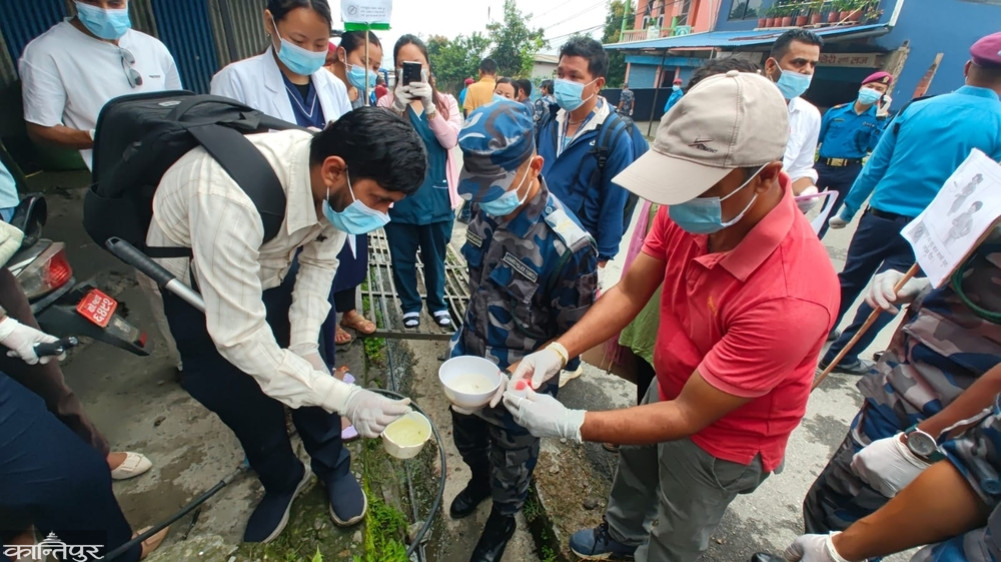
Locals have been warned to prevent water from accumulating around their homes and offices, clean water containers regularly, and remove mosquito breeding sites themselves.
We use Google Cloud Translation Services. Google requires we provide the following disclaimer relating to use of this service:
This service may contain translations powered by Google. Google disclaims all warranties related to the translations, expressed or implied, including any warranties of accuracy, reliability, and any implied warranties of merchantability, fitness for a particular purpose, and noninfringement.
As dengue infections increase with the monsoon, the District Health Office, Dhankuta, has launched a district-wide campaign to search for and destroy mosquito breeding grounds. Since Baisakhi alone, 65 people in the district have been confirmed to have dengue infections, the Health Office has launched a 'Search and Destroy' campaign in coordination with government agencies and local levels.
Under the campaign, public places in market areas, garages, under-construction buildings, puddles of water, old tires, drums, tanks, flower pots, plastic containers and other potential places where mosquitoes can breed have been inspected and the larvae have been destroyed. In addition, locals have been made aware of not allowing water to accumulate around their homes and offices, regularly cleaning water containers and removing mosquito breeding grounds themselves.
District Health Office, Dhankuta, Chief Sirjana Banjade said that since the monsoon increases the breeding of mosquitoes, a campaign has been launched to destroy larvae at the source to control the infection. According to her, 65 people have been confirmed to have dengue infection in the district since April.
According to Banjade, the campaign will be expanded to all seven local levels of Dhankuta district. She said that a program will be launched in each municipality to identify potential risk areas, search for and destroy larvae, and make the community aware of dengue control.
According to the health office, dengue is a viral disease transmitted through the bite of female Aedes mosquitoes. Since these mosquitoes breed in clean and stagnant water, it is said that preventing water from accumulating in containers such as tires, drums, buckets, pots, coolers, tanks, etc. around the house and office is the most effective way to control the disease.
Health workers have urged people to immediately reach a health institution and get tested if they experience high fever, headache, pain behind the eyes, joint and muscle pain, nausea, or red rashes on the body. They have also suggested not to ignore the symptoms as some dengue patients may develop complex problems if not treated on time.
The Health Office has urged every citizen to make it a habit to inspect their own homes and workplaces for at least 10 minutes every week and remove stagnant water, stating that dengue control will not be possible with the efforts of government agencies alone.