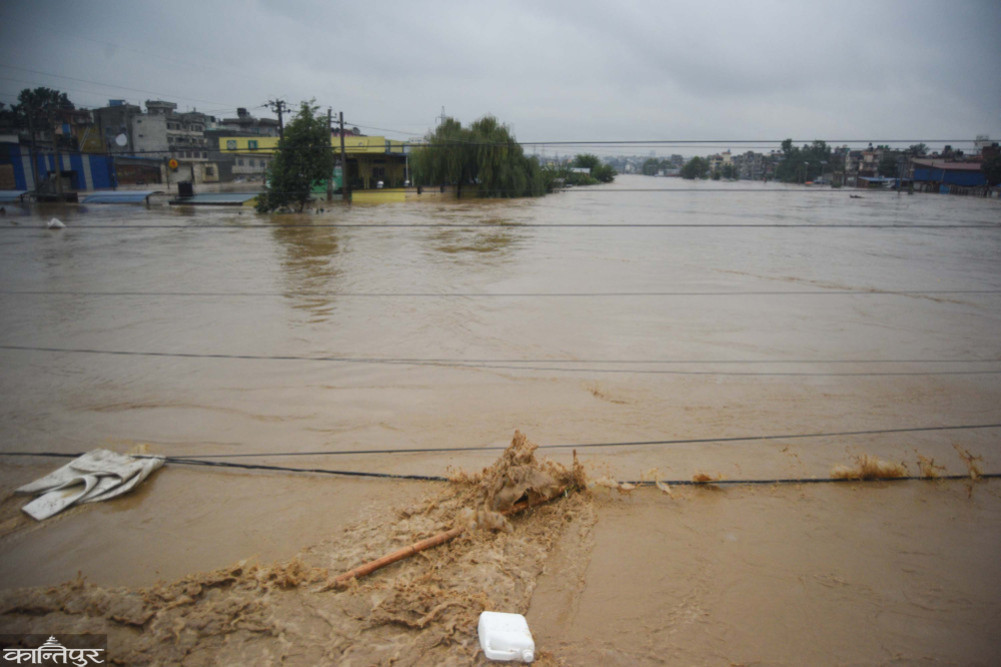
The District Administration Office, Jhapa, has urged people to adopt high alertness in view of the potential risk of flooding and inundation.
We use Google Cloud Translation Services. Google requires we provide the following disclaimer relating to use of this service:
This service may contain translations powered by Google. Google disclaims all warranties related to the translations, expressed or implied, including any warranties of accuracy, reliability, and any implied warranties of merchantability, fitness for a particular purpose, and noninfringement.
The Department of Hydrology and Meteorology has forecast heavy to very heavy rainfall in various parts of the country, including the eastern Terai, on Tuesday and Wednesday, and the District Administration Office, Jhapa, has urged people to be on high alert in view of the risk of possible flooding and inundation.
The District Administration Office has issued a press release on Monday, urging the public to be vigilant in riverine areas and areas at risk of flooding as monsoon activity is likely to increase, accompanied by thunder and lightning. The administration has requested people not to travel through rivers and streams that may suddenly flood, not to cross rivers and streams, and to seek advance information about safe places.
Areas around the main rivers of the district, Kankai, Biring, Ratuwa, Mechi, Mawa and Ninda rivers, are most affected by floods. Of the 15 municipalities in the district, Gauriganj, Kachankawal, Barhadashi, Jhapa, Kamal, Shivasatakshi and Bhadrapur municipalities in the southern part are at high risk of flooding and inundation.
To deal with potential disasters and minimize loss of life and property, the Nepal Army, Nepal Police, Armed Police Force, Nepal Red Cross Society and local level mechanisms have been kept in a state of readiness with relief materials. Informing about the preparations for disaster management and response, Jhapa Chief District Officer Shivaram Gelal said, 'The District Disaster Management Committee has prepared an integrated disaster response plan and is in a state of readiness. Although there are many types of disasters in the district, flood disasters are the first priority. Therefore, we have prepared to adopt all kinds of measures to prevent loss of life and property. Continuous coordination is being done with the police, army, Red Cross and local municipality heads.'
Keeping in mind the annual floods in Jhapa and the humanitarian crisis they cause, the Nepal Red Cross Society has made special preparations and food storage arrangements in the low-lying coastal areas this year. Informing about this, Lokraj Dhakal, President of Nepal Red Cross Society Jhapa, said that according to the Red Cross data, more than eight thousand households in the district are at very high risk of floods. He said that since there has been a huge loss of life in the past years, special emphasis has been placed on the early warning system and local level proactivity this time. He said that more than 120 volunteers and first aid teams are on standby across the district with search and rescue equipment.