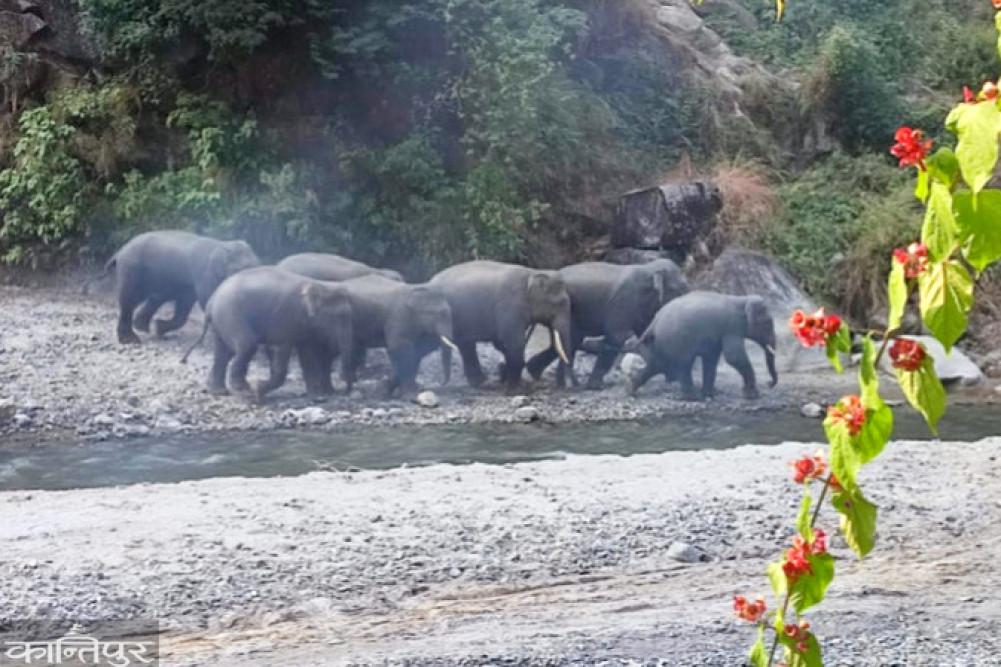
Residents are in panic after wild elephants, which arrived from India with tents, began roaming around the village all day long.
We use Google Cloud Translation Services. Google requires we provide the following disclaimer relating to use of this service:
This service may contain translations powered by Google. Google disclaims all warranties related to the translations, expressed or implied, including any warranties of accuracy, reliability, and any implied warranties of merchantability, fitness for a particular purpose, and noninfringement.
Mid-Ashar is the main time for farmers to work hard in the fields to harvest their annual crops. However, the residents of Bahundangi, Mechinagar-4, Jhapa, are more concerned about saving their lives and property than the rush of planting.
The residents are in a state of panic after wild elephants from India, accompanied by their calves, started roaming around the village all day long. The herds of elephants, numbering 40 to 50, sometimes return to India every day, and sometimes stay in the tea gardens and bushes of Bahundangi itself. Locals say that since the elephants, accompanied by their calves, are more aggressive, there is a fear that an unpleasant incident will happen in the village at any time.
The fear of encountering elephants on the road has affected the education of children. Farmers have stopped planting rice in the mud of Ashar and are walking all day long to chase away the elephants, putting their lives in their hands. Local youth, villagers and police administration teams are trying to drive the elephants hiding in the tea plantations to a safe place away from human settlements by blowing sirens and adopting various measures, but this effort has proven to be only 'short-lived'.
Arjun Karki, Ward Chairman of Mechinagar-4, said that teams of local government and security agencies are continuously deployed in the field for the safety of citizens. 'We are working to drive the elephants away from the settlements and tea plantations towards India by blowing sirens with the help of local youth, Nepal Police and Armed Police Force. This problem cannot be solved by the sole efforts of the local level, for this the federal government must take concrete steps,' he said.
Neelkantha Tiwari, a local of Bahundangi, who has been facing the problem for a long time, said that it has become difficult to save money and people. He said that a memorandum has been submitted to the Prime Minister through the Chief Minister and Chief District Officer to take initiative for control, but no response has been received.
The conflict between Bahundangi and elephants has existed for decades. This is a natural corridor that has been used by elephants since ancient times to travel from Assam and West Bengal in India to the Koshi Tappu Wildlife Sanctuary in Nepal. After human settlement and deforestation obstructed their path, they started entering villages.
The electric fencing installed at a cost of crores of rupees in the border area to stop elephants has deteriorated in many places, and elephants have found new ways to enter villages by pressing the wire with tree branches or knocking down poles. Similarly, the lack of sufficient food (bamboo, sugarcane, bananas) for elephants in the forest area and the availability of stored grain or field rice in the villages attract them to the villages.
This problem will not be solved by blowing sirens at the local level or chasing them away for a while. For this, it is necessary to manage the old elephant corridor by coordinating 'cross-border' between the governments of both Nepal and India. For the time being, it seems that a humanitarian crisis could arise in Bahundangi unless the local administration repairs the fencing, adopts high security alert in the affected areas, and guarantees proper compensation to the farmers.