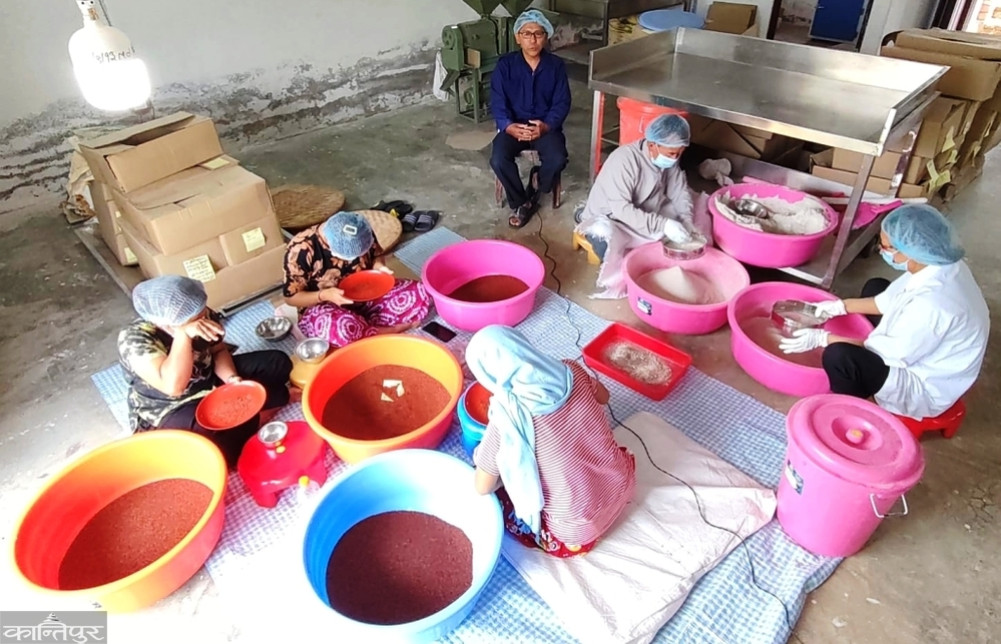
Roshan Rai, who left his job at big companies like Patanjali and Dabur Nepal and returned to his village, is collaborating with local farmers to expand the market for indigenous food products.
We use Google Cloud Translation Services. Google requires we provide the following disclaimer relating to use of this service:
This service may contain translations powered by Google. Google disclaims all warranties related to the translations, expressed or implied, including any warranties of accuracy, reliability, and any implied warranties of merchantability, fitness for a particular purpose, and noninfringement.
The market is full of attractive packets, flashy advertisements and cheap products. Amidst this crowd, consumers have started looking for pure, clean and local traditional food products. Taking the changing needs as an opportunity, Dhankuta entrepreneur Roshan Rai has launched a campaign to bring traditional products to the kitchens of consumers.
'Ani's Food Industry', operating in the industrial village of Amletar in Dhankuta, is processing, packaging and marketing millet, phapar, maize, local pulses and other traditional food products and taking its 'Chasum' brand to various districts of Koshi Province. The industry, which was registered with the Cottage and Small Industries Office in 2079 BS, has started bringing its products to the market since 2080 BS.
Having worked in the field of food technology for a long time, he was in good employment in big companies like Patanjali and Dabur Nepal. He decided to return to his village with the aim of doing something in his own place rather than the facilities and salary provided by the company.
He says he was even more inspired after the International Millet Year 2023 was celebrated. Born and raised in Chhintang, Dhankuta, he says, 'Our village was previously known for its millet and phapar production. Seeing this potential, I decided to quit my good job and start my own industry.'
But after starting the industry, he saw an unexpected reality. The same millet and phapar cultivation that he had started the industry with, seeing the potential of the product, was declining in the village. After that, he did not limit himself to being an entrepreneur. He started going from village to village and encouraging farmers to expand millet and phapar cultivation again.
Even now, he is encouraging farmers to expand the production and cultivation of traditional crops including millet, phapar, bodi, beans, kaguno and others, by reaching out to Dhankuta, Tehrathum, Bhojpur and Sankhuwasabha.
He is also working on making advance production agreements with farmers and ensuring purchases for the coming year. The entire process of purchasing produce from farmers, bringing it to the industry, cleaning it, processing it, packaging it as per standards, and delivering it to the consumer's kitchen is now being handled by the industry itself.
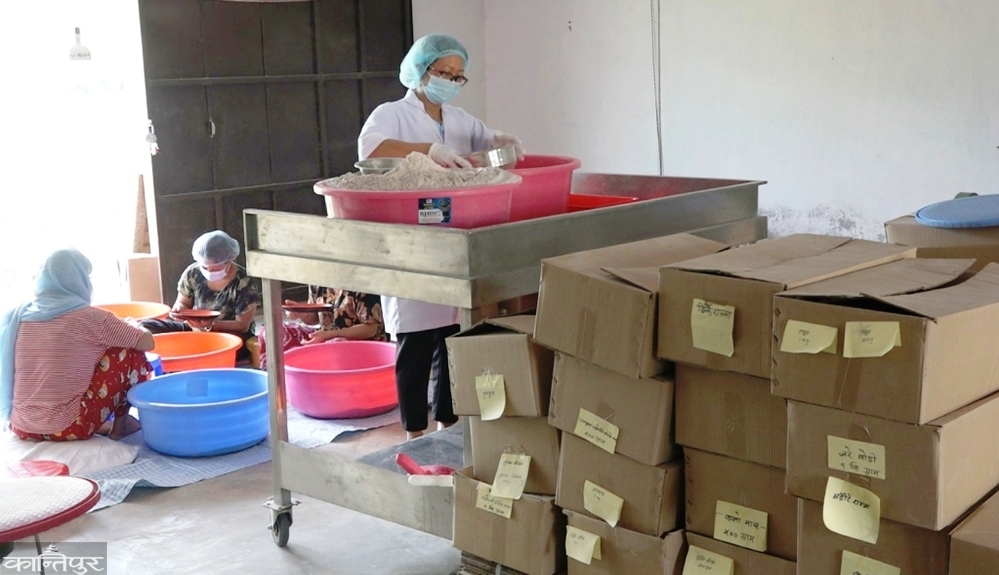
According to Rai, the aim of the industry is not only to trade, but also to revive the culture of pure food. 'The traditional food eaten by our older generation is the most suitable for our body,' he says, 'The body is made of food and water. Many diseases can be prevented by balancing food. With this message, we are on a campaign to deliver traditional food dishes to every home.'
He expresses concern that the current generation is losing its appreciation for pure food. He believes that the increasing use of adulterated, highly processed and chemically treated food products in the market has led to the disappearance of local indigenous foods. 'Today's children may not even know what pure millet and pure sorghum are like,' he says, 'That is why the greatest feature of our products is purity and hygiene.'
Currently, the industry is bringing local products such as millet and phapar flour, soybeans, black beans, kidney beans, rajma, and rajli dal to the market. He said that in the coming days, there are plans to systematically process and bring corn, rice, and gundruk to the market.
The industry, which started with an investment of Rs 1 million, has now reached about Rs 3 million in annual turnover. According to him, all aspects of the production chain need to be strong for the industry to be successful. 'If farmers don't produce, where will I get it? If I don't process, where will the consumer get it?' He said, 'Therefore, it is necessary to improve the entire chain from production to market.'
He is running the industry with his wife and has also provided employment to some locals. But he says that the biggest challenge is market expansion and increasing consumer awareness. 'If the market is considered the top of a tree, then we are the body of the tree, the farmers are the roots,' he says. 'Our market will expand further only when consumers start understanding what they are eating and what they should eat.'
According to Rai, multinational companies are bringing products to the market at affordable prices with attractive packaging. Since the cost of preparing pure and local products is high, the price is also a bit expensive. Therefore, he says that consumers should prioritize not only price, but also quality and health.
According to him, many consumers are now looking for the old taste again. He has experienced an increasing attraction towards pure millet, phapar, corn, wheat and gundruk. He believes that this change will benefit farmers, entrepreneurs and consumers.
However, he says that the government's support is indispensable to make this campaign sustainable. 'The goal can be achieved only if the government, farmers and entrepreneurs move forward together,' he says, 'the government should also help in reducing production costs by using technology, increasing farmers' production and bringing pure food to the consumer's kitchen at affordable prices.'