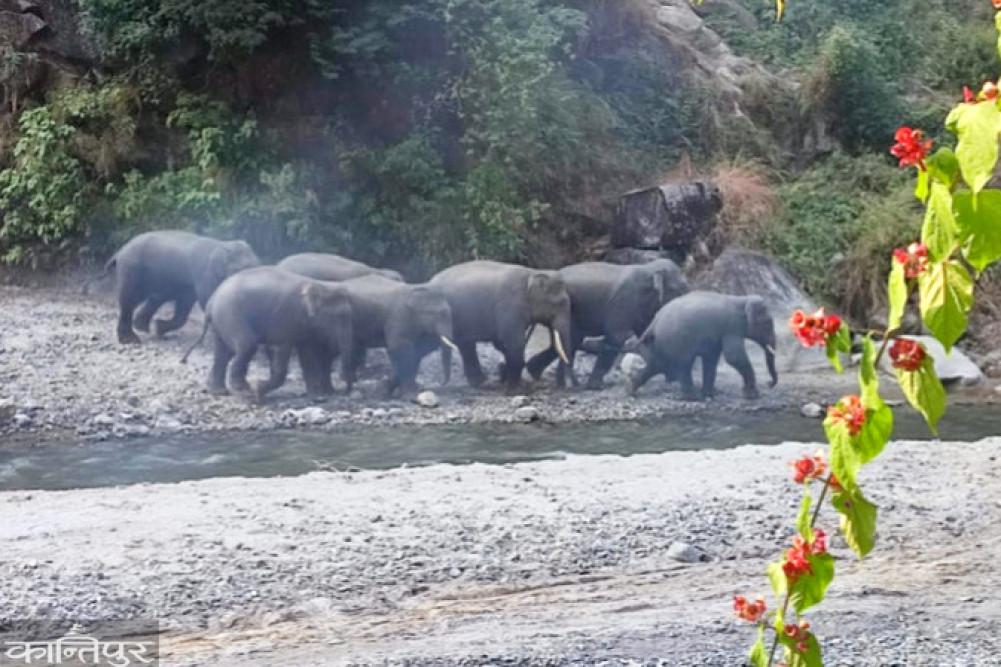
The Divisional Forest Office, Jhapa, has prioritized tree plantation in the current fiscal year and has initiated a plan to extensively plant saplings on vacant land in collaboration with community forests.
We use Google Cloud Translation Services. Google requires we provide the following disclaimer relating to use of this service:
This service may contain translations powered by Google. Google disclaims all warranties related to the translations, expressed or implied, including any warranties of accuracy, reliability, and any implied warranties of merchantability, fitness for a particular purpose, and noninfringement.
Due to the low expansion of forest area, rapid population growth and increasing migration, human-wildlife conflict is becoming a challenge in Jhapa. Keeping this situation in mind, the Division Forest Office, Jhapa, has prioritized tree plantation in the current fiscal year and has initiated a plan to plant saplings extensively on vacant land in collaboration with community forests.
The total area of Jhapa, the district with the highest population density in the Eastern Terai, is 1,606 square kilometers. However, the forest area is limited to only 18,065 hectares. This is 11.24 percent of the total area of the district. This ratio of forest area is lower than the national average. The population pressure here is continuously increasing due to internal migration. As the pressure on the forest area increases due to increasing settlement expansion, the natural habitat of wildlife is shrinking. Its direct impact is being seen in the conflict between humans and wildlife.
The Government of Nepal has set a goal of reducing deforestation to zero by 2030 and increasing the country's forest area to 50 percent. According to Ram Bhakta Yadav, Forest Officer of the Division Forest Office, Jhapa, the country's forest area has currently exceeded 46 percent. However, due to the geographical location of Jhapa, limited forest area and rapid urbanization, it is challenging to achieve the national target.
According to Forest Officer Yadav, about 50 hectares of vacant land will be planted this year with the aim of reducing human-wildlife conflict and expanding greenery. This program will be conducted in coordination with the community forest user group. According to him, trees will be planted in 15 hectares of area with fences under the National Forest Development and Management Program. Similarly, 20 hectares will be planted through the Model Tree Plantation Program, four hectares under the provincial government's Forest Development and Herbs Promotion Program and an additional four hectares through the Agroforestry Promotion Program.
Forest Officer Yadav said that nurseries have been operated in five places in the district to make the tree planting program effective. He informed that about two lakh saplings of various species have been produced in the nurseries located at Division Forest Office Chandragadhi, Mechi Bahuvan Sub-Division, Jalthal Sub-Division Rangiyadaanda, Damak Sub-Division Jhiljile and Kankai Sub-Division Surunga. In addition, the Forest Office is preparing to purchase bamboo saplings worth about Rs 1 million and fruit saplings worth about Rs 1 million and distribute them free of cost.
Planting of bamboo saplings will be encouraged, especially in areas where wild elephants move. It is believed that this will help in managing the natural diet and cover of elephants. According to Forest Officer Yadav, saplings of Shrikhand will also be distributed for the first time this year. The promotion of Shrikhand, which is considered important in both economic and environmental terms, is expected to create long-term income opportunities for the local community and also contribute to the conservation of the biodiversity of the forest.
Along with expanding the forest area, the tree plantation campaign, which aims to protect the natural habitat of wildlife, maintain environmental balance, and reduce human-wildlife conflict, is seen as an important initiative for long-term environmental protection in Jhapa.