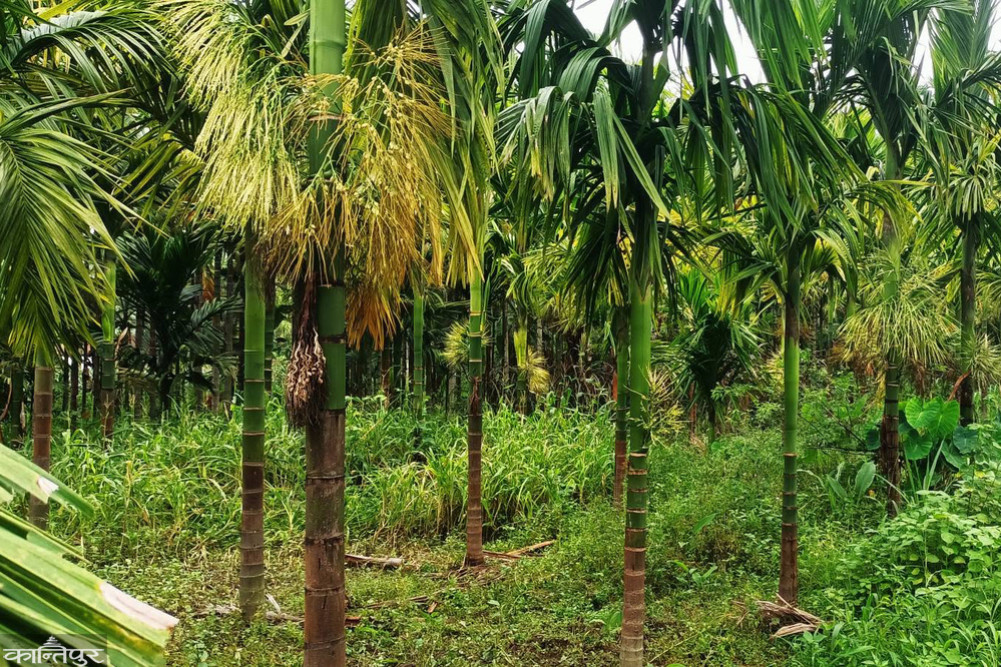
Betel nut farming is expanding in settlements connected to forests in Buddhashanti, Arjundhara, and Mechinagar municipalities of Jhapa.
We use Google Cloud Translation Services. Google requires we provide the following disclaimer relating to use of this service:
This service may contain translations powered by Google. Google disclaims all warranties related to the translations, expressed or implied, including any warranties of accuracy, reliability, and any implied warranties of merchantability, fitness for a particular purpose, and noninfringement.
The problem of wild elephants in the settlements connected to the northeastern forest area of Jhapa is not a new issue. Farmers have been affected by the damage caused by elephants to rice, corn, wheat, mustard, banana, sugarcane and vegetable crops every year. However, amidst this challenge, betel nut farming is becoming a reliable cash crop for farmers in elephant-affected areas.
Betel nut farming is expanding especially in the settlements connected to the forests of Buddhashanti Rural Municipality, Arjundhara Municipality and Mechinagar Municipality. Farmers have increasingly preferred betel nut because it is less damaged by elephants compared to other crops, produces for years, provides good income with less labor and can be intercropped.
According to Anil Wagle, ward chairman of Buddhashanti Rural Municipality-1, once a plantation is established, betel nut can produce for 40 to 50 years. He says that labor costs are lower than other cash crops as regular irrigation, fertilizer management and general care are sufficient. Due to which, farmers in northern Jhapa are attracted to betel nut farming.
Buddhashanti Rural Municipality is considered to be the largest center of betel nut farming in Jhapa. Betel nut farming of farmers in wards no. 1, 3, 4 and 5 of the rural municipality is linked to household income. According to Ward Chairman Wagle, most of the farmers in the rural municipality are directly or indirectly dependent on betel nut farming.
Buddhashanti Rural Municipality Chairman Manoj Prasai said that the contribution of betel nut farming to the rural economy of the rural municipality is significant. According to him, the living standards of farmers have improved due to the cash income from betel nut. Some of the youth who go for foreign employment have started returning to this farming. Prasai, the rural municipality chairman, says that many farmers have chosen betel nut as a safe alternative to rice or corn as it is an area where elephants regularly roam.
Betel nut farming is expanding in areas connected to forests in Arjundhara Municipality and Mechinagar Municipality. According to local agricultural technicians, about 40 percent of farmers in these two municipalities are involved in betel nut production in some way or the other.
Although elephants cause great damage to rice, corn and vegetables, farmers have experienced relatively less damage to betel nut plantations. This is why the number of new plantations has increased in recent years.
About 20 percent of farmers in Birtamod, Kankai, Shivasatakshi, Gauradaha and Damak municipalities are cultivating betel nut. With the increase in demand for betel nut seedlings, commercial nurseries have also come into operation in those areas. Sagar Bista, the head of the Agricultural Knowledge Center in Jhapa, said that farmers in the south of the East-West Mahendra Highway have recently preferred betel nut farming.
The biggest feature of betel nut farming, he said, is its long-term production. 'Regular production starts a few years after planting the plant and continues to provide income for decades, which is why farmers in Jhapa are attracted to betel nut farming,' he said.
Gajadhar Poudel, a farmer from Buddhashanti-5, has planted about 600 betel nut trees in an area of 16 katthas. Of these, about 500 trees are producing. According to him, betel nut worth about Rs 250,000 is sold annually. He has experience that betel nut farming is getting good returns as it requires less labor compared to other crops. Some farmers in the district have cultivated betel nut in large areas and earned an annual income of Rs 8 to 10 lakh.