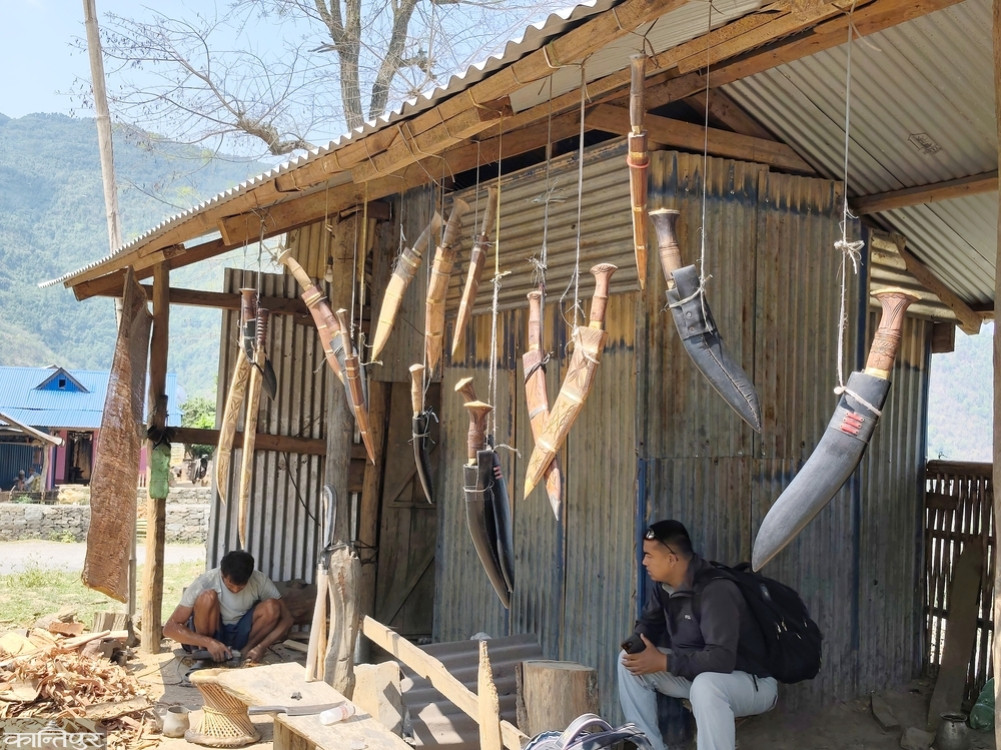
Local Tara Bahadur Bishwakarma says, 'Earlier, it was difficult to support a family even after working all day, but now Khukuri has started providing a good income.'
We use Google Cloud Translation Services. Google requires we provide the following disclaimer relating to use of this service:
This service may contain translations powered by Google. Google disclaims all warranties related to the translations, expressed or implied, including any warranties of accuracy, reliability, and any implied warranties of merchantability, fitness for a particular purpose, and noninfringement.
Even as the month of Jestha approaches, the fields of Katahare village in Ghorlikharka are still covered in piles of manure. Due to the lack of rain for a long time, farmers have not been able to sow corn. In some places, even the corn plants that have sprouted have started to dry up.
Although the fields look deserted due to the drought, a different scene can be seen as soon as you enter the village. Khukuri of various shapes, designs and prices are hung in front of every house here. Inside, craftsmen are busy hammering, shaping, making dies, sharpening and polishing iron on the aran. There is also a crowd of people looking at, selecting and buying Khukuri. The sound of iron being hammered echoes in every house, machines running and busy craftsmen. This scene reflects the changing situation of Katahare.
Katahare village in Ghorlikharka, Pakhribas Municipality-5, Dhankuta was once known as a settlement oppressed by poverty, deprivation and social discrimination. The Bishwakarma community here, who have been involved in traditional metal handicrafts for generations, used to make agricultural tools like scythes, sickles and spades for their livelihood. But now, that same traditional skill has led the village on a new journey of economic prosperity.
Katahare, considered the gateway to Bhojpur, Khotang and Sankhuwasabha, is today becoming known as an important khukuri production center in eastern Nepal. The khukuri made here are not limited to the local market, but have started reaching foreign countries through various cities of the country as per orders.
Local Jhamak Rasaili says that the changes in the village seem incredible when remembering the past. According to him, this settlement, which was once oppressed by the pain of a dry environment, poverty and untouchability, is today building its identity on the strength of its own skills and hard work. 'There is no comparison between then and now. There was only misery, poverty and unemployment in our village,' he added, 'but now almost every house has its own business, everyone is doing their own work, everyone is earning.' There are more than 17 workshops for making khukuri and iron tools in Katahare village, which has about 23 houses. Every house makes and sells at least 400 khukuris a year. 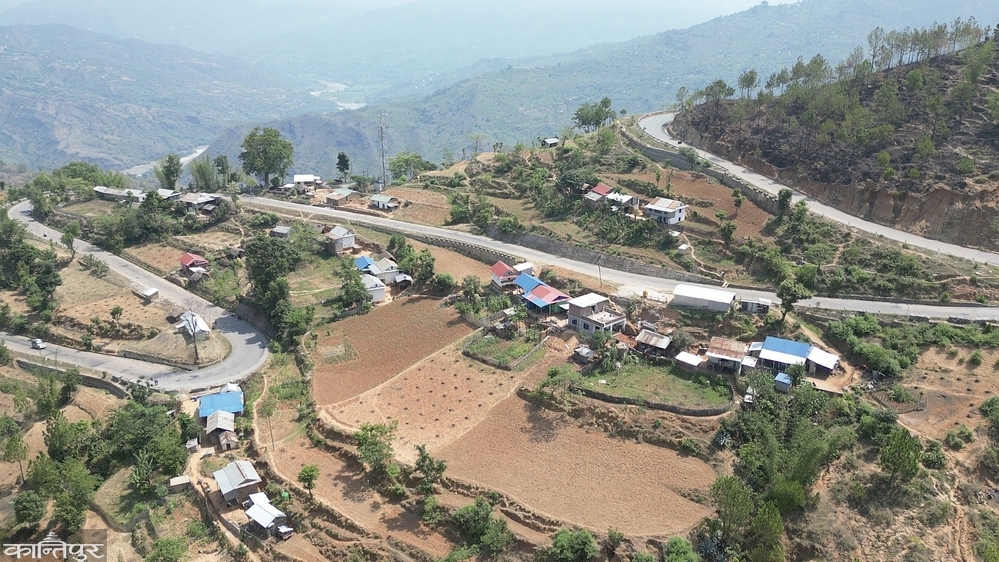
A khukuri costs a minimum of 1,500 to 12,000. In 2060 BS, the then District Development Committee and an organization called Salbh Nepal worked to improve livelihoods in this village. Salbh provided assistance for the construction of a collective workshop in Katahare. The materials for the workshop were provided by the then District Development Committee. Sitaram Gautam, deputy secretary of the then District Development Committee and now working in Dhankuta Municipality, says that the DDC and VDC also supported the locals of Katahare in operating the industry.
To enhance the capacity of the locals and improve their livelihoods, a revolving fund was established in the community forest and loans of up to Rs 15,000 were provided through Salvh to those who wanted to start a business at an interest rate of 6 percent, says Rajendra Pradhan, who has been working in the field of livelihood improvement and self-reliance for a long time. He says, 'It takes time to get results even after working. Although it is slow, professionalism has begun in the village of Katahare.' But now most of the houses have their own arans with modern equipment in operation. Traditional hand arans have been transformed into small industries with modern machines.
Local Tara Bahadur Bishwakarma says, 'Earlier, it was difficult to support a family even after working all day, but now khukuri has started giving good income.' Depending on the quality, size and design of the khukuri, its price usually ranges from Rs 1,500 to Rs 12,000.
A family in Katahare produces and sells up to 400 khukuris a year. The traditional profession of khukuri making is now being transformed into a commercial industry. With the expansion of business, the tradition of farming for generations has also come to an end. Tara Bahadur said that the days of working for two maana rice, one part maize and two parts oil as before are gone. He said, 'We do not do work that comes from the village. But not with food grains like before. Now all work is done in cash.'
According to local Jhamak Bishwakarma, most of the houses in the settlement now have industries producing khukuri and other household tools. Generations from grandfathers to grandchildren are involved in this profession. This has not only preserved the skills, but has also created opportunities for the new generation in the village.
Prem Bahadur Bishwakarma is operating an aran in the village after returning from abroad. Many young people like him have left foreign employment and started businesses in the village. 'Combining the experience gained abroad and the skills here has shown a good future in their own village,' he says.
The khukuri industry has not only increased the income of the people of Katahare, it has changed the appearance of the village. The settlement, filled with thatched roofs and thatched houses, is now covered with zinc sheets. The improvement in the economic situation has also had a positive impact on the education sector. Once upon a time, helping the family earn a living was more important than school for children. Now, most children have started going to school regularly. The children of this village study at the nearby Shantiniwas Secondary School.
Road infrastructure has also played an important role in the development of Katahare. After the Hile-Pakhribas-Leguwa road along the Mid-Hill Highway was blacktopped, the village is easily connected to the market. With the expansion of transport access, the market for khukuri and other tools has also expanded. Prem Bahadur Bishwakarma, a local of Katahare, recalls; 'There was a square in Katahare to sell the tools and weapons made by my grandfather. We used to set up shop in that square and sell our goods to passersby traveling between Bhojpur, Khotang, Sankhuwasabha. The square was called Khukuri Square.'
Prem Bahadur says, 'Earlier, we used to carry the manufactured iron tools, including khukuri, on our heads and go to Dhankuta, Bhojpur, Khotang, Sankhuwasabha, Tehrathum and the Terai districts, but now we sell them from the porch, and the road has also become a boon for us.'