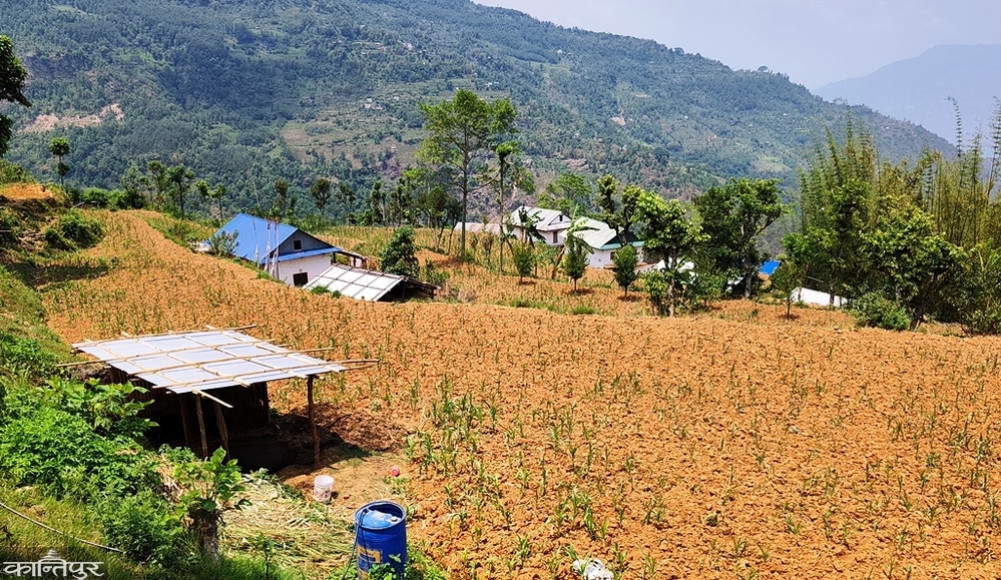
Farmers are worried that they will not even be able to save seeds for next year as drought destroys the corn crop following the armyworm outbreak.
We use Google Cloud Translation Services. Google requires we provide the following disclaimer relating to use of this service:
This service may contain translations powered by Google. Google disclaims all warranties related to the translations, expressed or implied, including any warranties of accuracy, reliability, and any implied warranties of merchantability, fitness for a particular purpose, and noninfringement.
Farmers in the lower reaches of Pakhribas and Mahalaxmi municipalities in Dhankuta are in trouble due to the lack of rain for many days. Farmers who had previously faced the scourge of armyworms are now suffering from drought.
As corn plants have started to dry up, farmers are worried that it will be difficult to save even the seeds for the coming year. Corn crops planted in areas such as Dikure, Gairigaun, Diyale, Katahare, and Daduwa under Pakhribas Municipality have been affected by the drought. When the fields should look green, the corn plants have started to turn yellow and dry up, and in some places they have become like straw.
Kumar Tamang of Gairigaun in Ghorlikharka said that the corn crop planted in his five ropani field has dried up and been destroyed. 'It seems that even the seeds cannot be saved this year,' he said. 'Even if there was a little rain in Chait, there will be none after that. The corn has dried up, even the grass used to feed the livestock has started to dry up.'
According to local farmer Gopal Bahadur Thapa, the corn plants that were ready to bear fruit have been dried in the sun and turned into straw. 'It was the time for the rice harvest, but the drought ate all the corn,' he said. According to him, some farmers have even stopped cultivating corn after the plants died. 'Now, even if it rains, there is no hope of production,' he lamented.
Farmers in some places have said that they have not even been able to sow corn due to the drought. Local farmer Dyandra Bahadur Karki from the Khola Kharka area said that they have not been able to plow the fields and sow corn due to lack of sufficient moisture. 'In previous years, corn would have been green at this time, but now there has been no rain even for sowing,' he said.
According to him, not only corn, but fruit plants and other crops have also started to wither.
According to farmers, the effects of the drought have also started to be seen in the rice that has been harvested. Although the beds should have been laid by now for the rice that will ripen in Mangsir, most farmers in areas that depend on rainwater and do not have irrigation facilities have not been able to prepare the beds for rice. There is growing concern that if there is no timely rain, rice production will also be affected.
A similar situation is also seen in the Legua and Salghari areas of Mahalaxmi Municipality. The maize crop there is drying up. Farmers in areas such as Jarayotar under Arun Rural Municipality in Bhojpur, across the Arun River, are also facing problems due to the lack of rain for a long time. Some have said that they have not been able to sow maize and even the sprouted plants have started drying up. The drought has added to the concern that farmers will not only reduce production, but also lack the necessary seeds for the coming year.