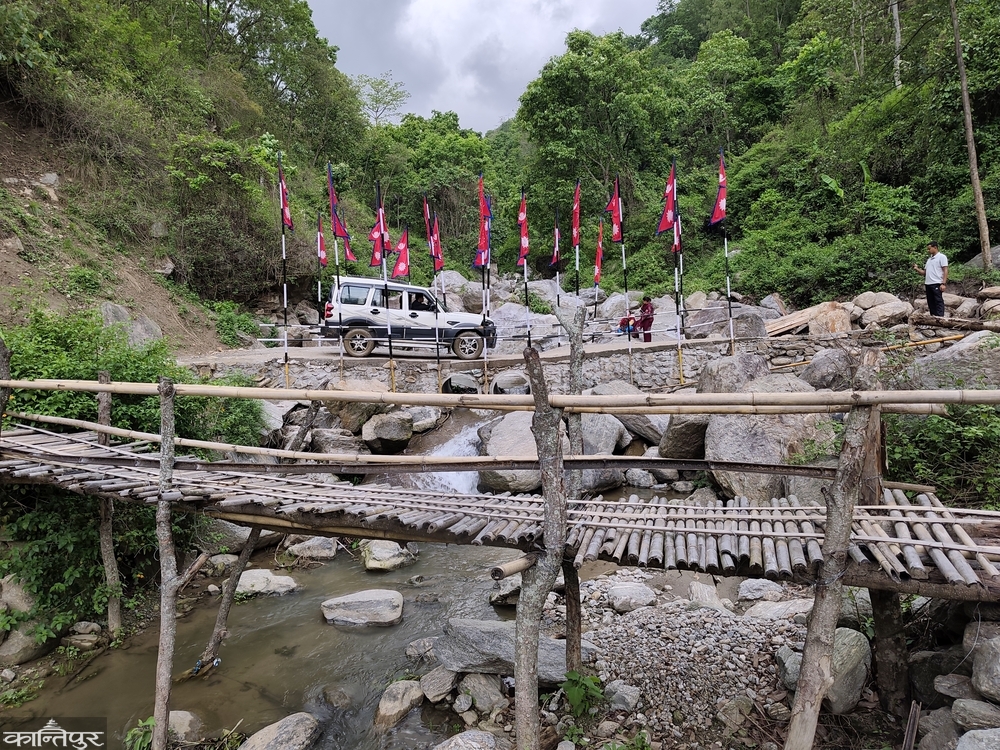
Dozens of suspension bridges have fallen into disuse due to the expansion of the road network in Dhankuta district.
We use Google Cloud Translation Services. Google requires we provide the following disclaimer relating to use of this service:
This service may contain translations powered by Google. Google disclaims all warranties related to the translations, expressed or implied, including any warranties of accuracy, reliability, and any implied warranties of merchantability, fitness for a particular purpose, and noninfringement.
Suspension bridges were once an integral part of life in the remote hills. Whether it was a river that overflowed during the rainy season or a river that flowed all year round, suspension bridges built over them were a safe and reliable option for travelers.
For children going to school, relatives carrying sick people to the health post, and locals going to the market to buy daily necessities, such suspension bridges not only shortened their journeys but also made life easier.
Most of the suspension bridges in Dhankuta, which connected the villages of Ollo and Pallo, are now falling into disuse. The suspension bridge over the Tangkhuwa River, which connects Khaniyabas in Dhankuta Municipality-5 and Banchare Puchar in Chhathar Jorpati Rural Municipality-3, has witnessed a similar fate.
This bridge, which was once used by travelers from Teliya, Tangkhuwa in Dhankuta and Fayak, Fakhro and Fakchamara in Tehrathum to cross the river, is now completely unused. After the construction of a blacktop road from Dhankuta headquarters to Thuyur Hat, Karmitar, Khaniyabas, Banchare, Teliya and Khoktap, travelers have not returned to this bridge. Sometimes, passengers stop here to take photos.
A similar situation exists with the suspension bridge over the Nibuwa River connecting Sipting Puchhar in Dhankuta Municipality-3 and Bhirgaun in Ward-2. The structure has been damaged by rocks falling from above. The bridge has also become isolated after travelers stopped walking.

The Kangsuwa Bridge built on the Teliya River in Chhathar Jorpati-4 is also facing the same fate. This bridge has also not been in use for a long time. The suspension bridge has lost its use as there are no more farmers or passersby to walk for farming. These are just a few representative examples of bridges that have fallen into disuse due to the expansion of the road network in Dhankuta district. With the expansion of the road network, dozens of suspension bridges have fallen into disuse. Many bridges built in the past are lying unused and unprotected after being replaced by roads and culverts. According to Sitaram Gautam, the then District Development Committee officer, more than 60 suspension bridges were built across the district. 'Many bridges built as per the need at that time have become irrelevant now,' he says. 'Now there is a provision to relocate those bridges to the required location, but no attention has been paid to that.' According to him, at least 15 bridges in seven local levels of the district are currently completely unused.
According to Min Prasad Subedi of Pardep Nepal, Dhankuta, who has been socially mobilizing for the construction of suspension bridges since 2065, an investment of Rs. 3 million to Rs. 10 million has been made in the construction of such bridges. "Some bridges are still in use, but most are losing their relevance," he says. "As roads and new roads replaced the old ones, bridges became useless."
People had to travel dangerously across rivers and streams to reach schools, health institutions, and markets. Suspension bridges were built to address this problem. The rural road network expanded rapidly in the last decade. As motorways began to reach villages, footpaths became obsolete. Roads that were once busy routes have now been dug up. People are now moving by vehicle. Such changes have reduced the usefulness of suspension bridges, says Milan Khadgi, ward chairman of Dhankuta-6.
Leaving unused bridges as they are, risks wasting crores of rupees. Materials such as steel parts and logs have deteriorated. Sitaram Gautam, an officer with the District Development Committee, Dhankuta, who has worked for about 20 years, says that such bridges can be rehabilitated in remote areas not touched by new roads, on routes connecting schools and health institutions, or on tourist trails.
Min Prasad Subedi also emphasizes the same point, saying, 'Unused bridges should be moved to the necessary places as soon as possible, otherwise the structure itself will become useless.'
Currently, the responsibility of protecting and managing suspension bridges falls under the jurisdiction of the local level. However, the local level has not shown interest in removing unused and irrelevant suspension bridges and installing them in needed places.