Once upon a time, the middle market and lower Kopche areas were densely populated with thatched houses. Built by local traders and the Newari community, these houses became the hallmark of the market. But now, they can be counted on the fingers of one hand.
We use Google Cloud Translation Services. Google requires we provide the following disclaimer relating to use of this service:
This service may contain translations powered by Google. Google disclaims all warranties related to the translations, expressed or implied, including any warranties of accuracy, reliability, and any implied warranties of merchantability, fitness for a particular purpose, and noninfringement.
With the lack of repairmen, the changing tastes of the new generation, and the expansion of modern houses made of zinc sheets and concrete, the hundreds of years old thatched houses of Dhankuta are gradually disappearing. Dhankuta Bazaar, once known as the main trading center of the eastern hill district, is now losing its original architectural identity.
The lower part of Dhankuta was once the center of commercial activity. When it was the headquarters of the Eastern Region, it was the main trading center of the Koshi Hill District. Dhankuta was the administrative center of the East even during the Rana, Raja, Panchayat, and multi-party systems.
Here, there was a dense settlement of thatched-roof houses built in the Newari style by local traders. Not only the houses, but also the resting places and party-pauas were covered with stone-clay and thatched roofs. But with time, these structures are disappearing one after another.
The thatched house built by Buddhiman Pradhan, a famous cloth merchant from Tallo Kopche, in 1970 is still intact. Although his grandson Bikash Pradhan renovated the house in 2059 BS, he is worried that if it has to be renovated again, he will not be able to find the craftsmen. 'The old generation is gone, the new generation does not have this skill,' he says, 'Even if you want to install the thatched roof, you cannot find anyone. You do not even know where the thatched roof is made. Now if the roof leaks, you have to install a tin roof.' 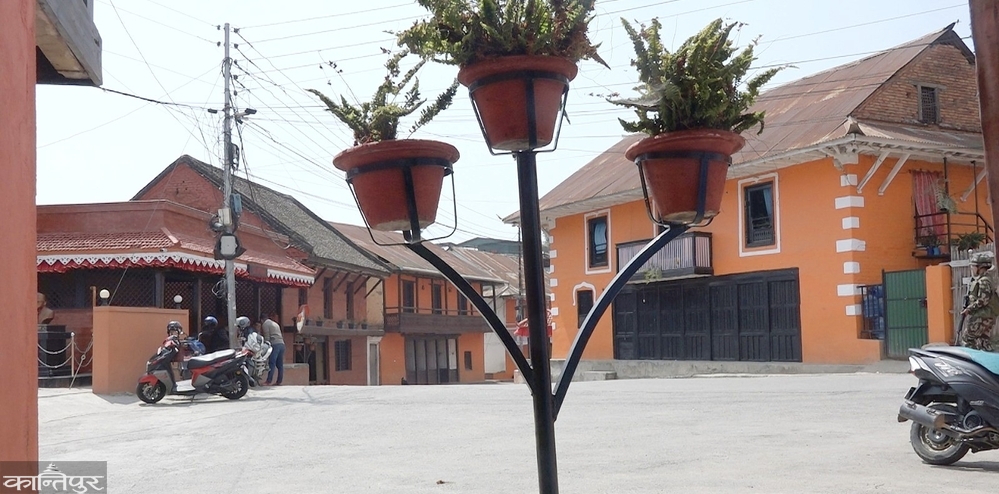
There were many historic houses with similar thatched roofs in Tallo Kopche. An old house that can be seen as soon as you enter Tundikhel is now in a dilapidated state. Due to lack of maintenance and the lack of skilled craftsmen, many houses have had the tin roof removed and zinc sheets installed. A local Ujwal employee says that he had to remove the tin roof of his house and install a zinc roof five years ago. 'I was forced to put up tin roofs because I couldn't find a carpenter,' he says, 'but after finding a carpenter, my desire to put up a tin roof has not died.' He also said that he is collecting tin roofs from demolished houses in the village.
Vijaya Shekhar Shrestha's house in Siranbazar was also once covered with a tin roof. He said that when the roof of his 190-year-old house built by his great-grandfather in 1903 started leaking and he didn't have the manpower to repair it, he had to remove the tin roof and put up tin. 'I had to remove the tin roof not out of desire, but out of compulsion,' Shrestha said, 'What can I do when I don't have the manpower to build it myself?'
Although the era of tin houses seems to be coming to an end, a search for such houses as models has begun recently. Archaeologists and conservationists have also started showing interest. According to Rajendra Bahadur Pradhan, former head of Dhankuta Nagar Panchayat, the Jeevnat Hadigaun Sanstha is searching for tin houses in Dhankuta. 'There are more and more people who understand Newari culture and want to live in thatched houses,' he said, 'We are trying to preserve such houses as a model.'
Once upon a time, there was a dense settlement of thatched houses in the Beech Bazaar and Tallo Kopche areas. These houses built by local traders and the Newari community became the identity of the market. But now those houses can be counted on the fingers. There were also many thatched houses in villages such as Teliya, Tankhuwa, Muga and Phalate in Chhathar Jorpati Rural Municipality of Dhankuta. The Hunekhane class used to build such houses. At that time, people at various levels of local government including Subba, Thari, Ditta, and Jimmawa also built thatched houses. But due to lack of conservation, all of them have almost disappeared.
According to historians, the tradition of making thatched roofs is believed to have started about a thousand years ago during the Lichchhavi period. These houses, built from local soil, wood and stone, provided good protection from the sun, rain, cold and wind. In addition, such structures that reflect the unique beauty of Newari architecture are also cultural heritage. But local elders complain that old heritage is disappearing due to lack of interest in conservation. Subhash Chandra Joshi of Beech Bazaar says, 'Neither the new generation tried to preserve it, nor the government. Once it is finished, it is very difficult to rebuild it. When we were young, almost all the houses were made of jingti, that beauty was different.'
Jingti houses are not just residential structures; they are living documents of local history, culture and identity. As such houses are being destroyed, Dhankuta is losing its originality. In the long term, its impact seems to be multifaceted. Rajendra Bahadur Pradhan says, 'There is serious damage to cultural identity. The Newari architecture, lifestyle and social structure associated with jingti houses are gradually disappearing.'
Tourism potential is reduced. Since the original structure is the main attraction of tourism, the historical attraction of Dhankuta may decrease without such houses. In addition, traditional skills are lost. He believes that the risk of complete disappearance has increased due to the lack of transfer of skills of craftsmen, masons and jingti makers.
Initiatives are needed for preservation Joint initiatives of the state, local levels and communities are needed to preserve jingti houses. He believes that programs such as jingti production and training, revival of jingti making technology, subsidies for the repair of old houses and listing as cultural heritage are urgently needed .
If such concrete initiatives are not taken forward, there is a concern that jingti houses, which carry the history of Dhankuta, will completely disappear within a few years and be limited to the pages of books .

