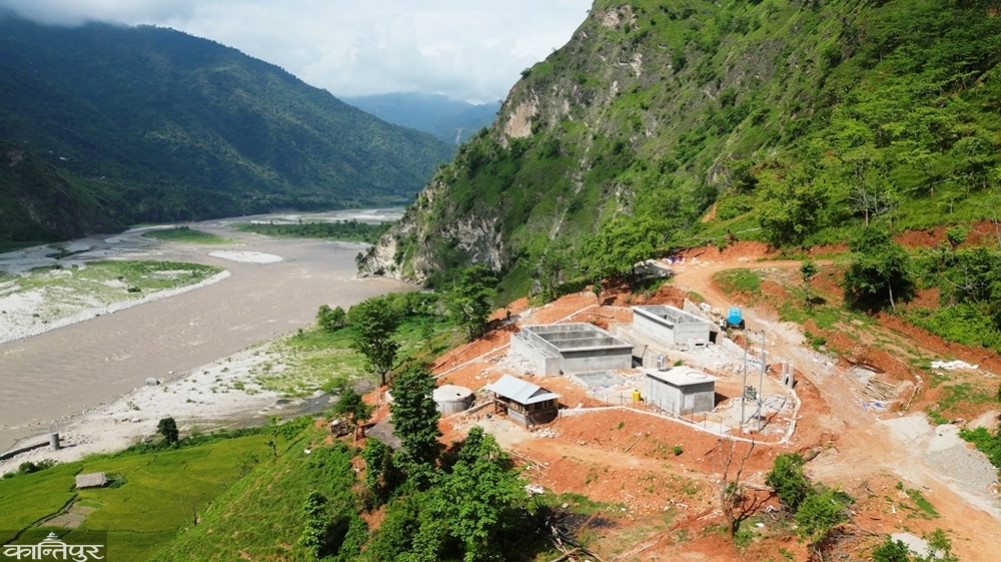
Dhankuta, where the drinking water problem is worsening due to the drying up of springs, springs, wells and ponds, has seen the construction of 68 new drinking water projects, including rehabilitation, quality improvement and new ones.
We use Google Cloud Translation Services. Google requires we provide the following disclaimer relating to use of this service:
This service may contain translations powered by Google. Google disclaims all warranties related to the translations, expressed or implied, including any warranties of accuracy, reliability, and any implied warranties of merchantability, fitness for a particular purpose, and noninfringement.
Ambika Bhandari of Sahidbhumi Rural Municipality-6 lives in Suntalabari village. This drought-stricken village is always short of drinking water.
After the dry season of the spring, well and pond, Bhandari is forced to rely on water from streams, rivers and fields.
Chamcha village here is also facing a severe drinking water problem. The drinking water source that the locals have been using for the past 45 years has dried up. With the number of houses increasing, the existing sources have stopped reaching the locals.
Dhankuta, where the water supply problem is getting worse due to the drying up of spring, well and pond, has been rehabilitated, improved quality and added 68 new drinking water projects. These projects, costing around Rs 250 million, will benefit 17,000 consumers in Dhankuta.
Bhandari of Suntalabari says that the project has raised the hope of consumers who are facing problems due to the dry season of the source. ‘A tank has been built on the side of the house, and if the pipe is also pulled and the vehicle is able to drive, there will be no more water problems,’ she said. Residents of Suntalabari, who face drinking water problems during both the winter and rainy seasons, are hopeful that they will now be able to use tap water all year round.
To solve such drinking water problems, the Federal Water Supply and Sewerage Management Office is operating underground and lift technology-based drinking water projects in Dhankuta, Mahalaxmi and Pakhribas municipalities and Chhathar Jorpati, Chaubise, Sangurigadhi and Sahidbhumi rural municipalities as a campaign.
Ankitman Shrestha, an engineer at the Federal Water Supply and Sewerage Management Office, Dhankuta, said that 132 schemes of 68 small and large projects are under operation based on climate adaptation, drinking water and sanitation, co-investment and service expansion.
Out of the 68 projects under operation in Dhankuta, there are 13 lift technology projects at places like Leguwa in Mahalaxmi, Teliya-Tankhuwa in Chhathar Jorpati, Sindhuwa, Falametar in Chaubise, Sangurigadhi and others. Engineer Shrestha said that all these projects will provide drinking water facilities to about 17,000 consumers of 13,000 households in Dhankuta.
Some of these projects have already been completed and put into operation. Ganga Basnet of Hansmorang in Chaubise Rural Municipality says that the under-construction projects have added more enthusiasm to local consumers. A large-scale Tamor Lifting Drinking Water Project is also under construction to provide facilities to about 5,000 consumers of Teliya, Tankhuwa and Parewadin in Chhathar Jorpati, where there is a rapid migration due to the acute problem of drinking water.
Although there is abundant water source in Hansmorang, there was no management. Local residents were forced to drink water from the river. There is a plan to transport water from Triveni Ghat on the Tamor River to Pathibhara, Lamichhanedanda and Pingdanda at a cost of about Rs 170 million and store it in a reserve tank. The office has stated that about 65 percent of the project has been completed.
Engineer Shrestha says that if the projects under implementation in Dhankuta are completed on time, it is expected to support the national campaign of One House, One Tap.
Only 85 percent of the total population of Dhankuta has access to basic drinking water. The availability of clean and safe drinking water is limited to between 25 and 30 percent. Although access to basic drinking water is increasing, projects to improve its quality have not been implemented.