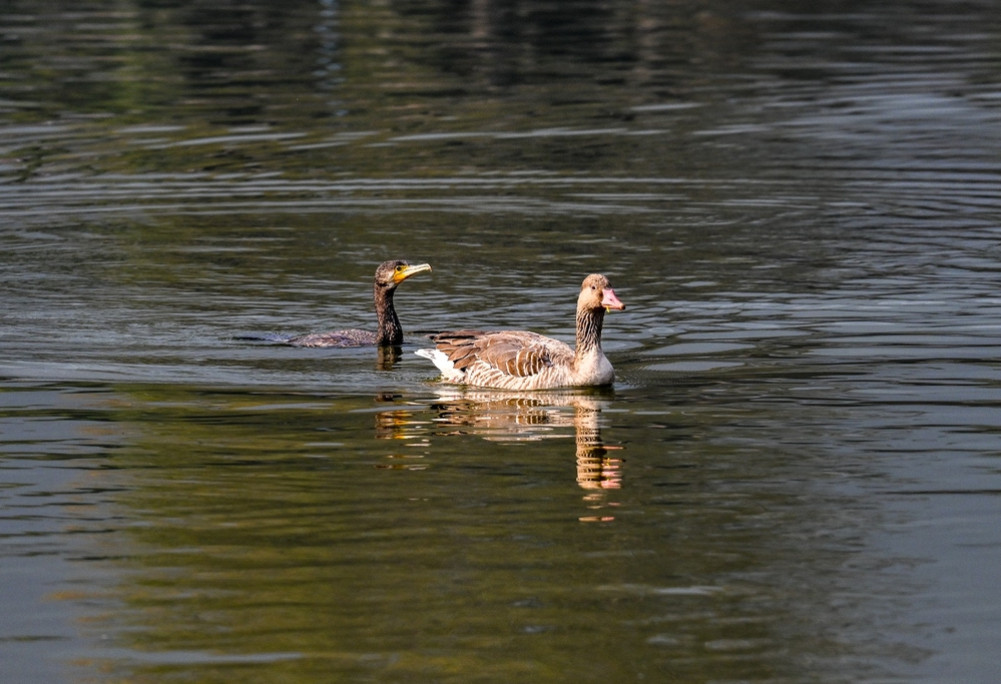
Tourist birds, who started arriving in the second week of October, stay in Nepal for about six months and then return.
We use Google Cloud Translation Services. Google requires we provide the following disclaimer relating to use of this service:
This service may contain translations powered by Google. Google disclaims all warranties related to the translations, expressed or implied, including any warranties of accuracy, reliability, and any implied warranties of merchantability, fitness for a particular purpose, and noninfringement.
Like in the past, this year too, bird tourists have arrived in Nepal to escape the winter. With the onset of snowfall in the North Pole and the increasing cold of the winter season, hundreds of species of birds have arrived in Nepal from the lower Himalayan region, various areas of the hills and Terai, and around lakes, ponds and rivers.
Looking at past details, the tourist birds that started coming here from the second week of Asoj will stay in Nepal for about six months and then return, said Dr. Hem Bahadur Katuwal, associate professor and bird researcher at the Chinese Academy of Sciences. 'Every year, about 150 species of birds come to Nepal from Russia, Kyrgyzstan, Turkmenistan, Uzbekistan, Azerbaijan, China, Mongolia, as well as Europe and the Tibetan region. Some of these species of birds travel to South India via Nepal,' he said.
As the number of tourist birds that consider Nepal an attractive and safe destination has been decreasing compared to previous years, Associate Professor Katuwal emphasized that all concerned bodies should work to secure and manage their habitat. According to him, the Koshi Tappu Wildlife Sanctuary, located at the confluence of Sunsari, Saptari and Udayapur, is considered a habitat for birds.
Although new species of birds are arriving at Koshi Tappu every year, the number of birds coming in flocks has decreased like in previous years, said Birendra Gautam, head of the National Trust for Nature Conservation, Koshi Conservation Center. According to him, Nepal is becoming an attractive destination for guest birds, especially to escape the winter and raise their young. He said that the number of bar-headed geese (Khoya Goose), which come in thousands, has been decreasing recently.
The winter visitors who come to escape the winter are mainly from the major wetlands of Nepal, including Koshi Tappu Wildlife Reserve, Chitwan National Park, Bisahajari Lake, Jagdishpur Lake, Ghodaghodi Lake, Shuklaphanta Wildlife Reserve, and the Koshi, Gandaki, Narayani rivers and their tributaries, informed Chief Gautam.
According to him, most of the migratory birds in Nepal during the winter season are duck species. He informed that the birds that come here include the Khaya goose, Sunjure goose, Cailo-tauke goose, Narikhi goose, Ratkhade goose, Hario-tauke goose, Laxman stork, Karyangkurung stork, Rajhutitau lagaut. Other species of predatory and carnivorous birds include the Gomayu Mahachil and Sheenbaz, while the ground birds include the Himalayan pheasant, Chanchar, Sana fiesta, Arjunak, Jhapsi, Bagale Bagedi, etc.
'In the summer season, migratory birds come to Nepal to breed. These birds raise their young by Asoj and return to their original habitat. Most of the about 60 species of birds that come in this way are of the Cuckoo species. Out of the 19 species of cuckoo found in Nepal, 15 species do not build their own nests and lay their eggs in the nests of other birds. The bird considers the cuckoo's chicks as its own offspring and raises them,' said Chief Gautam.
He informed that other birds that come to Nepal include the Murlichari, Gazle Sunchari, Swargachari, Chitrak Pitta, Katus Tauke, etc. The main habitat of the summer visitor birds is the forest, surrounding grasslands, agricultural land and other areas.