We use Google Cloud Translation Services. Google requires we provide the following disclaimer relating to use of this service:
This service may contain translations powered by Google. Google disclaims all warranties related to the translations, expressed or implied, including any warranties of accuracy, reliability, and any implied warranties of merchantability, fitness for a particular purpose, and noninfringement.
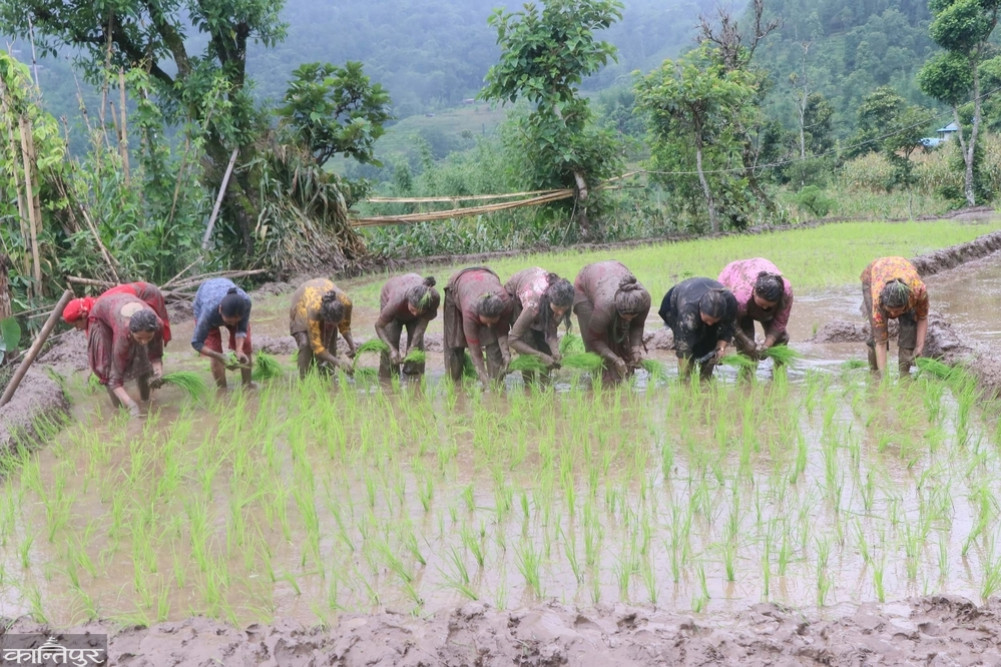
After the third week of June, only 56.98 percent of paddy has been planted in Khotang. Out of 10 thousand 18 hectares of paddy cultivable land, 5 thousand seven hundred 8 hectares are planted with rice.
According to Ravin Rai, assistant horticulture development officer of Agricultural Knowledge Center Khotang, by Saturday, 65 percent of paddy has been planted in Diktel Rupakot Mazhuwagadhi Municipality, 70 percent in Halesi Tuwachung Municipality, 50 percent in Jantedhunga Rural Municipality, 60 percent in Barahapokhari Rural Municipality, and 45 percent in Khotehang Rural Municipality.
Similarly, 65 percent planting in Diprung Chuichumma Rural Municipality, 65 percent in Sakela Rural Municipality, 25 percent in Rawabesi Rural Municipality, 85 percent in Kepilasgarhi Rural Municipality and 40 percent in Aiselukhark Rural Municipality. Rai said that due to the monsoon, paddy was planted faster this year than last year. "Last year till this time, only 37.77 percent of rice was planted," he said.
Diktel Rupakot is 3500 hectares in Mazhuwagadhi Municipality, 120 hectares in Halesi Tuwachung Municipality, 240.96 hectares in Jantedhunga Rural Municipality, 657 hectares in Barahapokhari Rural Municipality, 1200 hectares in Khotehang Rural Municipality, 12 hectares in Diprung Chuichumma Gaupalikam, 800 hectares in Sakela Rural Municipality, 850 hectares in Rawabesi Rural Municipality. Hectares, 750 hectares in Kepilasgarhi Rural Municipality and 1000 hectares in Aiselukhark Rural Municipality are cultivated.