Traders, laborers, lahures were not happy until they reached Indrachok to exchange money. Being like a financial and trading centre, there were 'Sarafi' shops where dry goods, stamps were exchanged.
We use Google Cloud Translation Services. Google requires we provide the following disclaimer relating to use of this service:
This service may contain translations powered by Google. Google disclaims all warranties related to the translations, expressed or implied, including any warranties of accuracy, reliability, and any implied warranties of merchantability, fitness for a particular purpose, and noninfringement.
Apart from Indra Chowk, which was the commercial center of the valley since the Lichchavik period, economic activities were not so active in Kathmandu even before the political change of 2047. The trade spread from the trading center Indrachowk for two centuries due to the businessmen has now spread from east to west.
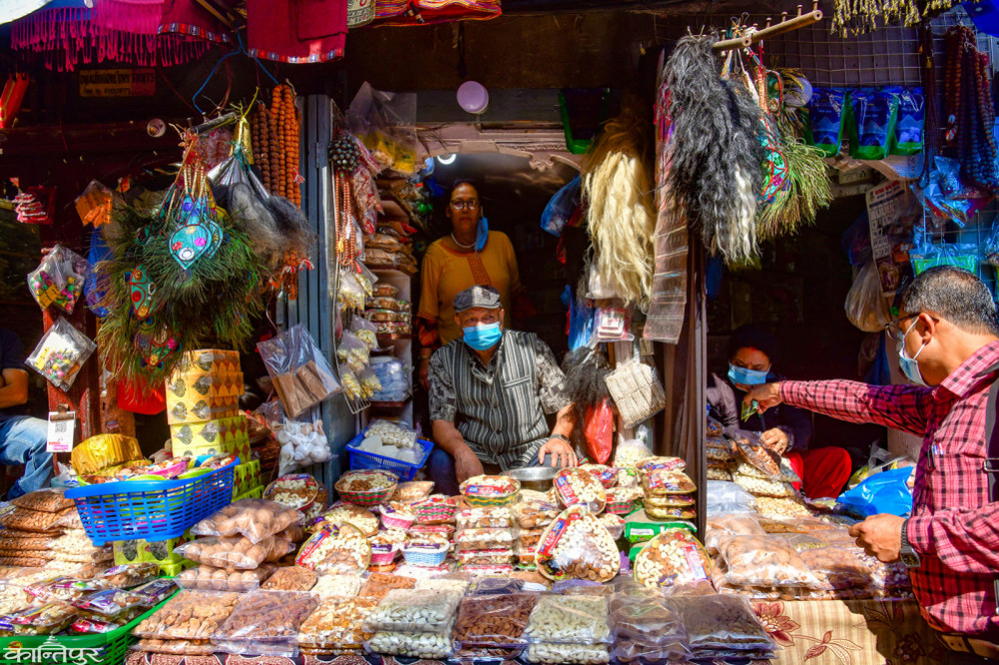
Raithane Newar and Marwari communities had trade in Indrachok. Mainly there were clothes, food, utensils shops here. Trade was carried on here by bringing goods from India and Tibet. Every house had a shop on the ground floor and a residence on the upper floor. Indra Chowk was also a money exchange center at that time. Traders and workers from the valley and outside were not happy without reaching the shops of Indrachowk to exchange money. Lahures often came to exchange money. Indrachowk was like a financial and commercial center. At that time, there were only money exchange shops like Suka and Mohar. Such shops were called sarafi. Our family business started from Sarafi.
Indra Chowk used to be a clothing and grocery business of today's big business houses. Clothing was mostly imported from India, while woolen cloth, pottery and metalware came from Tibet. The wholesalers of Indrachowk also bought cloths woven by locals from places like Kirtipur and Luvhu in the valley. Goods had to be brought from India mostly through Birganj pass. At Indrachowk, Lunakarandas Chaudhary (Vinod Chaudhary's father), Banbarilal Mittal and our shop were together. 5/7 of all present-day trading houses were clothing and grocery wholesalers. At that time, there was no unhealthy competition between businessmen like now, nor was there such a hassle from the government. The government also eased the rules to increase state resources by giving concessions to traders.
Grandfather and father (Indrabhakt Shrestha) were engaged in grocery and cloth business through Sarafi business. Nepal Chamber of Commerce was established from Indra Chowk. My father and others founded the chamber. My father used to tell me that when my grandfather went out, he used to sit in the shop from the age of 10 and pick dry goods and stamps. Vanik Mandal, an organization of traders was formed before the Chamber of Commerce due to his father's activism. Father was also a director of Rashtra Bank. My father has also mentioned many things related to business at that time in his book 'Mera Jakkan'.
Grandfather also became the main distributor of Indian Broke Bond Tea. There was also a trade in cloth. Trade was done by bringing cotton cloth from India. We also brought medicine from India and traded in Indrachok. After a while, clothes started coming from Japan and Korea. The shop that opened in the morning was also open till 9 pm.
At that time porters were the means of transportation. It used to take 6/7 days for the cloth brought from India through Birgunj to reach Kathmandu. We used to send the same from here to Pokhara, Gorkha, Palpa by porters. There was mutual trust between wholesale and small traders, government, banks. We used to lend goods to small traders. Father sometimes went to Palpa, Gorkha to collect loans. It took 12/15 days to walk. In 2007, travel became easier when small ships started plying to Pokhara, Simra. There was no communication facility. There was a telecommunication office in Tripureshwar. One had to wait in line for a long time even to make a phone call. Sometimes it took two/three days even to contact Birgunj. Gradually, after the facility of telegram, telex, fax came, something became easier.
Dharampath was the only Nepal Bank Limited office in Nepal, Anand Bhakta Rajbhandari was the manager. He used to conduct banking transactions by looking at the face of the merchant and deciding how much to whom. After depositing some amount in the bank as a guarantee, there was an arrangement to get the goods from India. He used to determine how much bail he would take from whom. The traders of Indra Chowk at that time left, now others have entered. As the family and income grew, so did the business as the brothers separated. Later the merchants there moved towards industry. Now many people in Indra Chowk have rented out their houses, so they have moved out.
At that time, cotton cloth and groceries were imported from India. Gold also used to come from Lhasa. Importing food was less common. Items like spices and tea also came from India. The government would have set a quota for importing clothes for the whole country. That responsibility was received by the father. After the goods were imported, they were kept in the bank. Customs officers used to come to the bank and collect taxes. After that, the father used to send clothes to other places in the country.
Buba has written in his book, "clothes and other goods were imported to Nepal from Britain, Germany, Japan through agents in Calcutta. Goods sent to Nepal by the Beatrice government in India were imported into Nepal under B form through Calcutta Katam. To prove that the goods have reached Kathmandu, the English used to check and verify the goods from the British Legation in Nepal at the Teku Customs Office.
The Marwari community dominated the textile trade. The government used to give a 10 percent discount to the Nepalese businessmen when transporting goods through the ropeway. Nepalese traders also had concessions in customs. Marwaris had to pay the customs in the second month, while Nepali traders had to pay in 14 months,'' the father wrote in the book. The book also mentions that a company named 'Nepal Trade Syndicate' was established after the number of traders increased in other parts of Nepal and it became difficult to supply them from the relevant agencies of the Indian government. At that time Rana Prime Minister arranged a loan of Rs 30 million from Nepal Bank to Nepal Trade Syndicate to pay 6 rupees as working capital and to pay India as soon as the goods are imported. For Kathmandu, Nepal Bank and in the districts started distributing goods only to firms licensed by Bada Hakim,' says the book 'My Memories'.
Now there are many business houses in Nepal, all of them have expanded from Indra Chowk. As the business gradually increased, the merchants formed the Vanik Mandal. It gradually established the Nepal Chamber of Commerce. From the commercial organization started by the businessmen of Indrachowk to get organized, the Chamber of Commerce was established in 2009, and now dozens of industrialists and businessmen's organizations and thousands of industries have opened. Seeing the need of the organization as the business was expanding, my father used to tell me that he called an expert from London to draw up the constitution of the chamber organization. Dad has been active in many other organizations since the Chamber's founding. Later, organizations such as industry and commerce association were formed and now it has become a network of businessmen.
- Shrestha is the former president of the Federation of Nepal Industry and Commerce.

