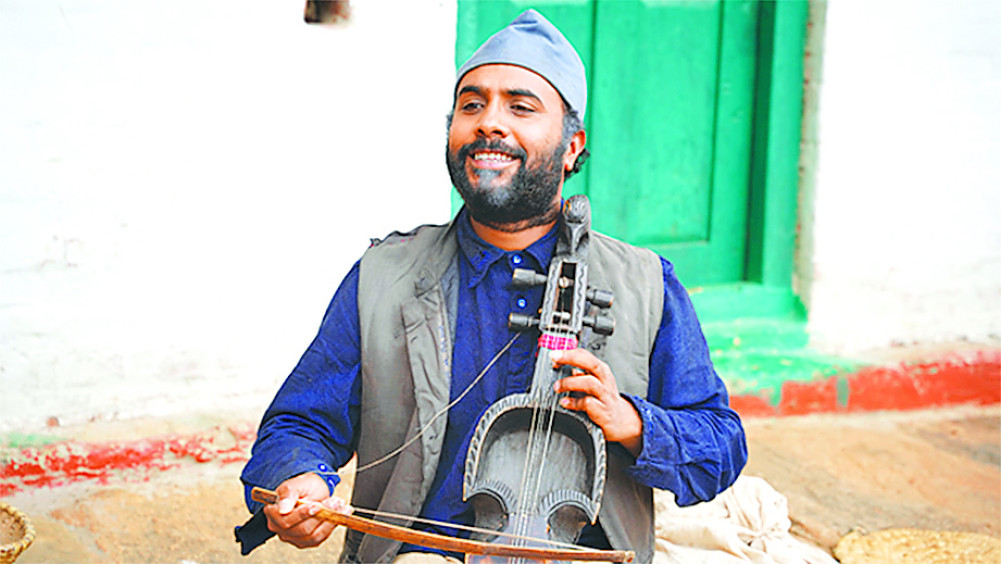
How can a Gandharva-father be engrossed in building the future of his children by playing with the sarangi all his life? ”Poorna Bahadur's Sarangi” tells the story of this.
We use Google Cloud Translation Services. Google requires we provide the following disclaimer relating to use of this service:
This service may contain translations powered by Google. Google disclaims all warranties related to the translations, expressed or implied, including any warranties of accuracy, reliability, and any implied warranties of merchantability, fitness for a particular purpose, and noninfringement.
When villages and cities were enjoying the glitter of Tihar, when Lakshmi Puja was going on from house to house, I went to the cinema to watch 'Poorna Bahadur's Sarangi'. The effect of Tihar was good in the movie hall. Between the empty seats of the hall 15/20 people were entering the movie world.
'Poorna Bahadur Ko Sarangi' starts with the story of Sarangi. When the story of a Gandharva's struggle begins, floating on the screen is the true reality of society. How difficult is it to live a very low class life? The film tells that story. Things like bitter grievances, suffering, hunger, poverty, untouchability, suffered by Dalits seem normal to those who have not experienced them. However, if we look at these events with a microscopic eye and look very closely at the story of Dalan, we can see a different picture that Nepali society has cultivated for centuries and the real life environment of the people of our society. This film is his story, which the society and the state have always separated in the name of caste, sometimes in the name of class, sometimes in the name of religion and sometimes in the name of deeds - from history to today. In the role of
Purna Bahadur – hero Vijay Baral, who has done justice to his role. Especially his shoulders have lifted the weight of this film. His performance leaves the audience speechless. From the role of son to father, he looks strong. How can a ganesha (Gandharva) continue to play the fiddle and sing and sacrifice his life for his dear children? How is an uneducated father always ready to fight against social order, oppression, oppression? Is he engrossed in building the future of his children, with a hungry stomach and lack of a sarangi? Even though the main task of singing life is to lose one's own voice, how does one continue to travel on the path of struggle by suppressing feelings and emotions for the advancement of children? And, for the future of the children, is he forced to sell the beloved sarangi, the sign given by his father, which he has played all his life? It tells a long story - 'Poorna Bahadur's Sarangi'.
Vijay Baral's speechless, voiceless grandiose and powerful acting keeps the audience in tears. Especially in the old age character, he seems to be more adept. Purna Bahadur (Vijay Baral), Batuli (Anjana Barailly), Vijay's dear friends Bire (Mukun Bhusal) and Maila (Buddhi Tamang), Master (Bholaraj Sapkota), Kamal (Prakash Saput), Swayam KC (child actor), patriotic Khanal , Shankar Acharya, Subhas Gajurel, Maotse Gurung, Sarita Sah's excellent acting has made the film commendable.
In the role of Purna Bahadur's son, child actor KC himself is seen as innocent like other rural children. The dialogues he utters touch the audience deep inside. As he asks his father Purna Bahadur - 'Baa, why do everyone hate you?' Purna Bahadur, who could not answer his son, bursts into tears under the canopy of a tree, hiding from his son. There are other such dialogues of his which make the audience go crazy. Whether it is when talking about the mother who left her son at a young age or about going to school or when she wants to wear a new dress, the audience's eyes get wet from time to time with her role.
The film has clearly succeeded in telling the story of the environment of the village of Baglung, its social system, living conditions, the living standards and discrimination of Dalits in a deeper way. The film has raised very real and sensitive issues such as the practice of singing Juhari, the practice of chasing away girls, stereotypes, illiteracy, poverty, ignorance, and Dalits living in poverty. The lyrics used in the film are contemporary and in the style of Vedanka Katha i.e. the poignant sagas sung by the Gandharvas. However, in a film based on the story of Sarangi, the title of the film could still be meaningful if only Sarangi tunes were played and his style of songs were sung. While watching the
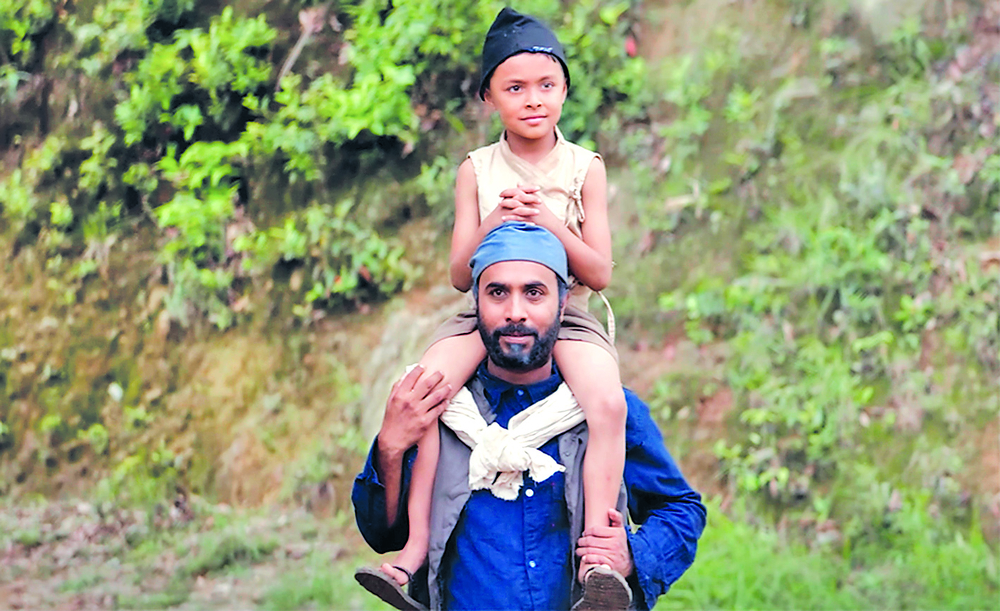
movie, some scenes brought back my childhood memories, which I had almost forgotten. For example, there was a time when there was no electricity in the village, when we used to read by Tuki Batti. The memories of those nights when the kerosene ran out and could not read came back. After sewing the school dress once, I had to work for many years and after passing SLC, my sister used to wear the same dress. He remembered that incident. It was unpleasant to see the incident of discrimination in the village with my own eyes. However, the film took me back to my time. Many scenes in the
film are often emotional, many times eye-filling. But, when the son finally came to look for his father, and the father, who was crying for his son for the rest of his life, couldn't even hear the news that his son was a doctor, that moment also missed me. Tears burst as the eye dam broke. I cried like this for the first time in the hall while watching a Nepali film. Why was the role of Poorna Bahadur's wife reduced like this? That's the part that doesn't make sense. Why did his role disappear in the middle? If a female writer or female director were to direct, how would they present the role? These questions are also coming to mind. I thought, the melody of the sarangi was overshadowed in the story of Sarangi, i.e. the story of Gandharva.
Sarangi is Nepali culture, which the film says should be preserved. The film has advocated for the beleaguered Gandharvas who walk around with a sarangi, considering the sarangi to be the identity of the Gandharva caste. Overall, the film has raised the issue that every caste should protect their own identity and culture. How is the jealousy between the Gandharva brothers also creating conflict? The film tells that story.
Actually, 'Poorna Bahadur Ko Sarangi' is an excellent film that succeeds in presenting a different, original and real life.