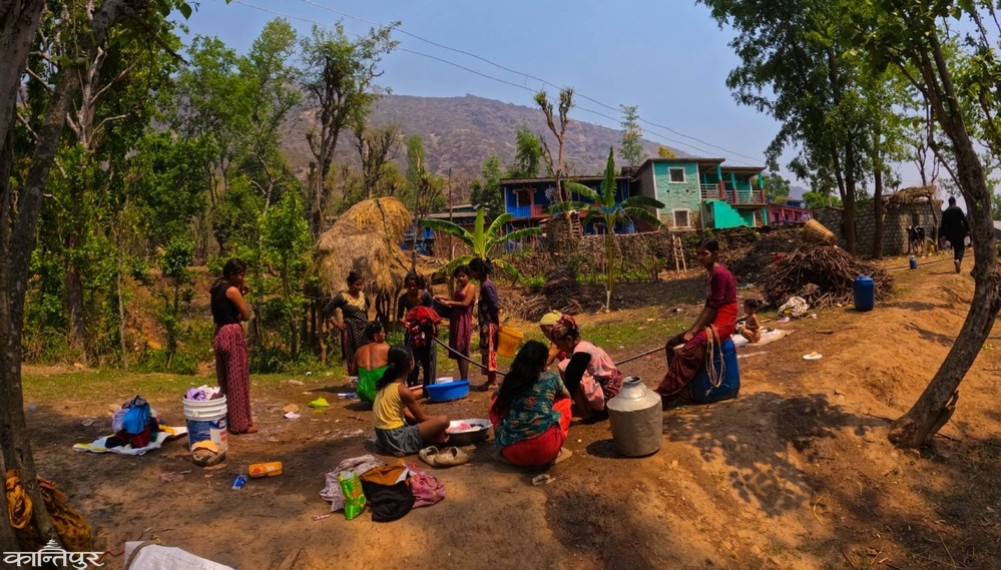
The earthquake-affected people are forced to walk for hours to consume contaminated water from the rivers and Bheri River, and they also drink the same water in a stagnant manner.
We use Google Cloud Translation Services. Google requires we provide the following disclaimer relating to use of this service:
This service may contain translations powered by Google. Google disclaims all warranties related to the translations, expressed or implied, including any warranties of accuracy, reliability, and any implied warranties of merchantability, fitness for a particular purpose, and noninfringement.
The sources of the Airari and Labisa drinking water projects in Nalgad Municipality-5 of Jajarkot dried up due to the earthquake two years ago. Due to which, about 80 houses in the two settlements are facing a shortage of drinking water. ‘We are forced to go to the surrounding villages to collect water, and we are also forced to wait in line to get water,’ said local Dil Bahadur Oli, ‘The work of women and children has become the work of carrying water, there is no alternative to walking at least half an hour for a jug of water.’
The earthquake also damaged the Bayala drinking water project in Barekot-1. After the source was submerged due to the earthquake, about 200 families from Bayala and surrounding villages are forced to walk for half an hour to get water from rivers including Panikhola, Laherikhola, Jamun and others. ‘The one jug of water brought in the morning is not enough to cook food,’ said local Saraswati Gharti, ‘After the drought, the springs around the village also dried up. Not to mention hunger and thirst, one person has to carry water all day long. Now we are forced to use water intermittently.’
According to the District Disaster Management Committee Jajarkot, the springs of 143 drinking water schemes across the district have dried up due to the earthquake that hit Barekot, Jajarkot on Kartik 17, 2080. According to the committee, the supply of drinking water was cut off due to the collapse of tanks, pipelines and other structures of 106 drinking water schemes. Purnakala Rana of Bheri-1 Rimna said that living in a tent has become difficult due to the problem of drinking water. According to her, nearly 150 households in Rimna have been struggling to find water for drinking, defecating and feeding their livestock.
She said that the water from the Budbudi drinking water source above the village stopped flowing into the tap after the earthquake flooded it. She complains that she is now forced to go to the Bheri River, half an hour away, to fetch water. ‘Due to the lack of water, we are forced to go to the surrounding bushes to defecate,’ she said. ‘The government has neglected to build permanent housing, let alone provide drinking water.’
Mayor Dambar Bahadur Rawat said that the drinking water problem is most severe in Jajarkot, with 23 schemes completely damaged and 26 schemes partially damaged. According to him, although some schemes damaged by the earthquake have been repaired, nearly 3,000 families are forced to search for water by searching for water from the rivers, Bheri River and various springs due to the prolonged drought. ‘Residents of settlements along the banks of the Bheri River are forced to consume contaminated water from the river,’ he said. ‘Health problems including diarrhea and dysentery have also started appearing due to contaminated water.’
Vishal Upreti, chief of Nalgad Municipal Hospital, said that with the increasing heat, the number of patients suffering from fever, cold, typhoid, and diarrhea has increased due to contaminated water.’ He said that up to 150 patients come to the hospital for treatment daily.
Badri Pant, ward chair of Nalgad Municipality-4, said that the water shortage in Jajarkot, which was already suffering from water shortage, has worsened after the earthquake. ‘After the earthquake, there was a long drought last year and this year,’ he said. ‘After the water dried up, there was no option but to drink contaminated water from the Bheri River.’
He said that the water shortage has had a major impact on animal husbandry. Barekot Rural Municipality Chair Bir Bahadur Giri said that a plan has been prioritized to solve the problem of water shortage. ‘The earthquake has also damaged drinking water schemes in all wards along with other public structures,’ he said, ‘Last year, work was done on about 20 schemes, and we have given priority to drinking water in the current year as well.’
According to the data of the Ministry of Water Resources and Energy Development of Karnali Province, 480 different drinking water schemes were damaged in Jajarkot, Salyan and Rukum West due to the earthquake, causing a loss of about 3 billion rupees.
Birendra Chand, Chief of the Drinking Water, Irrigation and Energy Development Office, Jajarkot, said that the problem of drinking water shortage after the earthquake could not be solved due to budget problems. According to him, this year, out of a budget of 1.6 billion rupees requested from 7 local levels, only about 80 million rupees has been allocated.
He informed that last year, about three dozen drinking water schemes were repaired and 3 new schemes were constructed from a budget of about 90 million rupees. "In some places, schemes have been repaired through public labor. Since there is no money to build new schemes, we have repaired them by distributing pipes," he said. "It will take at least 5 years to build the drinking water schemes damaged by the earthquake."