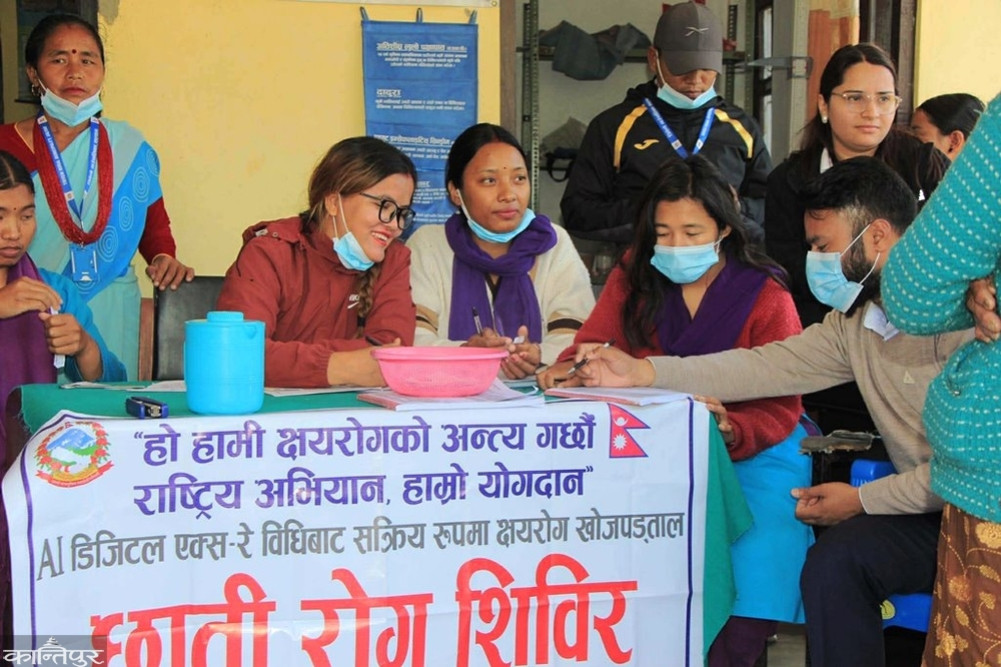
In the district, services are being provided by DOTS centers at 58 locations, DMC services at 5 locations, and one expert at the district hospital for tuberculosis identification and treatment.
We use Google Cloud Translation Services. Google requires we provide the following disclaimer relating to use of this service:
This service may contain translations powered by Google. Google disclaims all warranties related to the translations, expressed or implied, including any warranties of accuracy, reliability, and any implied warranties of merchantability, fitness for a particular purpose, and noninfringement.
According to the action plan launched by the government to make Nepal free of tuberculosis by 2035, the health service office, local levels and organizations have been conducting various awareness-raising programs every year to control tuberculosis.
In the district, DOTS centers are being provided in 58 places, DMC services in 5 places and an expert in the district hospital are providing services for the identification and treatment of tuberculosis collectively. The 'TB Free' program has been implemented in Kapurkot Rural Municipality and Sharda Municipality. Testing camps are also being conducted every year on the occasion of World Tuberculosis Day.
Although the health service office, local levels and organizations have been providing various services for the prevention of tuberculosis, the lack of health awareness and the tendency of patients to hide the disease have not been able to bring it under control.
The health service office Salyan, local levels and Birat Nepal Medical Trust have not only been conducting various programs but also administering medicines under the direct supervision of health workers. But the disease is increasing rather than being controlled. Not only are the activities and camps held in limited areas depriving the residents of remote areas of awareness, but locals also complain that the program has not had an impact as they do not go to the hospital for treatment until the condition becomes serious.
When patients do not take precautions and mingle in groups, the risk of spreading the disease to family members and others increases. According to the data of the Health Service Office Salyan, 176 tuberculosis patients were found in the fiscal year 2077/078, 261 in 2078/079, 246 in 2079/080, 263 in 2080/081 and 271 in 2081/082.
Only 143 patients have been identified so far in the current fiscal year 2082/083. In Salyan, 1,360 tuberculosis patients have been identified in a period of 6 years, and 46 people have lost their lives so far. All those who died due to tuberculosis infection are above 60 years of age. According to last year's data, the highest number of patients, 51, was found in Chhatreshwari Rural Municipality among the 10 local levels of the district. Kapurkot Rural Municipality was second and Sharda Municipality was third. Thalraj DC, Information Officer and Tuberculosis Focal Person of the Health Service Office, Salyan, said that new patients have been found in large numbers due to the increased search and rescue efforts along with the implementation of various programs in all municipalities of the district. He said that since one person with tuberculosis can infect up to 10 people, it has not been completely controlled. According to him, tuberculosis treatment services have been effective in Salyan. Last year, the treatment success rate reached 94 percent. He said that even though some people are taking medicine under the supervision of health workers at the district hospital and other health institutions, some people stop taking it in between. He said that people who stop taking their medicine in between are at risk when they mix with other people.
Bharat Chand, the program chief of Birat Nepal Medical Trust, which has been working with the Nepal government for the past few years to prevent tuberculosis in Salyan, said that due to the lack of sufficient budget, they are forced to work only in limited places. He said that the tuberculosis control program seems to be ineffective due to the fear of being ostracized by society and the problem of going to the hospital only in the last stages.
He said that those who are hiding their disease are being searched for and given medicine. He said that some problems have been seen when people who have been working in various districts of the country, including India, return home after working for a long time and do not get tested immediately even though they show symptoms.
Subash Hamal, the health department chief of Kapurkot rural municipality, where the 'TB Free' municipal program has been implemented, said that even though they have been identifying and treating patients, the problem of those showing symptoms moving around in groups has added to the challenge of controlling the disease. He said that those who show symptoms do not reach the concerned agencies for treatment in normal conditions and go to the last stage, so the problem of the sick person spreading it to others is more. 'If you take regular medicine, tuberculosis is completely cured.' But some patients have been ignoring it. Those who neglect treatment are losing their lives,' he said. Ganeshman Dangi, the head of the health department of Chhatreshwari rural municipality, where the highest number of tuberculosis infections have been found so far, said that three people who stopped taking tuberculosis medicine in the middle lost their lives last year and one this year.
He said that all those who took regular medicine under the supervision of health workers have recovered. 'Due to the lack of sufficient budget in the municipality, it has not been possible to go to all the settlements and conduct awareness programs and camps. If work could be done in the settlements, deaths from tuberculosis could have been reduced to zero,' he said.