This year, 6,407 people visited Kailash-Mansarovar, collecting a revenue of Rs 72 lakh 27 thousand. For almost 5 months, hotels in Simkot and Hilsa were full, and everyone from porters to airline and travel agency employees were busy.
We use Google Cloud Translation Services. Google requires we provide the following disclaimer relating to use of this service:
This service may contain translations powered by Google. Google disclaims all warranties related to the translations, expressed or implied, including any warranties of accuracy, reliability, and any implied warranties of merchantability, fitness for a particular purpose, and noninfringement.
Hotels in Simkot, the district headquarters of Humla, and Hilsa, located on the Nepal-China border, have been full almost every day since the first week of Jestha. Nearly a dozen tourist hotels have opened in Simkot and eight in Hilsa after Indian tourists started using the Hilsa checkpoint for the Kailash-Mansarovar pilgrimage.
‘Every day, 40 to 80 tourists were accommodated in hotels,’ said Vijay Lama, the operator of Hotel Vijay in Simkot. ‘This time, the hotels did not have to accommodate the pilgrims in tents as the tourism industry sent them according to their capacity.’
According to him, before the Corona pandemic, the hotels did not have enough rooms, so the pilgrims had to be accommodated in tents.
Not only hoteliers, but also porters, tourist guides, and even flight and helicopter staff became busy due to the Indian pilgrims going to Kailash-Mansarovar. Up to 83 flights were made from Nepalgunj to Simkot Airport in a single day due to the Indian tourists, while five helicopters were on standby at the airport to ferry tourists from Simkot to Hilsa. The flight companies had given employment to about 25 people to load and unload luggage due to the pressure of Indian pilgrims.
The season for Kailash-Mansarovar is almost over this year as the snowfall season has begun. According to the District Police Office, 6,407 foreign tourists have entered Humla this year. Of these, 5,957 are Indians and 450 are tourists from other countries, the office has said.
Hotelier Mim Lama said that the number of Indian pilgrims has increased since the pilgrimage season opened this year after the Corona pandemic. “The Indian pilgrims were packed in the big hotels, and it was not possible to accommodate other passengers,” he said. “Other hotels were also packed with airline employees, tourism entrepreneurs, and tourist helpers.”
According to him, a package of Rs 3,500 was fixed for a day for the tourists, which included accommodation with breakfast and dinner. “Pilgrims would stay in hotels in Simkot for two days when they came to Humla and one day when they returned, and in hotels in Hilsa for one day when they left,” he said. “They would stay in China for the remaining three days.”
He said that hotels generated a turnover of around Rs 10,500 per tourist. According to his estimate, the turnover in hotels in Simkot and Hilsa alone was at least Rs 77.2 million. He said that a hotel earned between Rs 1 million and Rs 5 million.
Deepak Rawat, the operator of Humla Resort, said that farmers have also benefited since local vegetables are used this year. "Until the Corona pandemic, the Indian vegetables that came by ship from Nepalgunj were the only ones available, this year all the vegetables were consumed locally," he said. "When tourists returned, they used to take Humli apples, walnuts, beans, phapar, chino, kaguno, Marsi rice and other produce as Koseli."
According to him, apples taken as Koseli are bought and sold for Rs 70 per kilogram and walnuts for Rs 10 per grain. Other agricultural products were also sold by farmers for Rs 150 to Rs 200 per kilogram. Currently, local vegetables are being sold in Humla for Rs 100 to Rs 250 per kilogram.
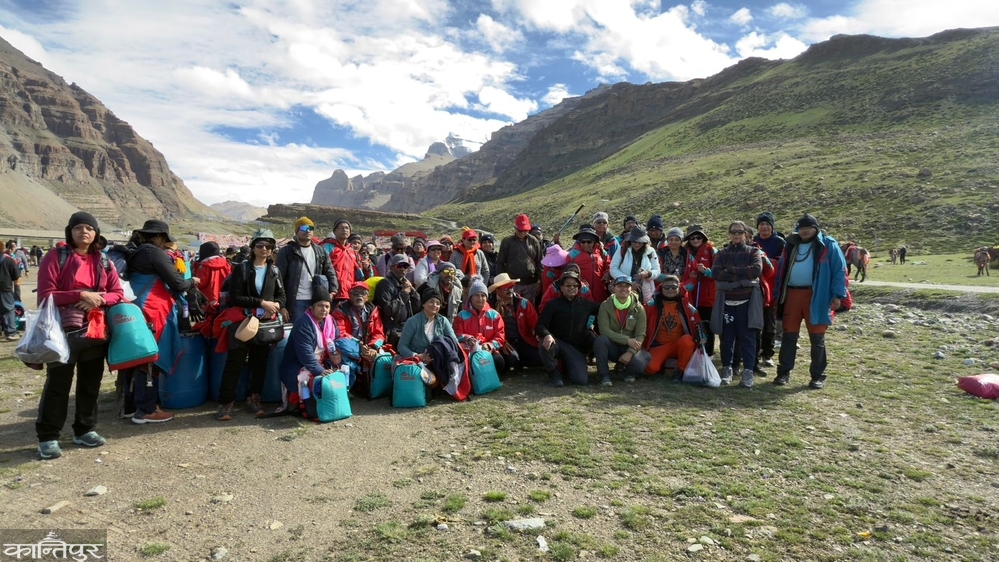
China opened the Mansarovar pilgrimage on April 18. Tourism entrepreneur Tshering Lama said that the attraction of Indian pilgrims passing through Nepalgunj has increased as the route to Mansarovar-Kailash is shorter. According to him, this pilgrimage has also created employment at the local level.
According to him, those who carried luggage from Simkot Airport to the hotel as porters have earned up to Rs 3,000 daily. ‘Porters used to charge up to Rs 100 for carrying ordinary bags,’ he said, ‘Even when carrying the luggage of 10 tourists, one person earned at least Rs 3,000.’
According to him, about 150 people worked as porters at Simkot Airport, while the number of workers hired by hotels, travel agencies, and airlines was also more than 200.
Simkot and Namkha rural municipalities had also collected fees from foreign tourists who reached Humla. Simkot rural municipality chairman Vijay Bhandari said that a revenue of Rs 1,100 per person was collected as a cleaning fee from Indian pilgrims. According to him, a fee of Rs 1,500 was collected from tourists from other countries.
He said that a revenue of Rs 6.552 million was collected from Indian tourists and Rs 6.75 million from tourists from other countries.
Since the Mansarovar pilgrimage opened for the first time after the Corona pandemic, this year, businessmen have taken pilgrims to Mansarovar with good management, says the rural municipality chairman Bhandari.
‘It has been seen that hotels should provide more quality service from next year, preparations should be made now to add hotel rooms and manage other infrastructure,’ he said, ‘If the road from Simkot to Hilsa could be upgraded, tourists could be taken to the China border while observing the life of Humli, and economic turnover would increase further.’
He informed that infrastructure development work has been started in tourist places near Simkot to accommodate tourists coming on pilgrimage in the coming days.

