We use Google Cloud Translation Services. Google requires we provide the following disclaimer relating to use of this service:
This service may contain translations powered by Google. Google disclaims all warranties related to the translations, expressed or implied, including any warranties of accuracy, reliability, and any implied warranties of merchantability, fitness for a particular purpose, and noninfringement.
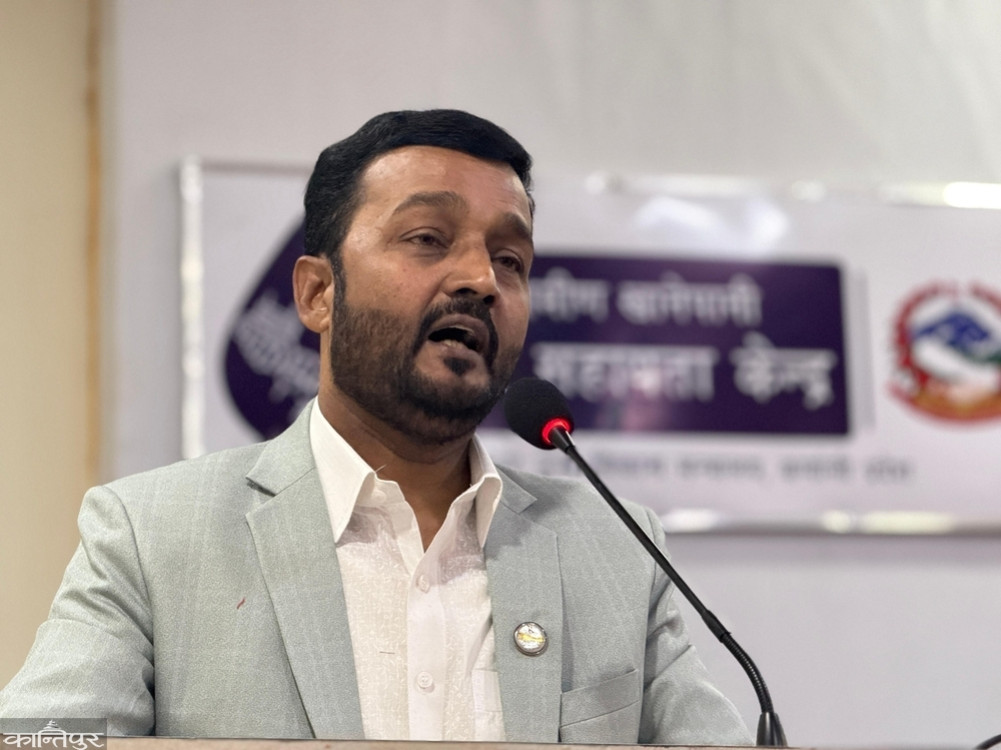
Federal Water Supply Minister Pradeep Yadav has said that water sources have suffered the most damage due to climate change in Nepal.
While inaugurating the state-level rural drinking water service assistance center in Surkhet, he expressed his concern that the water sources from the Terai Madhes to the hills are drying up due to the effects of climate change. "The underground water of the mountains and Terai are drying up, today there is no water even if we dig three and a half hundred feet," Minister Yadav said.
He said that the ministry is preparing to build recharge ponds in Chure area, distribute drinking water through lifting technology and give discounts on electricity tariffs.
Presenting the fact that only 4 percent of the people living in Karnali are getting clean water service, he said that there is still a lot of work to be done in providing quality water service. Minister Yadav made it clear that for the first time as a model, the rural water supply service assistance center has been brought into operation in Karnali province with the aim of providing quality water service at low cost. He promised that the aid center will be operated through efficient coordination between the union, state and local governments and the federal government will provide the necessary support.
The Sustainable Water, Sanitation and Hygiene for All (Suswa) project is providing technical support to the rural drinking water service assistance center. Padmaraj Devkota, Senior Divisional Engineer of the Ministry of Energy and Water Resources informed that the state government has allocated the necessary budget to operate it in the current financial year.
Pramiladevi Shakya Bajracharya, secretary of the Ministry of Water Supply, said that the government has emphasized on the distribution of treated drinking water. Ramkumar Shrestha, Director General of Water Supply and Sewerage Management Department, said that for the operation of water supply services, instead of small consumer committees, large consumer committees should be formed or by forming a board at the municipal level, service delivery can be made more efficient. Laxman Shahi, chairman of Hima Rural Municipality of Jumla, said that the compulsion of women sisters to walk 4-5 km to Naula and bring water to the doko is gradually ending.
According to Suswa project's governance expert Neerajan Shrestha, the drinking water service assistance center has been brought into operation with the aim of sustainable management and upgrading of dilapidated and old infrastructure in the water supply, sanitation and hygiene sector in Karnali province.
With the financial and technical support of the Suswa project, data collection and analysis of the rural water supply system at 25 local levels has been going on. The service center will analyze the condition and data of the non-operational streams and create an action plan for maintenance. In the
workshop, there was also a panel discussion about the work progress of the service center so far and the steps taken in relation to the sustainable operation of learning, drinking water and sanitation infrastructure.