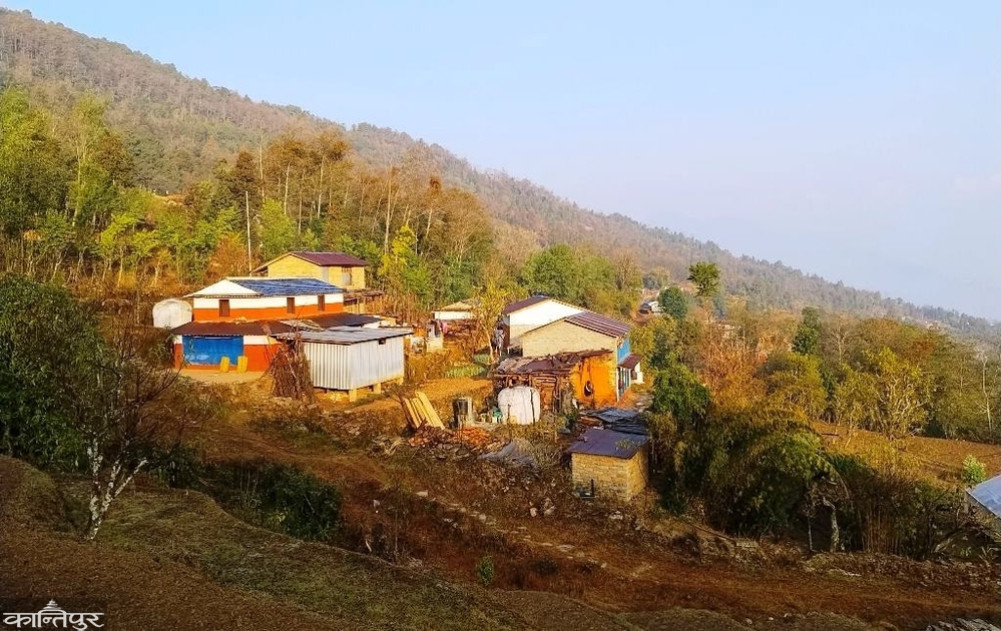
There has been an increase in people leaving their villages due to lack of irrigation, problems with drinking water, and a decrease in people moving to the district headquarters citing education and health as reasons for the lack of roads.
We use Google Cloud Translation Services. Google requires we provide the following disclaimer relating to use of this service:
This service may contain translations powered by Google. Google disclaims all warranties related to the translations, expressed or implied, including any warranties of accuracy, reliability, and any implied warranties of merchantability, fitness for a particular purpose, and noninfringement.
With the Himalayan range visible to the north and homestays and organic cuisine prepared to welcome guests, Bhakunde is a suitable destination for tourists.
But there is a lack of road infrastructure in Bhakunde. The existing road network is dilapidated. The locals have been suffering as the contracted roads have not been built on time. Tourists who want to come have not been able to reach it. Locals of Bhakunde in Baglung Municipality-10 say, ‘It has become difficult to attract tourists and conduct promotional programs because the roads are difficult.’
Dhaulagiri, Annapurna, Machhapuchhre, Nilgiri and Manaslu mountain ranges are visible from Bhakunde, which is at an altitude of 2,100 meters. The view of the district headquarters, Baglung Bazaar, is also attractive. But the road leading to this village, which is 15 kilometers away, is dilapidated.
Local Yam Bahadur Thapa said that due to this, the locals are facing difficulties even in carrying daily necessities. "We are ready to work hard to produce crops and attract tourists by running homestays," Thapa said. "There are more complaints about the inconvenience caused by the road." He said that it is difficult to run a service-oriented business when the road track opened almost 22 years ago is still in disrepair.
Bhakunde is an area with excellent livestock farming, grain production such as millet and corn, and vegetable and green production. But farmers have not been able to cultivate as planned due to lack of irrigation, people are leaving their villages due to drinking water problems, and people are coming to the district headquarters citing education and health as reasons due to the lack of roads.
Ward Chairman Til Bahadur Thapa also says that he is concerned about the suffering of the citizens. They say, ‘Until the roads are easy, the people will not believe in any other development,’ he said, ‘Even with good governance, the people will not be able to stay, only if the roads are made standard, the common citizen will stay in the village.’ He said that the city-level budget alone has not been able to make the roads standard here, and the contracts from the state and federal budgets have been delayed.
The Barah Lake, Viewpoint, and homestays in Bhakunde also attract tourists. But there is no standard trekking route. Some foreign guests want to visit, but tourism entrepreneurs have the experience of not being able to take them due to the lack of good trekking routes. ‘Either a standard road is needed, or a good trekking route is needed,’ said Rajan Kumar Shakya, President of Baglung Chamber of Commerce and Industry, Baglung, ‘The private sector also supports capacity development training and promotion, and the state’s investment in infrastructure should be increased.’
Even though more than 30,000 tourists visit the homestays here every year, they complain that they cannot travel easily due to the lack of roads. He believes that if stakeholders are interested in promoting tourism, development can gain momentum.
During the visit, tourists from Korea, America, China and Europe also visit here. Vegan groups from America and Britain also prefer to hike to Bhakunde in Baglung, the Buddhist monastery in Rayadanda, and Baur in Kathekhola Rural Municipality-7. Hikers have been traveling here for up to 7 days. But tourism entrepreneur Mahadev Sharma says that the number of foreigners who come now can be doubled if there is an attractive hiking trail.
Locals have also raised the issue of quality roads, drinking water and irrigation as a concern for the upcoming elections. ‘We want good roads, we will also eat from our own businesses,’ said local Tika Thapa, ‘The plans for drinking water are incomplete.’ If we have roads, irrigation and drinking water, we don't need a city.'
She said that the political leadership should support the initiative of irrigation for food production by producing daily necessities. She also urged that the roads be blacktopped so that livestock, vegetables and agricultural produce produced in the village can be easily transported to the market.