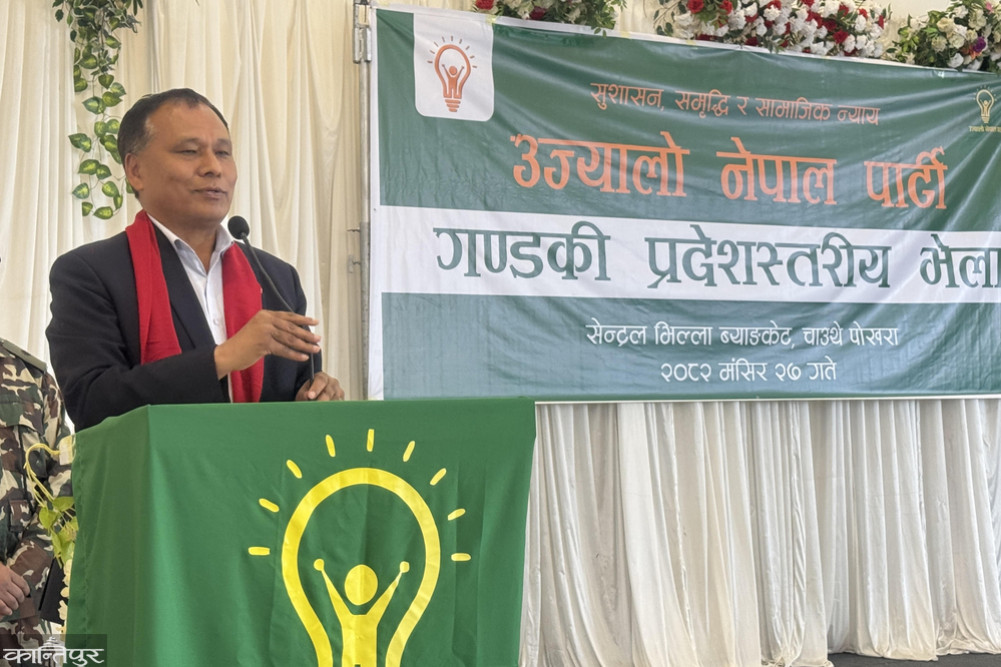
Minister Kulman Ghising has said that the right person should take the lead at the right time. His complaint was, ”Our politicians have not been able to become leaders.”
We use Google Cloud Translation Services. Google requires we provide the following disclaimer relating to use of this service:
This service may contain translations powered by Google. Google disclaims all warranties related to the translations, expressed or implied, including any warranties of accuracy, reliability, and any implied warranties of merchantability, fitness for a particular purpose, and noninfringement.
Minister for Energy, Water Resources and Irrigation, Physical Infrastructure and Transport and Urban Development Kulman Ghising has said that despite the large number of politicians in Nepal, there is a lack of leadership skills. He said this while speaking at the Gandaki province-level gathering organized by the Ujjaya Nepal Party in Pokhara on Saturday.
‘There is a big difference between a leader and a politician. Leaders move forward for the prosperity of the country, for the good governance of the country, to change the country, to carry out the economic transformation of the country,’ he said, ‘Our politicians have never been able to become leaders.’
He said that the reason for political instability is the lack of economic transformation and the lack of good governance. He said, ‘The reason for instability is that whenever there is no economic transformation, no economic revolution, no progress towards economic prosperity and when the country is paralyzed by corruption. Good governance cannot be maintained.’
He pointed out the need for the right person to take the lead at the right time. ‘The right man in the right place at the right time. It should be at the right time. The right time, time is very important. Age is the most important,’ he said.
He emphasized the need to build bridges that are essential for the people rather than spending on building large buildings for government offices. He argued that it is necessary to build bridges in places where there is a problem in the movement of people even if they rent government offices.
He complained that more than two trillion rupees were spent on the construction of government buildings but the people did not get essential bridges. He said that instead of spending billions on government offices, investment should be made in bridges that have not been built for 15 years. ‘There are no bridges across the country. There are no bridges anywhere.’ The people are getting angry, he said, ‘More than two trillion rupees have been invested in buildings, why is that building needed? Why should government offices not be rented?’
Stating that there is a serious problem in determining priorities, he said, targeting the previous government, ‘Where are the priority sectors? Which sector should be given priority? Has the government given that?’ That priority should be given.'
He also objected to the construction of view towers and unnecessary structures. 'Why is Jhapa's view tower needed? And there is a view tower in every village, a hill. The rural municipality also builds a view tower there. Why is it visible from the hill?' he said.
He gave the example of the Kankai Bridge in Jhapa, describing the problems with the bridge he saw during his visit. 'I reached the Kankai Bridge in Jhapa. It connects two rural municipalities. It is a postal highway. The people are suffering so much because it is not built. "We are forced to walk for about two to three hours to places that can be reached or moved in 10/15 minutes," he said. "Work that has been contracted for 15 years neither breaks the contract nor does it work."
He said that a bridge has not been built in Kamala Mai for 15 years and people have to cross the river in boats. He informed that hours of people's time are being wasted because the Bagmati Bridge connecting Rautahat and Sarlahi districts has not been built.
He said that people's priorities should be considered in development projects. "Who will be given contracts, who will be given work, and in the name of giving work to their people, they will send as much budget as they want. People are crying and dying wherever they want. If they don't give it, there will be no work," he said. Defining delivery, he said, "Delivery is providing investment where the people want it, providing immediate facilities, that is delivery." Ujjaya Nepal Party's Gandaki Province in-charge and central member Kushal Gurung, central members Rima Bishwakarma, Sumi Moktan, and tourism entrepreneur Lucky Karki Chhetri spoke at the gathering.