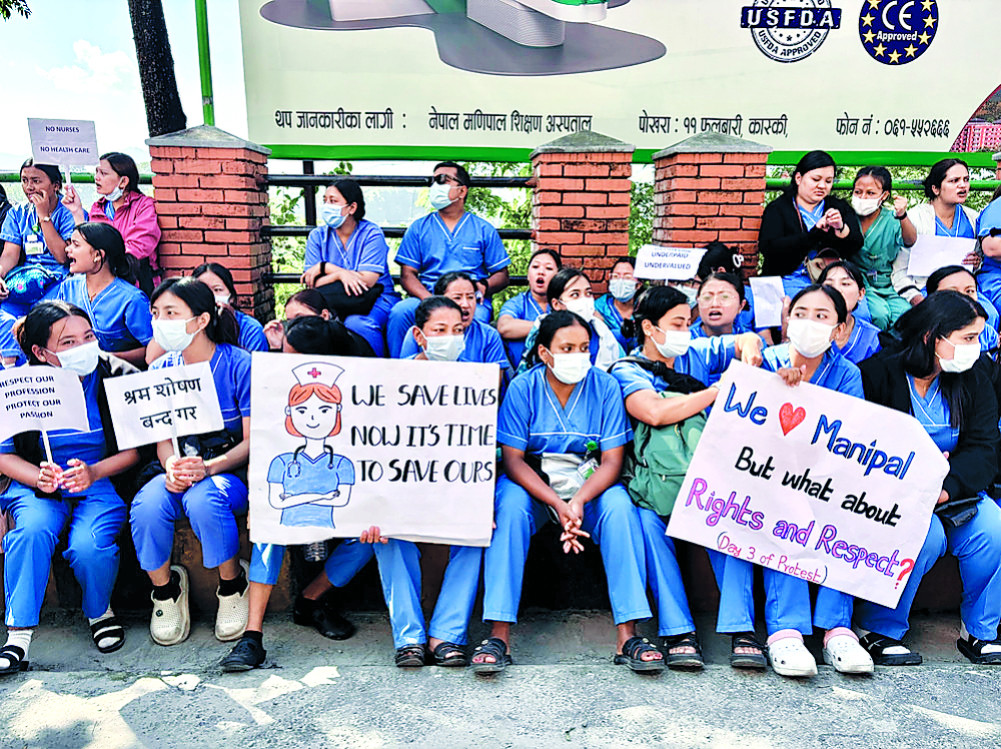
Nurses say: Human resources that have been educated, trained, and passed exams and are consumed worldwide should not be paid the same wages as unskilled human resources. Administrators say: It is not right for the government to set the salaries of human resources working in private health institutions.
We use Google Cloud Translation Services. Google requires we provide the following disclaimer relating to use of this service:
This service may contain translations powered by Google. Google disclaims all warranties related to the translations, expressed or implied, including any warranties of accuracy, reliability, and any implied warranties of merchantability, fitness for a particular purpose, and noninfringement.
Nurses at two large private hospitals in Pokhara have been on strike for a few days, demanding government-level pay. Nurses at Manipal Teaching Hospital in Phoolbari, Pokhara have been on strike since October 24 and nurses at Gandaki Medical College (GMC) in Nayabazaar have been on strike since October 26. Nurses at Charak Memorial Hospital in Nagdhunga have also been on strike since Saturday.
Two umbrella organizations, the Nursing Association Nepal and the Association of Private Health Institutions Nepal (AFIN), have come face to face over the issue of wages. The Nursing Association is in favor of providing government-like facilities as per the government circular, while AFIN is saying that this is not possible under any circumstances.
Even after 10 days of nurses carrying pamphlets demanding the price of labor, there is no sign of agreement. Nursing Association Kaski President Muna Silwal said that there has been no negotiation with the participation of the Nursing Association in Pokhara. The nurses from there have been participating in the negotiations to be held in Manipal. There has been no negotiation at all in GMC.
She said that it is unbearable to pay the minimum wage to unskilled labor even to skilled labor. ‘There is extreme labor exploitation in the private sector. The situation is the same everywhere,' Silwal said, 'The issue of paying 19,000 rupees as a salary to unskilled workers who are consumed all over the world after studying technical subjects, taking exams, and passing them has become unbearable. This pain is unimaginable.' She said that there was no negotiation with the Pokhara hospital and that the move would be made according to the circular issued by the center.
There are about 350 nurses working in Manipal and about 300 nurses in GMC. After the nurses went on strike, both hospitals sent some home after looking at the condition of the patients in the ward and referred some to other hospitals. Only these two private hospitals in Pokhara have the government's health insurance program. That is why the pressure of patients is high here. The OPD of both hospitals is still operating. No new patients have been admitted. Patients who need to be admitted have been advised to go to other hospitals.
After the services of both big hospitals that are insured are affected, the pressure of patients has increased at the Western Regional Hospital under the Pokhara Institute of Health Sciences. Although patients who can get treatment in private hospitals will not face any problems, if the services of both hospitals are not started immediately, the insured patients will suffer. After the services of both hospitals were affected and the Western Region was under pressure, insured patients who needed to be admitted were forced to be sent to Bir and Tribhuvan University Teaching Hospitals.
The hospital operators are not ready to meet all the demands of the nurses. Manipal had proposed to pay nurses between 24,000 and 29,000 rupees. The nurses are not ready for that either. At the initiative of AFIN, negotiations were held with the nurses in Manipal. However, AFIN Gandaki President Kapil Pokharel said that no agreement could be reached on that either.
1,200 patients receive services from Manipal and Gandaki daily. Although the operators of both private hospitals are ready to increase the services and facilities, they are saying that they cannot provide them on par with the government. Manipal had proposed to set four different salary rates based on qualifications and experience.
The hospital had proposed to pay Rs 29,587 per month to nurses who have completed graduation and have at least one year of experience, Rs 28,587 to PCL staff nurses with at least one year of experience, Rs 26,587 to those with one year of experience and CMA/ANM, and Rs 24,287 to new nursing staff. The nurses, however, have not withdrawn their agitation, saying that it should be around Rs 40,000, which is equivalent to the government's fifth salary. Manipal and GMC nurses are currently receiving a monthly salary of Rs 15,000 to 20,000.
Manipal Medical College director Narayan Poudel says that it is not right for the government to specify the services and facilities to be provided by private hospitals. He says that the government should not specify the remuneration other than the minimum as per the Labor Act. 'According to the Constitution, health should be free. This is not the case in government hospitals where the government sends doctors and machines,' he added. 'We have invested by taking risks. How is everything that the government says possible? He urged the government to think about the facilities provided to insured patients through health insurance and the investment made by the private sector.
The government has formed a committee on Sunday to address the demands related to the remuneration of nursing health workers. The 14-member committee has been formed under the coordination of Additional Secretary of the Ministry of Health, Prof. Dr. Shree Krishna Shrestha. The committee also includes representatives from the Ministries of Home, Finance, Labor, Education, Nepal Nursing Council, Nepal Nursing, Nepal Medical and Dental College Associations, AFIN, and the agitating nurses. The committee has a mandate to submit a report with suggestions on the work to be done to solve the problem in the immediate and long-term.
According to the spokesperson of the Ministry of Health, Dr. Prakash Budhathoki, in the talks that ended late on Sunday evening, it was agreed to form a three-member committee to create an environment for nurses to return to work and create an environment for this. In addition, the task force will make suggestions within seven days of the end of Tihar, and the Council of Ministers will take further decisions based on those suggestions. 'There is no doubt that the demands raised by the nurses should be met. For this, the issues raised by private hospitals must also be discussed. How to move forward will be decided after the task force's suggestions are received,' he said.
Meanwhile, the Association of Medical and Dental Colleges Nepal and the Association of Private Hospitals in Nepal (AFIN) have issued a joint statement expressing dissatisfaction over the display of derogatory placards by protesting nurses at the very place where the task force meeting was being held at the ministry. Both organizations have pointed out the weakness of the state side in creating the current situation. 'This unpleasant situation has arisen because the government did not bring sustainable policies, equal treatment and clear procedures in time,' the statement said, 'The state itself should take full responsibility for this incident.'