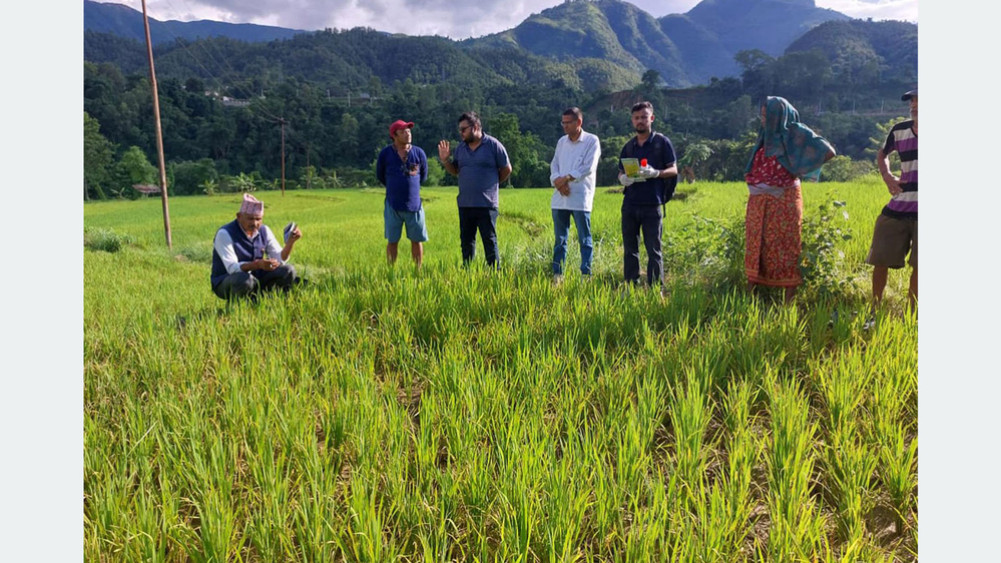
Abbadatta Bista, the crop protection officer of Krishi Gyan Kendra, informed that the paddy crops grown in three wards of Palungtar municipality were found to be affected by the disease.
We use Google Cloud Translation Services. Google requires we provide the following disclaimer relating to use of this service:
This service may contain translations powered by Google. Google disclaims all warranties related to the translations, expressed or implied, including any warranties of accuracy, reliability, and any implied warranties of merchantability, fitness for a particular purpose, and noninfringement.
In Gorkha, the problem of paddy dieback disease has been observed in paddy grown in an area of about 400 plants. Abbadatta Bista, Crop Protection Officer of Krishi Gyan Kendra, informed that the paddy crops grown in three wards of Palungtar Municipality of the district were found to be affected by the disease.
Death disease has spread in paddy crops planted in the area of 410 plants in Ward No. 4, 6 and 8 of Palungtar, most of the problems have been seen in Dwartar in Ward No. 8, which has one thousand branches. Officer Bista said that due to the disease, the rice plants in those areas have dried up.
'After the farmer informed the knowledge center, a team with agricultural technicians has reached the farm and studied the disease, the rice crop in the area where the disease has spread has dried up,' he said. Death disease is a type of insect that infects rice crops. He says that the disease can be controlled if anti-inflammatory drugs are used in time.
Death disease has been observed in paddy crops of Gorakhnath, Savitri and Mansuli varieties in that area. Officer Bista said that there was no disease outbreak in the ram paddy planted in the same field. The disease has also been observed in paddy fields in Ward No. 4 and 6 of Palungtar Municipality. He said that death disease was found in about 10 paddy fields there.
According to official Bista, it is believed that 50 percent of the paddy crop can be saved as 'spray' has been done in addition to providing anti-fungal drugs to the farmers in the affected areas. "There is a problem when the farmer does not take special care from the moment he buys the rice seeds", he said.