Today, Thaneshwar is producing 50 tons of different food items of lapsi annually. He says - ”If we can make quality hajmola and improved candy and export it abroad, there is a possibility that the world market will like the taste of lapsi”.
We use Google Cloud Translation Services. Google requires we provide the following disclaimer relating to use of this service:
This service may contain translations powered by Google. Google disclaims all warranties related to the translations, expressed or implied, including any warranties of accuracy, reliability, and any implied warranties of merchantability, fitness for a particular purpose, and noninfringement.
Until 2058, Thaneshwar Bhusal of Phalebas Municipality-4 Mudikuwa had no idea that lapsi, which was being wasted in the forest, would become a source of income. On the lapsi plant near the house, lapsi grew, fell and rotted.
Former Nepali Congress MP Rishikesh Tiwari used to tell the locals that they could earn money through the collection and processing of fruits such as lapsi and amla, which were wasted in the forest. Impressed by this, Thaneshwar's attention turned towards Lapsi.
Thaneshwar also joined the mountain community development organization opened under the chairmanship of former MP Tiwari, who is campaigning to connect politics with enterprise. Thaneshwar, who has an agricultural technical background, was initially employed in this organization. But after one year of employment, he turned into an entrepreneur. Thaneshwar has been continuously active in food processing industry near Kushma-Mudikuwa suspension bridge for 23 years.
In the same year as the organization was established, about 25 people including Thaneshwar participated in a 15-day He had reached Kathmandu for training. At that time, Thaneshwar learned to make lapsi candy, pickles, jam, titura, mada etc. . He said, "In the beginning, it was said that the members of the organization would take processing training and the organization itself would operate the processing industry." But when there was talk of legal trouble, I was alone.'
After opening the industry, he started collecting lapis . 'Money comes from waste in the forest!' The rumor spread throughout the village. He said, "Initially, I bought 6 rupees per kg of lopsi. Now the purchase rate of lapsi has reached 50 per kg.'
After starting the production of many dishes from lapsi, Thaneshwar realized that its marketing is not so easy. In the beginning, he used to market his products by going to market squares, fairs and crowded places. To get used to the taste of lapsi, they used to taste it for free . In this way, he gradually increased his market. In order to bring the
industry into operation within 12 months, he has been producing Satu for four years. He said, 'He has started producing mix satu by mixing corn, gram, wheat, bharta, phapar, barley and almonds, and there has been a good response.' Stating that he is selling 15 quintals of satu annually, he said, 'The mountain brothers living in America, Japan and Europe like it more.' 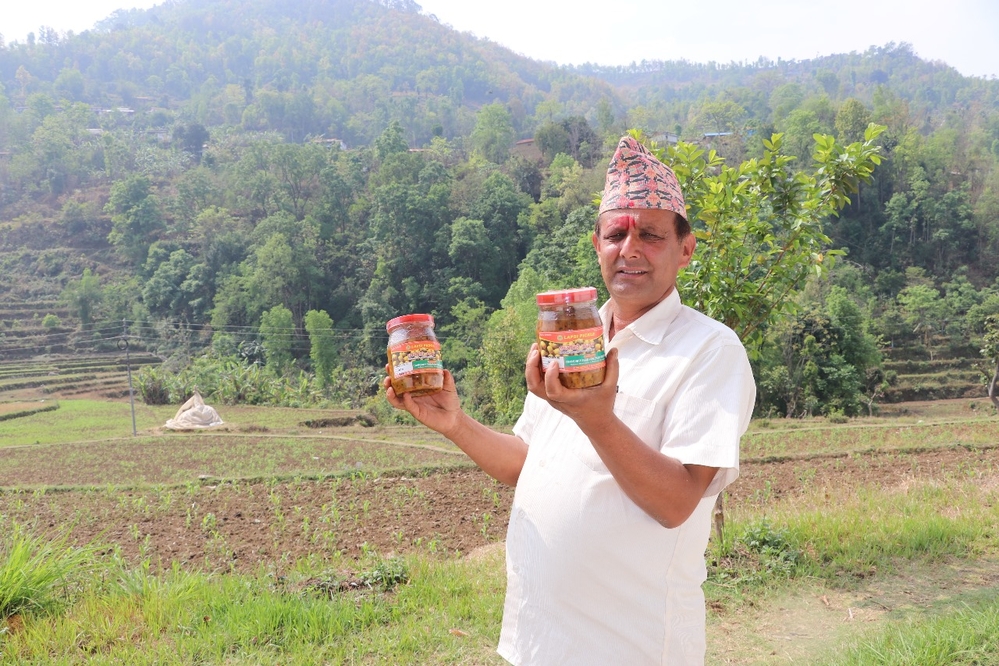
During the Corona period, he got a shock . He said, "Compared to earlier, the business has decreased by half." Today, Thaneshwar, who was selling 15 quintals of lapsi and amla pickles annually, narrated his experience of selling up to 25/30 quintals before the Corona period. "30 percent profit comes out of the goods sold," he explained about the profit/loss, and said, "Earlier, the profit was up to 13/14 lakhs a year. would have been . But since 4/5 years, there has been a profit of 6/7 lakh rupees.'
The loss suffered during the corona period continues to haunt him even now. He said, "There was a loss of more than 50 lakh rupees during the Corona period". The produced materials had to be destroyed.' Although the industry was insured, he could not get compensation from anywhere because there was no insurance for the produced materials.
In the year 2072, he suffered another tragedy. Landslide happened at the place where his industry was. Machines and products were washed away with the landslide. But even this time he didn't get anything from the insurance company . He said, "A few days after the landslide, the representatives of the insurance company came. Well, please bring the photos of the landslides. But they said that they cannot give compensation because there is no photo.'
Today, his 27-year-old son Shishir Bhusal is also helping him. He seems happy when his son started doing the work from bringing the raw materials needed in the industry to delivering the products to the market and promoting them on social media. Thaneshwar, who is employing 3 local women, said that 6/7 manpower is needed during the season, and said, 'Sometimes, when there is a shortage of workers, my daughter-in-law and wife help.'
Bhusal, who has passed 'level two' in agricultural enterprise from CTEVT, is not limited only to his enterprise . He also gives pickle making trainings. Thaneshwar, who has trained more than 3,000 people to make lapsi, amla and meat pickles, said that the farmers are not only learning the method of making pickles, but also learning about pricing, the right time to sell in the market and preparation for marketing.

Today, Thaneshwar is producing 50 tons of various food items of lapsi annually. Locals from Mudikuwa, Devisthan, Limithana, Thanamaula, Shankarpokhari and other places sell lapsi to him. Thaneshwar claimed that since it is a fruit found only in Nepal, it does not have to compete with India and China, it has strong potential in the international market as well.
Bhusal alleges that the state is making trouble for farmers in the name of subsidy. He argues that since the state policy has not touched the laboring farmers, the subsidy process should be corrected . "There should be a system for the employees to go to the farmer's fields and pay after completing the documents there," he said, "whether to run an office for grants or at your own farm." Farmers don't have this kind of leisure.'

