We use Google Cloud Translation Services. Google requires we provide the following disclaimer relating to use of this service:
This service may contain translations powered by Google. Google disclaims all warranties related to the translations, expressed or implied, including any warranties of accuracy, reliability, and any implied warranties of merchantability, fitness for a particular purpose, and noninfringement.
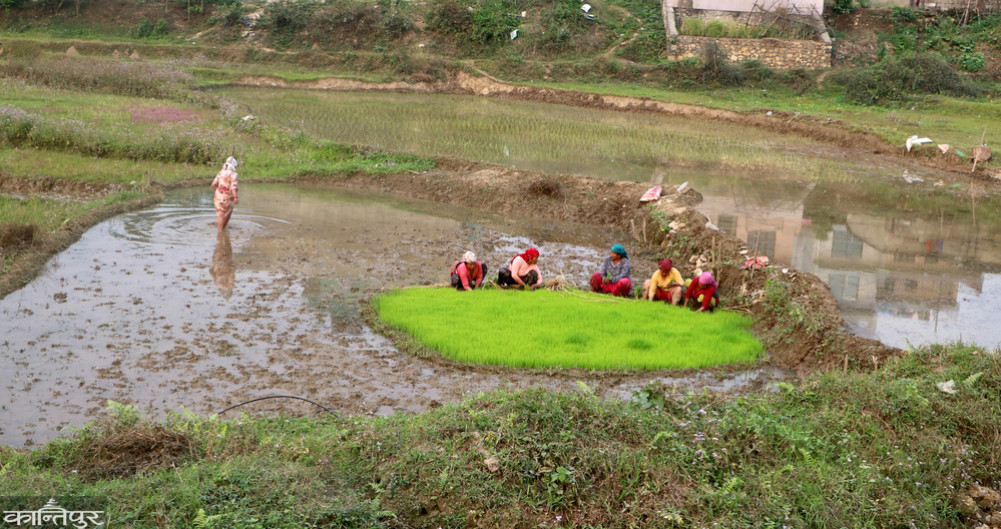
Mukti Kumar Goshli, a farmer of Beas municipality-7 Satrasaya branch of the district, is currently busy planting chaite paddy. He has invited 6 farmers of the village to the fair to plant chaite paddy in 3 plantation fields.
He said that time will be spent planting rice in the field from morning to evening. "We have planted paddy in some places with bulls and tractors in some places," he said.
Man Bahadur Darai of Vyas-11 Ranigaon says that the production was not good last year due to lack of fertilizer on time. "There is no rain on time, fertilizer is not available when needed." The rain spoils the newly harvested rice,' he said, 'even if we don't think about all this, what will we eat tomorrow?' Kiran Nepali said. He said, 'Until now, 75 percent of Chaite paddy planting has been completed.'
He said that Chaite paddy cultivation has been decreasing for the past few years. According to him, Chaite rice cultivation is decreasing every year. Last year, up to 6,000 hectares of chaite rice was cultivated. "In recent years, it has started to decrease," Nepali, the information officer of the center, said. As there are no young people in the village, most of the farms are barren. According to
on, last year 8 thousand 704 metric tons of chaite rice was cultivated on 1 thousand 802 hectares of land. Similarly, in 2079/80, 11 thousand 183 metric tons of rice were produced in 2 thousand 470 hectares of land. In the
district, about 51 thousand 550 hectares of area will be cultivated, but 6 thousand 347 hectares of the area have irrigation facility available for twelve months . 13 thousand 583 hectares of irrigated area and 7 thousand 236 hectares of unseasonal irrigation facilities are available, so farmers cultivate paddy even with sky water.