We use Google Cloud Translation Services. Google requires we provide the following disclaimer relating to use of this service:
This service may contain translations powered by Google. Google disclaims all warranties related to the translations, expressed or implied, including any warranties of accuracy, reliability, and any implied warranties of merchantability, fitness for a particular purpose, and noninfringement.
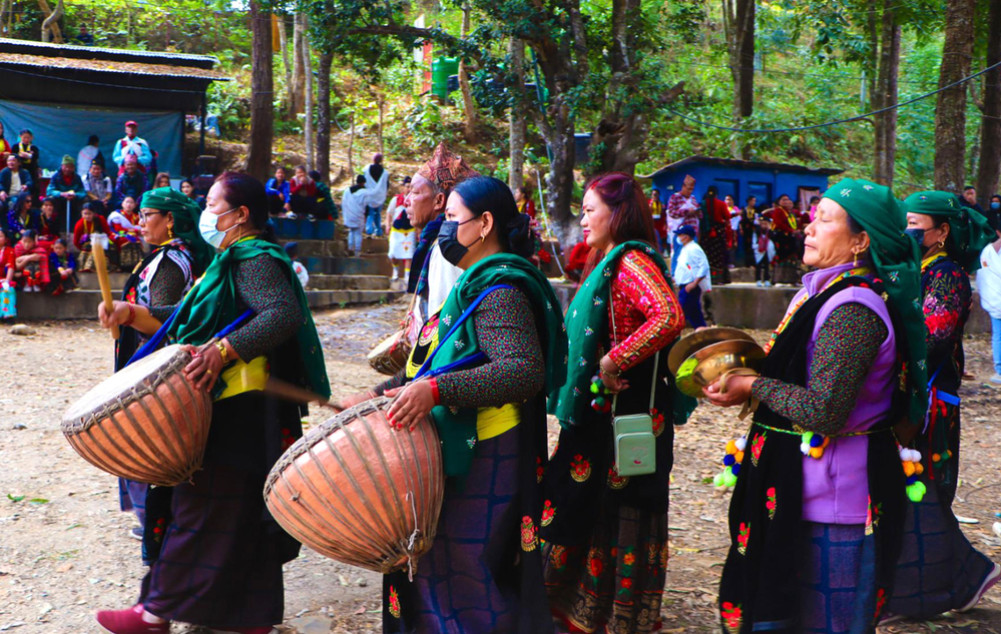
As the ancestral profession of the Pariyar community, Panchaibaja has also started to be played by other communities today. After the practice of saving panchaibaja gradually disappeared in villages and cities, the women and youth of Magar community in Baglung became interested in conservation.
The practice of playing Panchaibaja, which started to face a crisis after the youth migrated abroad, is being preserved recently.
Now women's groups here have also started playing instruments. Sarita Thapa Magar, President of Baglung Municipality-3 Deurali Chowk Mother's Group, said that after the practice of playing panchaibaja started disappearing, women are protecting it.
He says that they started playing the instrument when there was no one to play the instrument at weddings, fasts and other public events. Earlier, many groups played baja in the village, but now there is no one. Thapa said, 'Nowadays it is difficult to find the manpower to play the instrument, the new generation rushes to go abroad after finishing school, the elderly cannot play, in the village they stop playing the instrument when someone's wedding, fast bandh, pasni, so the sisters started playing the panchaibaza together, at first it took some time to learn. Now, after everyone has learned, we go to play from place to place.'
The women who learned to play the instrument two years ago have now started earning from it. Initially, they learned from the panchaibaja group of the village and started playing professionally by purchasing a baja set for 150,000.
Kala Shrees, a member of the Panchaibaja group, informed that they take 30,000 to 50,000 from a marriage. He says that on the occasion of marriage, they go from the rural areas of Baglung to the big cities to play baja.
'In the beginning it took some time to learn the rhythm of the baja, now more than 50 sisters play panchaibaja', she said, 'now even those who want to learn can be taught, we have a vivain in November and January, this has also improved our income.'