We use Google Cloud Translation Services. Google requires we provide the following disclaimer relating to use of this service:
This service may contain translations powered by Google. Google disclaims all warranties related to the translations, expressed or implied, including any warranties of accuracy, reliability, and any implied warranties of merchantability, fitness for a particular purpose, and noninfringement.
Kedarsyun Rural Municipality-9 Sekugaon was full of Dussehra. Friends, relatives and relatives gathered to celebrate the biggest festival of the year. Dauntari's gathering and Ramramita were happy. The next day after Dasain Tika, the sky started to get cloudy.
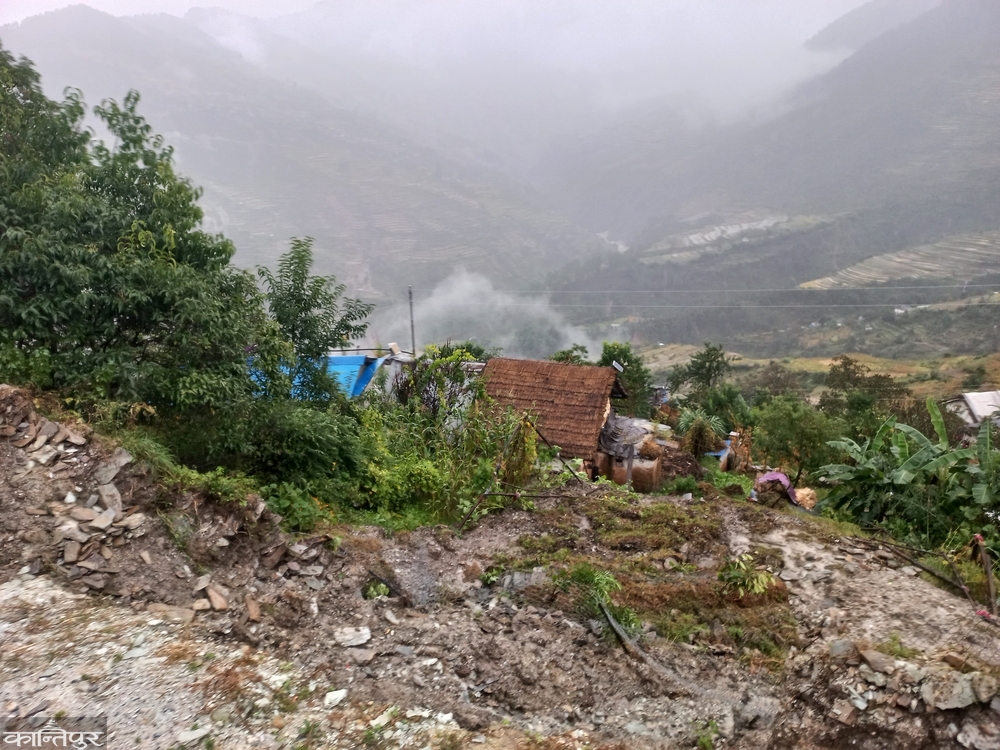
Due to the heavy rain since the evening of October 30, 2078, the rumbling of the nearby Khare started to increase alarmingly . Water wells started flowing like a river in the streets and gutters. 65-year-old Sher Damai of Sekugaon was sleeping in Sadak Muntir's house. The hoarse voice of the khare five meters away from the house made him feel cold, "Is there going to be something bad?"
Except him, all the family members were fast asleep . But he was disappointed. He came out saying that he had to look outside as the rain did not stop even till midnight. The flood has reached the house. "Now, we as a family went up to the road after picking up the sleeping children that it is not appropriate to live in this house, the wall on the left side of the house collapsed suddenly," he remembered. That disaster damaged 15 houses of Sekugaon, where 85 Dalit families live, including lions.
That year, Bajhang was the most affected by the unexpected disaster that occurred after the monsoon prolonged for 12 days . The private houses of 1 thousand 145 families in the district were damaged and needed to be rebuilt, while the houses of 854 families had to be repaired. Out of these 463 families belonged to the Dalit community. (According to the National Disaster Risk Reduction and Management Authority, the place where the houses of 31 families were located was dangerous and had to be resettled elsewhere.)
Even after four years have passed since the floods and landslides caused destruction in Bajhang amid the rush of Dasain, the affected people are deprived of getting the reconstruction funds promised by the government. Due to this structural disparity, about 3,000 Dalits have been forced to migrate to India in search of livelihood due to debt incurred during reconstruction, and failure to provide safe housing.
Among them, more than 125 houses have been locked. The Dalit community has been the worst affected by the calamity, and they are more hurt due to the government's neglect of relief distribution and reconstruction.
Govind Pokharel, the former chief executive officer of the National Reconstruction Authority, who was also the vice-chairman of the National Planning Commission, said that the lack of rehabilitation and reconstruction work for the victims of Bajhang and the fact that the victims left the country is a weakness of the government.
'After the disaster, the government has to arrange temporary accommodation and arrange permanent accommodation within two/three years . But this matter was not a priority of the government," he said. When it collapses, there is no option to raise other financial resources . Such people and communities should be identified and given more facilities than others. But that didn't happen . Neither the state saw it, nor the victims saw the state .'
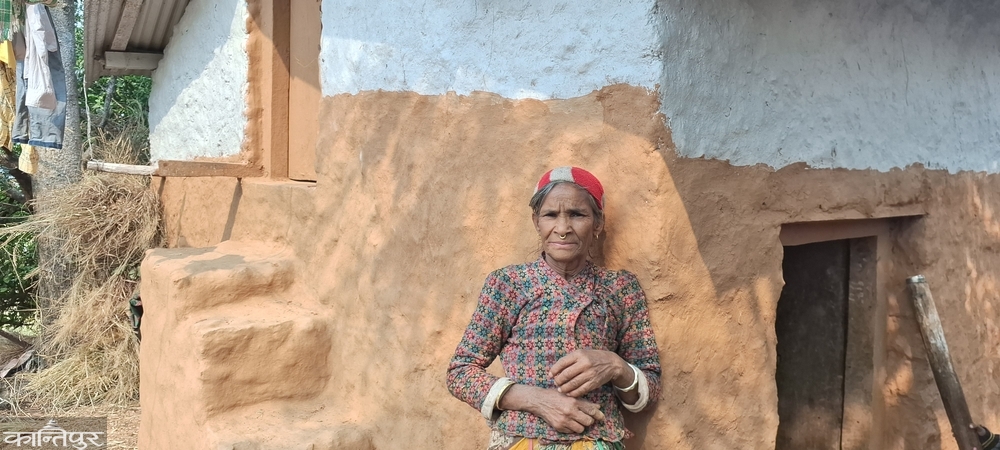
When the state did not show its presence in Apthera, the people left the country disappointed . 'This is the state's irresponsibility.'
In spite of the Dasain Chataro, a few days after the incident, various teams, including the rural municipality, arrived to assess the damage. Some of them also brought relief. Deepak Luhar was among the relief crowd. The floor of the house was filled with mud brought by the landslide. Ledo entered the house by breaking the single wall.
He and his neighbor Sher's family saved their lives because they left the house suddenly, but the house was destroyed. He learned that the government will provide assistance for housing reconstruction. They say, 'Apply to the ward and municipality.' After that, if money comes for the reconstruction of the house . But it's been four years since we submitted the application, we haven't received anything yet.
Most of the Dalit families in Bajhang who are in debt for building and repairing (retrofitting) the house are forced to work across the border, even after submitting the application because the house is damaged. Someone's house is locked. Some of them locked their houses and entered India with their families. Some are ready to go. Due to the calamity, the Dalit settlements of the district are being abandoned one after the other.
Even though the government did not give the money for the reconstruction, Sher Damai repaired the wall of the house destroyed by the flood by taking a loan. The walls of the house, which had been torn apart by their own means, have cracked, and stones have started falling from the walls .
Deepak's family has taken shelter in a neighbor's house. Sher sews the clothes of non-dalit and Deepak earns some livelihood from the kholo (grain given twice a year for doing work) for doing the work. They make a living by doing wage labor and loans in their spare time .
Both families want to build their own strong house. But this desire has added to their burden of debt . And they are leaving the village to pay that debt. Deepak's brother and sister-in-law went to work in Anarkatta, Bangalore, India in Baisakh 2079. Sher Damai's three sons and two daughters-in-law went to work in India two years ago with four children. "They went to earn money to build the house taken away by Pahira. He will also send the money left over after taking care of that life. It will eat us well,' said Sher, 'We don't know when the dream of building a strong house will be fulfilled.' When the reporter gave this information to both of them, they got angry. "There are names of those who have less damage than us and have no damage, our names have been removed," Deepak said angrily, "Even if the victims are not victims, they will get relief, what kind of justice is it to cut off the names of those who are in trouble?"
It is mentioned in the records of Pradhiran that 46 Dalit families from Kedarsyun rural municipality-1 to 9 were affected by the flood. Out of these, 33 family houses need to be rebuilt and 13 need to be repaired, according to the authority's survey. However, not only the disaster victims whose names are not included in the list, no one in the list in Kedarsyuun has received the funds for housing reconstruction and repair even for four years .
Among them, 63-year-old Kainsi Odko of Kedarsyun-1, Dundil, destroyed the wall of the house with thatched roof and mud mud. The family of 19 spent the night under a tent for two months after the house they lived in collapsed.
When the children started getting sick from the cold, they built a house by borrowing. The walls of the old house were also torn down and a tin roof was taken, and a loan of 6.5 lakhs was taken. They were freed from having to spend a painful night in a tent, but they went to India with their four sons, three daughters-in-law and nine grandchildren due to the debt incurred while building a house. How does she live in a house with two granddaughters?
'There is a debt . There is no employment here . Everyone went there to work and pay," she said. How can she pay such a debt?' She complained to the government saying that after the damage to her house, she did not give money for the reconstruction of her house. I am old, I would not be alone like this.'
6 families of Dundil, where 23 families of Dalit community live, are on the authority's list. It is mentioned that the houses of five including Kayinsi need to be rebuilt and one needs to be repaired. But according to the residents of Dundil, 13 families' houses were damaged in the disaster.
'Everyone's name is picked up . How much was cut, how much was added, what should we know?' Dharma Ode said, 'One or two people are in the village after repairing their houses. Those who did not pay their debts left their houses and went to India.' She told that seven Dalit families from the village left their houses and went to India.
Not only representatives of the municipality, then Prime Minister Sher Bahadur Deuba, Home Minister Balkrishna Khan, Far Paschim Province Chief Minister Trilochan Bhatt, Speaker Arjun Thapa, Internal Affairs and Law Minister Poorna Joshi and Federal Parliament Development and Technology Committee Chairperson Kalyani Khadka's team came to Bajhang in different helicopters to inspect the damage after the incident.
All of them assured that according to the government's Monsoon disaster-affected private housing reconstruction and rehabilitation grant procedure 2077, grant funds will be available for house reconstruction, repair and rehabilitation soon.
In the case of Himalayan districts like Bajhang, where houses have to be rebuilt due to monsoon disasters, there is a provision of 500,000 per family and 50,000 per family for repairs. In the case of the affected people who need to be rehabilitated, there is a provision to give an additional subsidy of three lakhs per family for the purchase of land . But most of the flood victims of Bajhang have not received government subsidy since it is almost four years. In section 3 of the
procedure, there is a provision that the local disaster management committee in the municipality should identify the beneficiaries and send the details along with the list to the district disaster management committee.
In this way, based on the details entered into the electronic system by the ward of the concerned municipality, the beneficiary has been collected, a government document revealing the identity of the concerned person or a copy of the land being occupied, if it falls under the risk category according to the procedure, it should be submitted to the district along with a certified document issued by a government agency confirming the same.
Based on that, the District Disaster Management Committee analyzes the damage. After studying the recommendations, the affected families are selected as beneficiaries.
Looking at the government data on beneficiary selection and grant distribution, it seems that many affected people from Dalit community like Deepak Luhar and Sher Damai were left out in the initial list, while those included in the list were also gradually ignored.
When looking at the authority's data, it is clear that in the survey conducted after the disaster, 463 Dalit families were in the list of beneficiaries to receive subsidies. After that, in the second list prepared for distribution of subsidy, that number has decreased to 97 families .
But so far only 33 Dalit families have received 50,000 for the first installment of subsidy. The spokesperson of Kedarsyun Rural Municipality, Photo Vick, says that the voices of the Dalit community have not been heard in the municipality.
We have also raised our voice in the municipality on this issue. But not only in Kedarsyu, there is a practice of not taking the problems of Dalits seriously,' says Vick, 'Even now Dalits are seen as low-ranking people in the society . On the other hand, there are no Dalits in decisive positions. For the same reason, Dalits are deprived of service facilities.'
To know how disaster affected Dalit community are deprived of getting reconstruction and rehabilitation grants, Durgathali Rural Municipality should be reached. 107 Dalit families were affected by the same flood in 2078. Out of them, 31 houses have to be reconstructed by the disaster authority.
In the initial survey, it is mentioned that the house of 73 families needs to be repaired and the condition of the houses of three families needs to be re-examined . Only 14 families here are included in the second list of eligible beneficiaries. But not one of these 14 families has received the first installment of subsidy distributed by the government.
The Dalit families who are eligible to receive the subsidy are from Durgathali-3 Rakail village . The village itself was washed away after a landslide occurred in the village road due to rain. Some houses were destroyed and some were cracked. Five disaster-affected families in Rakail left the village three years ago after locking their cracked houses. Most of the remaining houses have only elderly people and children .
'We submitted an application to the ward . We submitted an application to the municipality. So far, we have not received anything from anyone," Dhan Bahadur Parki, affected by the disaster, said while searching for the reason for leaving when the village was empty. We have to sleep in a house like Dharap, the government doesn't care about us.''His son also went to India three years ago to work as a laborer to raise money to build a house.
According to the district disaster management committee, the list of affected people who have not yet received the first installment in the list of beneficiaries have been deprived because the municipality has not approved the list.
The list of beneficiaries who will get the grant for reconstruction and repair will be in the authority's online system, and the process will proceed only after the municipality confirms and approves it, said Chief District Officer Kailas Thakurathi, who is also the chairman of the District Disaster Management Committee. The affected people did not receive the first installment because the municipalities did not complete the process on time. We have been asking for it to be done quickly, but for some reason it is not happening yet," he said.
Since then, the representatives of the municipality are not aware of this, nor are they ready to take responsibility . This disaster happened during the time of the previous representative. They should have created an environment for the affected people to receive grants,' said Ramesh Bahadur Bohra, the ward president of Durgathali-3, 'I only found out now that the name is on the list but they have not received the funds. Now I will take the initiative.'
He said that because the settlements of Dalits are in dangerous places, they are more affected by disasters such as floods and landslides, and when disasters are added to the poverty of generations, they are forced to leave the country .
Locked houses
As Bohra says, the situation is found in Thalara Rural Municipality-4 Diklama. The family of Kalak Sarki and Nare Parki lost everything in a landslide on 1st October 2078. Kalak's mother, wife, four children, brother, sister-in-law and nephew, 18 people and Nare's mother, wife and three children, 23 people died. The landslide wiped away five other houses and 50 ropanis of land in the village.
A few days after the incident, the then prime minister Sher Bahadur Deuba's helicopter flew in the sky above Dikla village of Nare and Kalak, where families and homes were lost to the landslide. Only a few days before that, the team of Acting Prime Minister Balkrishna Khand had reached there and promised to give the funds for the reconstruction.
Five other families along with these two were included in the list of recipients of reconstruction grants made by the municipality. According to government standards, they will get 500,000 for building a house, but three years after the incident, they have received only 50,000 for the first installment. Kalak has been working in India for two years after the disaster but has not been able to pay the loan of one and a half lakh for building a house .
After the disaster, 57-year-old Nare bought land for 150,000 with the amount given by various individuals and non-governmental organizations and laid the foundation of the house. But the money was not enough to build the whole house . He has also gone to India after leaving the construction work unfinished. Everyone in the house has left. The government helped me, I thought I would die on the same soil after building a house,'' Nare, who is currently in Bangalore, India, said on the phone, 'God cheated me, cheated me, the government also cheated me.' As it was not enough to buy land and build a house, the whole family left the village and went to India. Some family members have taken refuge in their relative's house . "Three years after the house was swept away by the landslide, 50,000 was deposited in the account in January 2018," says local Bhagwati Devi Dikli, "that is not enough to buy the land." How to build a house?' Her husband, son and daughter along with 10 people have been in India for three years .
Khaptadchanna Rural Municipality suffered the most damage in this disaster. Due to floods and landslides, 287 families were rendered homeless in this municipality alone. Among them, 63 families were Dalits. There are 18 settlements of Dalits from Khaptadchanna-1 to 7. In the Dalit settlement of Ward 3 Meltadi village, where there are 23 households consisting of 20 families of Damai (clothes tailors) and 3 families of Chadara (wooden plank makers), only eight houses are now open. All other Dalits have locked themselves in their houses and gone to India.
They were living on the khalo given by Bhagya (non-dalit) because of working, they had nothing left except a small piece of land to build a house. Surjan Damai, a local resident, said that they had taken shelter in the sheds of non-Dalits in the hope of getting relief and rebuilding their destroyed houses.
Kali Kami of Ward 1 Masuradi of this municipality is also preparing to go to Delhi with her children after locking the house she built on loan. Her husband has already gone there two years ago . A loan of 4 lakh 25 thousand was incurred while building the house. But so far his family has received only 50,000 .
"The government cheated us," she said disappointedly, "If they had not said to give us money to build a house, we would not have incurred so much debt."
Out of 23 families in Masuradi village, 12 Dalit families left their homes two years ago. Prakash Sarki, a local, said that he is afraid to stay at home even now when there is heavy rain. He said, "The house is like a rock". He said that other families are also preparing to leave the village. According to the census of 2078, the number of Dalit community in Khaptadchanna is 2 thousand 223. According to Ram Bahadur Singh, Ward President of Khaptadchanna-5, not even a quarter of the Dalits are in the village. "Almost all the Dalit settlements are empty," he said, "most of them have gone to India with their families." If we calculate what happened here, 5/600 were found across the municipality.'
It is not that there is no provision in the law to give priority to the marginalized communities in rescue and relief after disasters. The National Policy on Disaster Management 2017 and the 12-year strategy from 2018 to 2030 state that the budget should be allocated to prioritize the rescue and relief of senior citizens, single women, Dalit communities, disabled and marginalized groups who are at central risk of disasters.
'It seems that our government has hardly made a mistake in making policies in the name of marginalized communities . When it comes to its implementation, the social, cultural and economic discrimination faced by the Dalit community is clearer than the policies made by the government. "Policies fall into the shadows," says Roop Sunar, president of Dignity Initiative, an organization that studies Dalit and marginalized communities. Due to government neglect, they are forced to leave the country after handing over the truth of their homes to their neighbours.
He said that it was unfortunate that the state could not implement its own policies and that citizens had to leave the country.
Harak Kami of Khaptadchanna rural municipality-1 says that after the havoc caused by the flood of 2078, festivals like Dasaintihhar and Bisu (festivals celebrated in the new year) are not as colorful as before. On top of that, most of the flood-affected villages, burdened with debt, have fled to India. He says, "At home, it seems that Dasain 2078 has become a season for us". In the subsequent Dasain, there has never been a gathering in the village like before.'