We use Google Cloud Translation Services. Google requires we provide the following disclaimer relating to use of this service:
This service may contain translations powered by Google. Google disclaims all warranties related to the translations, expressed or implied, including any warranties of accuracy, reliability, and any implied warranties of merchantability, fitness for a particular purpose, and noninfringement.
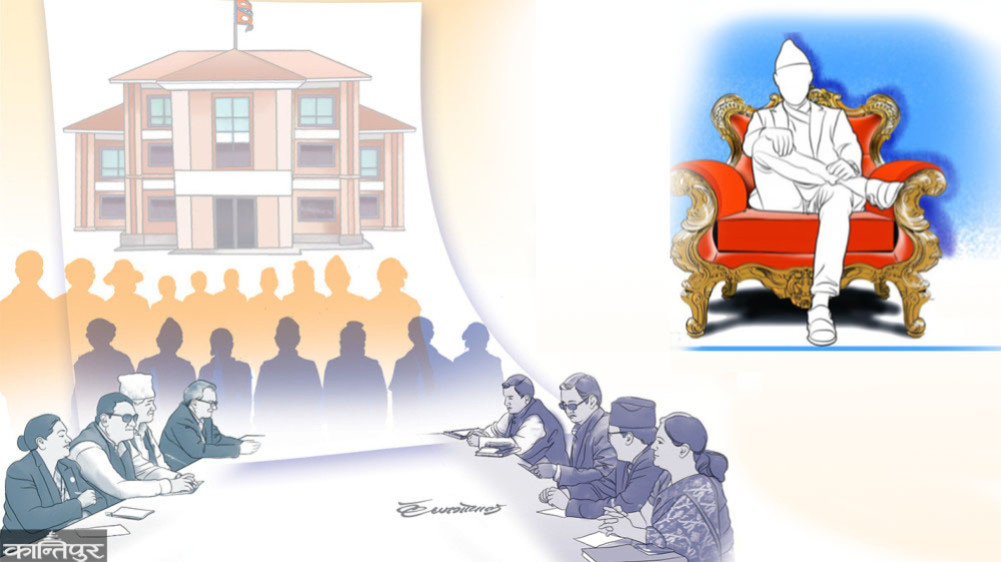
After the country went to federalism, the representatives elected in the two elections have practiced provincial governance. After the completion of the term of the previous State Assembly, the term of the second State Assembly is going on. In this second term, the provincial assemblies were busy with government building rather than law making. Therefore, essential legislative activities have also been affected.
Change of power 6 times in Koshi
In the two years of the second term of the state assembly, the state assembly of Koshi has changed power 6 times, but it has been very slow in making laws . According to Koshi State Assembly Secretary Gopal Prasad Parajuli, 76 Acts have been made in Koshi State during 7 years. During the first term of the Parliament, 63 laws were enacted and 13 laws were enacted in the two years of the second term. In which there are the provincial financial procedure 2074 to the bill made to amend the provincial civil service act, 2079 . Parajuli said that no bill is stuck in the parliament.
A total of 68 meetings have been held till the fifth session of the second term of the Provincial Assembly. While in the previous term, up to the fifth session, the Provincial Assembly had sat 170 times. Until the fifth session, MP Mohan Maharjan of Congress Jhapa has attended the least 38 days . Maximum 6 MPs have attended. Among them are Sheela Dixit Karki, Lalithakumari Chowdhury and Khadga Bahadur Basnet MPs from Morang. They have attended the meeting on 68 days. Similarly, Kamala Darnal of Tehrathum, Ramesh Kumar Basnet of Sunsari and Hom Bahadur Thapa of Jhapa also attended the meeting every day, according to the Parliament Secretariat. Chief Minister Hikmat Kumar Karki has attended the Parliament for only 58 days . "This indicates that there is a lack of necessary business in the House due to political instability," said Kamal Prasad Zawegu, MP of the United Socialist Party, "Especially, it seems that the House is running only for formalities."
In the previous term, both the parliament and the government were in rhythm, due to which the discussions on the bills and the debates on the issues of public concern could continue . However, since the beginning of the second term, the parties involved in power politics have not been able to make the government and parliament effective, says Bhaktiprasad Sitaula, the leader of the RPP parliamentary party. "When the government was changed six times during the second term, the people are more dissatisfied with the state government," he said, "when the state government was limited to political manipulation rather than delivering to the people, the parliament could not function properly." It is sad that they cannot spend even 15 percent.
Madhesh Pradesh Sabha: Slow second term
In the Madhesh Pradesh Sabha meeting held after 4 months on 23rd January last, Chief Minister Satish Kumar Singh admitted that there was some delay in calling the meeting when most of the MPs complained that the problems of the people could not be addressed due to the delay in calling the meeting. Although it was called late, the fourth session of the state assembly became turbulent. The resolution proposal brought by the consumer committee to advance the plan and the new bill brought by the Madhesh province government to determine the working language of the province have increased both controversy and debate. After Singh of the Janmat Party, who replaced the Jaspa-led government and took over the reins of power on May 25th, became the Chief Minister, the budget that was brought included the provision of development works through the tender process . However, Chief Minister Singh was unable to manage the budget even for 6 months and was forced to bring a resolution proposal.
After pressure from the ruling party Congress, UML and LOSPA, LOSPA MP Rupakumari Yadav submitted a resolution proposal in the state assembly meeting last Sunday. The resolution proposal brought to reverse the decision of the Madhesh state government in 081/082 to do development work through open competition (contracting) was passed by the majority. Jaspa Nepal and Maoists (Center) voted against the resolution proposal.
Similarly, the Madhesh state government's bill for working language in the state assembly last Wednesday has come under controversy. The meeting of the Provincial Assembly held on Thursday was disrupted after the opposition to the language bill. In last Friday's meeting, the language bill was withdrawn. Protests were being made outside and outside the meeting of the state assembly saying that languages such as Tharu and Magahi were not included in the language bill of the state's government employees. Rani Kumari Tiwari, Minister of Education of the Madhesh State Government, presented a bill in the state assembly meeting to make Maithili, Bhojpuri, Bajjika, Hindi and English the official languages along with Nepali. The Tharu community also has a majority in Madhesh province, and there is opposition that the Tharu language spoken by them is not included in the bill. The Magahi speakers also demonstrated outside last Thursday when the state assembly meeting was going on.
During the second term of the provincial government, the meeting of the provincial assembly has rarely been held in Madhesh . After the 11th meeting of the fourth session of the Provincial Assembly held on Friday, the meeting of the Provincial Assembly has been suspended until further notice. After Singh became the Chief Minister on May 25, the Provincial Assembly Secretariat has said that the Provincial Assembly meeting has been held 32 times under the third session.
In the second term, 9 bills have been passed and verified by the state assembly. In which the bill made regarding the protection of girls and the bill made to make provisions regarding the state sports development are important . In the second term, the state government has registered 12 bills in the state assembly. 9 of which have been verified, the State Agricultural Development Act-2080 has been sent to the parliamentary committee for discussion, while the bill regarding the development and promotion of tourism in Madhesh is currently under discussion in the State Assembly.
In the first term, 48 bills were introduced. In which the Bill-2075 made to make provisions regarding provincial police service and the Bill-2076 made to make provisions regarding the formation, operation and conditions of service of the provincial civil service were important . Even though Madhesh state government is the first state to introduce a bill related to state police service, this bill has not yet been implemented.
Half of the laws in Bagmati are still not made
The Wagmati State Assembly has not been able to create the necessary laws even after completing seven years of its establishment . Wagmati, which has identified 99 laws to fully empower the province, has created only 48 basic laws so far. Which is half of the identified original act . The Bagmati government, which has created many laws of the single rights list, has not been able to create laws that are in the common rights list with the Union government. Although some laws have been created by bypassing the federal government, the state has claimed that due to the changes in the power equation at different times, the state has not been able to accelerate the creation of laws.
84 of the 91 laws registered in the Bagmati State Assembly have been passed by the State Assembly. Out of which 16 are under consideration and one is under consideration . 70 Acts were passed by the first Provincial Assembly, 12 Acts were enacted after the second Provincial Assembly started. Since the establishment of the provincial government, 14 ordinances have been approved by the provincial assembly, while 5 have been inactive, according to the provincial assembly secretariat.
At present, four revised laws have been registered by the government in the state assembly and tabled in the house. The spokesperson of the government and Minister of Internal Affairs and Law Surajchandra Lamichhane informed that the discussion on the law registered in the assembly will begin from the winter session.
Government spokesperson Lamichhane said that problems are being created when the federal government does not delegate the rights in the constitution to the provinces. "The union's view of the state is wrong." The right to give is not given in the constitution. As a result, the province has not been able to work at its own speed. Minister Lamichhane said, "If the union has speedily drafted the law on the list of common rights, we have no problem in drafting the law." He pointed out that when the parties are in power and in the opposition, they are playing different roles in law making. The Constitution has provided for the basic structure of the state to be operated from the union, state and local levels under the federal structure. There is a constitutional arrangement to be based on the principle of relationship, cooperation, coexistence and coordination between the union, state and local levels. In practice, the federalism union is controlled. The state government has not been able to get the rights provided in the constitution. As a result, we could not work visibly," Minister Lamichhane said. He said that the province cannot function fully until the police, administration, industrial sector, Guthi Bill and other laws are made. Since the establishment of the state assembly till now, five chief ministers have been elected except for the transformation of Hetaunda from temporary capital to permanent capital and naming. So far, 79 people have been made ministers in the state assembly. From the two parliaments formed after federalism, UML, Maoist Center, United Socialists and Congress have got MPs from the state assembly for the leadership of the government.
52 million spent to pass 10 bills in Lumbini
14 bills have been registered in Lumbini State Assembly in 26 months. 10 of them have been passed and become laws. There are only 4 of the 10 basic laws . Of the rest, 4 are annual (budget related) and two are amendment bills . The state assembly has spent more than 52 million 15 million rupees to prepare 10 bills including amendments, amendments and originals. So far in the second term, a total of 79 meetings have been held in the Provincial Assembly. During the 6 sittings of the current session, two bills have been registered and are under discussion.
10 meetings were held in the first session of the Lumbini State Assembly. Only 2 bills were registered in the first session. 25 meetings were held in the second session. The second session passed 4 bills. The third session ended with only 3 meetings. 35 meetings were held in the fourth session. The fourth session has passed 6 bills with amendment and original. In the current fifth session, 6 meetings have been held so far.
According to the Information Officer of the State Assembly, Yajyan Subedi, 14 bills have been registered in the State Assembly during the 26 months of the second term. Among them, 10 bills have been passed. 2 Bills are under consideration in the State Assembly. "So far, 10 bills have been passed," she said, "there were 73 meetings held in the previous four sessions, and 6 meetings have been held in the current session." She said that she has reached the subject committee for weekly discussion.
83 bills were registered in the first term of the Lumbini State Assembly. 73 of them were passed and verified. During the 26-month period of the second term, the Provincial Assembly passed a bill to establish, operate and manage the Lumbini Training Institute, a bill to regulate the formation, operation and conditions of service of the provincial civil service, a bill to regulate the formation, operation and conditions of service of the provincial local service and the provincial disaster 4 main bills were passed as a management bill. Two bills related to personnel have been verified after being re-passed and sent by the current fifth session after being returned from the head of the state . In order to pass the four main bills up to the fourth session, more than 52 million 15 million rupees have been spent on service facilities including officials and employees of the Provincial Assembly. According to the Accountant of the Provincial Assembly, Binod Neupane, in the first year of the second term of the Provincial Assembly, 20 million, 67 lakh 74 thousand rupees were spent. Similarly, in the second year 2080/081, 22 crore 47 lakh 75 thousand rupees have been spent. 15 million is spent monthly on Sardar in the state assembly . According to that, more than 9 crores have been spent from July to the middle of the current year.
in Karnali from the beginning of accusations
After almost 3 and a half months, the fifth meeting of the second term of the Karnali State Assembly started on the 7th of January. In Karnali, the law-making work has been slow since the beginning, and since the government is unable to do business, the parliament has become a platform for political accusations and counter-accusations. In the 2 years of the second term of the State Assembly, a total of 7 laws have been enacted. Out of which 4 bills are made only for the work of the provincial assembly and the government, while the number of laws made for public importance is only 3 . Karnali Province Training Institute Establishment and Operation Bill-2080, Karnali Province Civil Service Formation and Operation and Service Conditions Bill-2080 and Only the Bill-2081, made to regulate the formation, operation and conditions of service of local services, is of public importance.
In the first term of the state assembly, 53 laws were made and the Karnali state economic bill 2080 and 081 and Karnali Province Appropriation Bill 2080 and 081 are only related to the work of the government. During this term, 14 bills were registered. Currently, 4 bills have been sent to the subject committee, while 4 bills are yet to be discussed in the state assembly, said Madan Khadka, legal officer of the state assembly secretariat. According to him, 3 of the 4 committees in the Karnali Provincial Assembly were without leadership for almost 6 months, due to which the discussion on the bill that went to the committee was affected. He said that he selected the leadership of that committee only last Wednesday. "Committees also need to be active to make the Parliament functioning," he said.
According to the Secretariat of the Provincial Assembly, the bill made to make provisions regarding the electricity of Karnali Province, the bill made to make provisions regarding the Karnali Province Police Service, the bill made to amend the Karnali Province Sports Development Act 2076 Bill & The bill made to make arrangements for the empowerment of the Dalit community and the promotion of living standards has now gone to different committees and is stuck. In the second term, the state assembly has spent nearly 19 million rupees.
Attorney Durga Prasad Sapkota said that due to power struggle, central power equation change, dispute over share sharing between the power partner parties, the Parliament could not function in Karnali. According to him, even during the first term, the MPs were engaged in political quarrels for a long time. Civic leader Narendra KC says that the government has not given enough business to the Parliament. "Parliament is a place to talk about people's problems, to put pressure on the government for solutions and to speed up the creation of laws," he said. He said that the government is also failing to proceed with the new process of nearly a dozen bills of public importance that were inactive during the first term of the state assembly.
The Secretariat of the Provincial Assembly has informed that 111 meetings were held in the second term of the Provincial Assembly. According to the secretariat, 15 meetings were held in the first session of the Karnali Parliament, 39 in the second, 11 in the third, 33 in the fourth and 3 in the fifth session. Deputy Speaker Yasoda Neupane said that efforts are being made to give sufficient business to this time's Parliament meeting. She informed that initiatives are being taken to open the blocked parliament.
New laws in Far West in two years zero
The Sudurpaschim Provincial Assembly could not make a single new law for two years . Instead, four governments were changed during this period . In the two-year period of the second term of the Provincial Assembly, the Secretariat of the Provincial Assembly has stated that there is no work in law making except passing the budget twice and passing five amendments to laws and one regulation.
Dharmaraj Pathak, a member of the state assembly of the current ruling party UML, said that it is a well-known topic that time is running out during the change of government. "During this period, no government has given priority to law-making, so the meetings of the provincial assembly have not been effective," he said, "more work will have to be done in terms of law-making." Bill made to amend, State Disaster Risk Reduction and Management Act 2075, Bill made to amend Public Document Verification (Procedure) Act 2075 The bill to amend the Far Paschim Province Economic Act 2079 has been passed. Last Thursday, the amendment of the bill related to Pragya Pratishthan was also passed. 14 bills including bills and amendment bills were registered in the state assembly of the second term.
According to the Secretariat of the State Assembly, 67 laws including 34 original laws were enacted during the two-year period of the first term of the State Assembly. Speaker Bhim Bahadur Bhandari says it is time to audit the law. "It is useful to make the desired law and keep the law made before only on the basis of necessity," Speaker Bhandari said ; Even now, the chairman of the committee has not been elected. There are four parliamentary committees and three committee chairpersons have been chaired by ministers at various times. Bir Bahadur Thapa of UML, who was previously the chairman of the Public Accounts Committee, became the Minister of Land Management, Agriculture and Cooperatives, and the position of chairman of the committee has been vacant since 21 July 2081.
The post has been vacant since May 28, 2081, when Maya Pant of the United Socialist Party, who was the chairperson of the Social Development Committee, became the minister. Ghanshyam Chaudhary, the leader of the parliamentary party of Civil Liberation Party, who is the chairman of the Economic Development and Natural Resources Committee, has been vacant since 25th February 2080 after becoming the Minister of Economic Affairs. There is a provision that the chairperson of the committee must step down after the MP who is the chairperson is appointed as a minister. Apart from the Legislation and Provincial Affairs Committee, three other committees are leaderless. Meanwhile, to arrange the share between the ruling parties, they have increased to five by adding one committee. During this period, two hundred and three meetings of the parliamentary committees have been held by the Provincial Assembly Secretariat.
52 meetings of the Social Development Committee, 55 of the Legislation and Provincial Affairs Committee, 39 of the Economic Development and Natural Resources Committee and 57 of the Public Accounts Committee have been held. During the second term of Sudurpaschim Pradesh Sabha, five sessions have been held. 74 provincial assembly meetings have been held in all five sessions till last Thursday.
in Gandaki Difficulty in using natural resources
After 7 years of formation of Gandaki Provincial Assembly, 72 laws have been enacted. When the federal government does not bring the law, there is a challenge in the implementation of the law in some states. According to Baburam Gautam, spokesman of the office of the Chief Minister and Council of Ministers of Gandaki, in order to facilitate the implementation of federalism, the laws made in the province have not been effectively used due to the lack of clarity in the work detailing report containing the list of powers of the three levels of government. He said that because the federal parliament did not enact some laws, the jurisdiction of the local government could not be identified. "The matter of forest protection is under the jurisdiction of the province, we have made the Forest Act according to that," he said, "but because the federal law is not clear, it is difficult to implement it." There are two protected areas in the state namely Annapurna and Manaslu. There is no revenue for the local level and the province.'
He said that although the province has the right to monitor and regulate mining and minerals, the province is not able to collect revenue due to the law giving permission by the union government. He said that since the union government did not amend the laws related to mining, the province was not getting the revenue from the use of natural resources. According to him, the Gandaki state government has prepared to introduce 3-4 new bills in the parliament session starting from January 21. In-principle consent has been taken from the Council of Ministers for drafting bills related to the survey of minerals, electricity bill, film screening bill, Dalit bill, etc. The Ministry of Social Development, Youth and Sports has prepared a draft regarding the Dalit Bill and is holding discussions with stakeholders.
In the second term of the Gandaki State Assembly, 70 meetings have been completed till the sixth session. The first provincial assembly meeting was held on January 18, 2079, and the last meeting was held on August 26. During this period, the state assembly has passed 12 bills. In the first session of the Provincial Assembly, a bill to amend the Appropriation Act 2079, a bill to amend some Gandaki Province Acts, a bill to make provisions regarding the formation, operation and service conditions of the civil service of Gandaki Province and a bill to make provisions regarding the formation, operation and service conditions of local services Passed. In the fourth session, Finance Bill, Appropriation Bill, Forest Bill, Mass Communication Bill and Seed Bill were passed. In the sixth session, a bill to amend the Private Firm Registration Act, 078, a bill to make provision for the allocation and spending of funds from the Provincial Reserve Fund for the services and operations of the fiscal year 081/082 (Appropriation Bill) and to implement the financial proposal of the Government of Gandaki Province Bill made, 081 has been passed .
Five of these are regular financial and appropriations acts . Gandaki State Civil Service Act, 2079, Local Service Formation and Operation Act, 2079, Gandaki State Forest Act, 2080, Mass Communication Act, 2080 and Seed Sowing Act, 2080 are newly added laws. Some are the Gandaki State Act Amendment Act, 2079 and the Private Firm Registration Act Amendment Act, 2081. Gandaki State Assembly Rules, 2080 have been passed during this tenure.
At present, various committees are discussing the Bill 080 regarding the construction, expansion and maintenance of public roads in Gandaki Province, the Bill regarding the management of pesticides and the Bill regarding the regulation and management of Gandaki Provincial Assembly Partnership Firm. According to Prem Subedi, Information Officer of the State Assembly, the Auditor General's report has been discussed in the Public Accounts Committee of the Parliament. He said that 5 reports from the financial year 074/75 to 078/079 were discussed.
"In the first term of the state assembly, no conclusion could be reached after such a discussion," he said. The implementation of the instructions given by the
committee is not satisfactory. Although the Finance and Development Committee has amended the law, the directive to hold the pre-budget discussion in February could not be implemented. According to Padmaraj Baral, the Accounts Officer of the State Assembly Secretariat, nearly one lakh rupees are spent on one day's sitting of the Parliament. Provincial Assembly members get 1000 rupees for meeting allowance and 750 rupees for transportation expenses. The number of state assembly members in Gandaki is 60. Employees working in meetings also get meeting allowance . He said that nearly 70 lakh rupees were spent during 70 meetings in the second term.
In the financial year 080/81, 15 crore 42 lakh 44 thousand rupees were allocated for the operation of the state assembly. Out of that, 138 million 887 thousand rupees were spent on the conduct of meetings, services and facilities of members of the provincial assembly, expenses of the speaker and deputy speaker, expenses of the secretariat of the provincial assembly.
–
mountain portal
(Viratnagar), Ajit Tiwari (Janakpur), Subas Vidari (Makwanpur), Ghanshyam Gautam (Butwal), Krishna Prasad Gautam (Surkhet), Arjun Shah (Dhangadhi) and Deepak Pariyar (Pokhara)