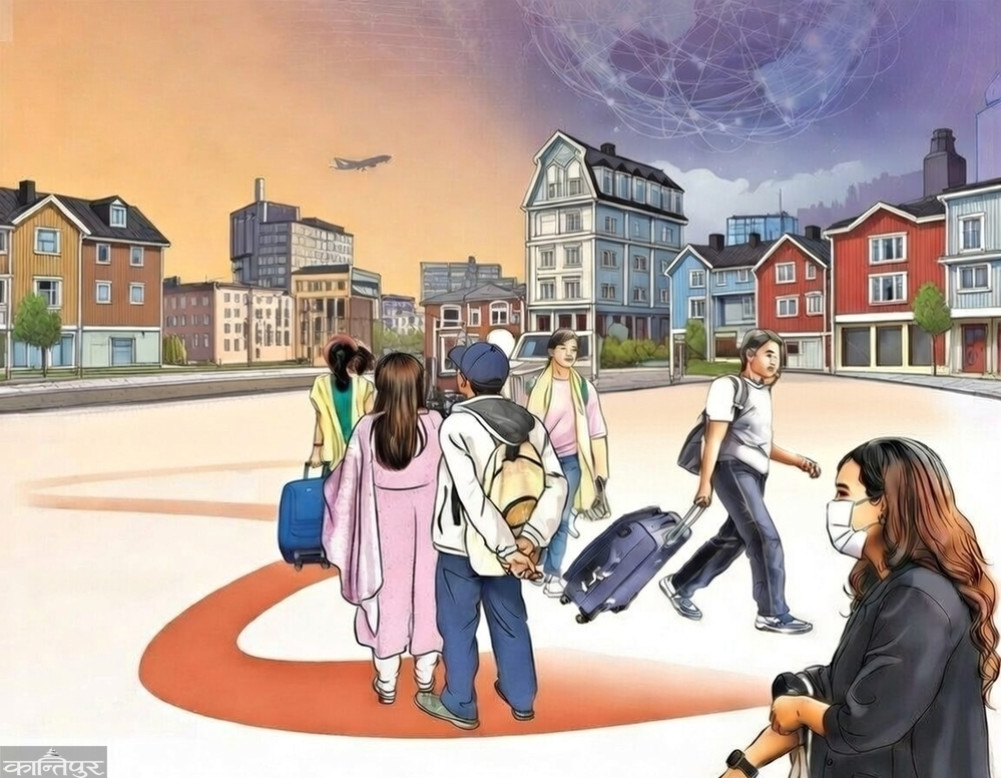
Photos add to the illusion—snow, clean streets, a beautiful library. But photos don't show fatigue, unemployment, or a tired mind from looking for a job all night.
We use Google Cloud Translation Services. Google requires we provide the following disclaimer relating to use of this service:
This service may contain translations powered by Google. Google disclaims all warranties related to the translations, expressed or implied, including any warranties of accuracy, reliability, and any implied warranties of merchantability, fitness for a particular purpose, and noninfringement.
A large number of Nepali Gen-Gs came to the Nepal stand. They couldn't resist seeing Nepal from afar. When they were at home, they didn't understand what the country was or didn't try to understand it. Brother, it's also a pleasure to hear you guys chatting in Nepali. Their conversations never stopped.
The college had brought them to participate in a tourism fair organized in Helsinki, Finland. They were happy to return carrying the country's flag. The country was in their hearts, yes. No matter what they were called fugitives in their own country, no one who struggles abroad has forgotten home.
They were teasing each other, saying that they would return to Nepal in a few days and that they had come from Nepal. Perhaps the thought of when the day would come to go home had weighed them down. Suddenly, one of the sisters asked, 'Will we get a job after we finish our studies?'
Not very loudly, but with a very deep meaning. The afternoon light was slowly fading. Students were walking around—some with coffee in their hands, some with headphones in their ears. But our conversation was stuck here.
Before I could say anything, another brother said, ‘It was easy before.’
Another added, ‘Now more people have come.’
The Nepali struggle in Finland is not a story of failure. It is the reality of time, numbers, expectations and a sluggish economy. Perhaps our real education is not in the classroom—it is in these unfinished conversations that change us more than degrees.
In the last few years, Finland has suddenly become a popular destination for Nepali students. This popularity is not because Finland is a country of extraordinary opportunities, but rather because other traditional study destinations are gradually closing. Earlier, the UK and Australia were the main destinations for Nepali students. But visas became stricter. The doors were getting narrower. And at that time, Finland came as an alternative—quiet, clean, safe, and good education, it was said.
Especially after Australia started tightening its rules for students with gaps in their studies, the list of options for many Nepalis became shorter. In this context, Finland seemed like an open door—where the possibility of getting a visa regardless of educational background, college fees that could be paid relatively easily, and the provision to bring dependents were the main attractions.
These conversations are no longer new. These questions are being asked everywhere in the campus canteen, kitchen, bus stop, tram, train.
This is what brought many here. Most couples came. Some got married quickly, some changed their plans to make Finland their destination. The calculation was made in Nepal—about five million rupees for two people. Land was sold, loans were taken, gold was kept. Everyone had the same hope—‘Something will happen after reaching Europe.’
After coming here, another story began. Studies are still going on on campus. But along with studies, another struggle is also going on—finding a job.
‘I emailed 20 places for a job,’ one said.
‘Did you get a response?’
‘Oh no.’
Today, Finland has about 11 percent unemployment, which is considered the highest among the Schengen countries. Everyone has had a similar experience. Some have found work, but it is not related to their degree. Some are cleaning, washing dishes. Some are still looking. Another fear of receiving unemployment benefits has begun—that they will be deported. At first, the benefits they receive seem like a relief, but when they do not find work, even that is not enough.
Language is another big barrier. It is no longer just an excuse for not getting a job, it is a reality. Many doors do not open until you know the Finnish language. If you have a degree, but do not have the language, the job is far away. Without experience, there is no opportunity, and without opportunity, there is no experience—many are trapped in this cycle.
Finland's employment system is fair, but not easy. No one is given a job out of kindness here. Experience is needed, language is needed, patience is needed. The economic recession in Finland has made the situation even tougher. Fewer jobs, more job seekers.
Today, Finland has about 11 percent unemployment, which is considered the highest among the Schengen countries. The job market is not growing, it is declining. The economy is slowing down. Finland's social security, which was previously considered an example of social security, has also been weakening in recent days. State support given to the unemployed is being reviewed, the rules are becoming stricter. This has made it uncomfortable not only for foreigners, but also for local Finnish citizens. In such a situation, the idea of working while studying, and having dependents get jobs and support their families is becoming more and more distant.
In the last three years alone, about five thousand Nepalis have come to Finland. With this, the total number of Nepalis here has reached about fifteen thousand. Most Nepalis work in restaurants. These areas are already full. Work is limited, competition is fierce.
In the evening, the conversation picks up again.
‘What will you do after school?’
‘Will you stay here or go to another country?’
‘Will you return to Nepal?’
No one hears these questions in Nepal.
Messages from friends come from Nepal.
‘You are lucky.’
‘Life in Europe must have been set.’
The photos add to the confusion—snow, clean roads, beautiful libraries. But the photos don’t show fatigue, don’t show unemployment, don’t show the tired mind from looking for a job all night.
What’s surprising is that when someone returns to Nepal—even for a few days—there is a different reaction.
‘Why did you return so soon?’
‘You should have stayed longer, right?’
‘You can’t survive even if you go to Europe?’
Lucky when you are here, stupid when you return—between these two poles lies the reality of Nepali students.
Finland offers many things—education, security, respect, peace. But it does not offer one thing—guarantee. There is no guarantee of getting a job after studying. Even if you work hard, it takes time. Sometimes it takes more than time.
The same sister asks again, ‘You can get a job after studying, right?’
This time I say, ‘Some people get it, some find it difficult. It is not easy.’
This answer may seem incomplete. But this is our reality. The struggle of Nepali students in Finland is not new, nor is it just a success story. It is a journey of questions, dialogues, and decisions.
Perhaps the biggest lesson here is this—life sometimes gives us experiences, not answers. And that experience becomes our true degree.