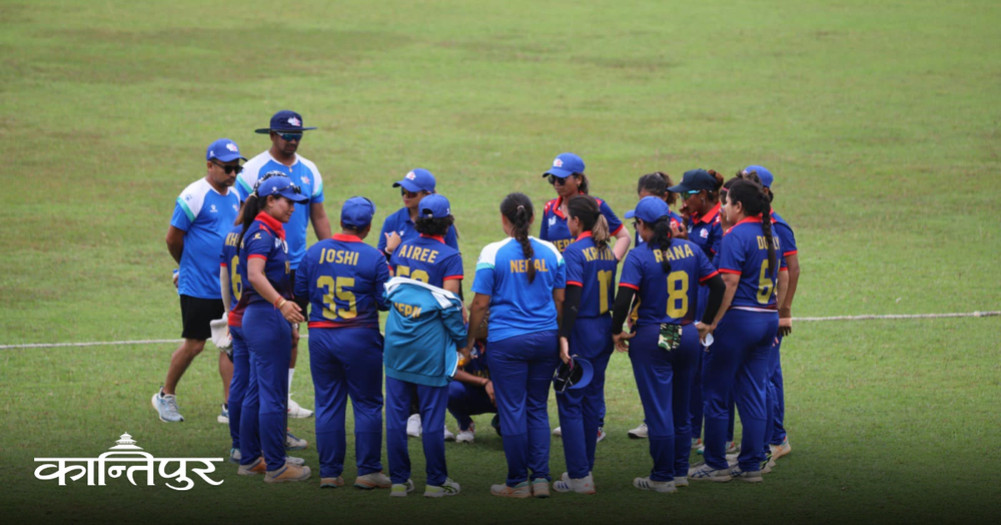
Just like the audience is enjoying the sixes of players like Rohit Paudel, Kushal Malla and others, I like to enjoy the fours and sixes of Indu Burma, Rubina Chhetri, Pooja Mahato.
We use Google Cloud Translation Services. Google requires we provide the following disclaimer relating to use of this service:
This service may contain translations powered by Google. Google disclaims all warranties related to the translations, expressed or implied, including any warranties of accuracy, reliability, and any implied warranties of merchantability, fitness for a particular purpose, and noninfringement.
My first experience of cricket is filled with childhood memories. I was eight years old and almost nine, when I saw my friends from the village playing with bats and balls. At that time I neither understood the rules of cricket, nor did I know its depth. However, that glimpse of the game planted a deep curiosity in my heart.
It was a new world, which I found as fascinating as it was strange. There was a distinct sense of excitement, which inspired me to understand the message and importance of this game .
My childhood was spent in the capital of cricket, Biratnagar. While I was growing up in Biratnagar, it has been 17 years since I entered Kathmandu, the capital of the country, looking for a future. When I was growing up in Biratnagar, cricket was dominated by boys. While the society of the time kept the field open for boys, such things were very restricted for girls.
In the school classroom, on the playground, and in the adjacent tea shop, Tareli boys used to discuss the names of the players, the statistics of the runs, and the strategy of the game. In that group of boys, the presence of girls was nil. Our society probably could not accept the natural presence of girls in such places which are known as boys' areas.
But, a question arose in my mind - why is there this discrimination in sports between women and men? This question has been bothering me for a long time. Society said that sports were only for boys, and this perception kept us girls in a cage and stifled our desires. But times have changed. Now, we are seeing women athletes changing the mindset of the society. Pooja Mahato is a strong example of this. As she heads to Malaysia to play the U-19 Asia Cup, she has become the inspirational face of Nepali women's cricket.
The society at that time did not know that Samba was born from football, Saraswati Chowdhury was born from volleyball. Serena Williams, Martina Navratilova in world tennis are born. Mithila Raj is born in cricket. Nepalese society did not know that the girls of our country play in such a way that they will be talked about all over the world.
Challenging such mindsets and norms, women athletes have proven themselves to excel in sports. Together, they have changed the way society thinks and have shown us that women can face the same challenges as men in any field.
There is a celebration of cricket across the country at the moment. From social media to tea chowtari, there is talk of cricket. From running and sitting Baji Thapeka's face is full of excitement and joy in the support of his team.
More than 100 Nepali male cricketers are now competing in the Trivi cricket ground. On the other hand, Pooja Mahato has reached Malaysia to play the Asia Cup with the U-19 women's cricket team. It is clear from this that the situation of women in our society is changing today than yesterday.
Now let's discuss the Nepal Premier League (NPL). It was half past one in the afternoon when I reached the ground of Trivi. The game had already started before I arrived. I had not reached the field, I was listening to the hooting and the hooting of the game from a distance. The game was on when I left. The spectators present at the
game were supporting their team with four-six written placards in their hands. When the wicket was taken, the ground would be resounded by the hooting of the Janakpur supporters, while the Chitwan supporters would stand on every four-six and clap and shout 'Go Chitwan Rhinos' and express their pride.
Chitwan had to win the game with Janakpur. After winning the toss, Chitwan batted first and set a challenging target of 181 runs. Janakpur, who started batting in response, got off to a bad start. Towards the end of the game, Janakpur's batting collapsed and Chitwan took the result in their favor without completing the entire over. Janakpur was all out before the last 2 overs . After beating Janakpur by 32 runs, Chitwan has reached the third place. Every moment of the
game, there was a mix of joy and sorrow from the audience. Family members, young and old, who were present on the ground, were supporting their team, showing joy and disappointment.
Cricket is not just a medium of entertainment, it is also a bridge between generations. Cricketer Brian Lara reached the Trivi ground to encourage the players. Who is one of the greatest cricketers in the world. His presence also reflected the importance of NPL and Nepali cricket. This game has succeeded in bringing every member of the family together. We have also seen that competitions like the Nepal Premier League have brought all generations together.
I was also attracted by this festive atmosphere. The new structure, changed pitch, added technology in the Trivi cricket ground was completely different inside and outside the boundary. I had a mixture of emotions as I reveled in this atmosphere. I was imagining Women's Nepal Premier League. Just like the audience is enjoying the sixes of players like Rohit Paudel, Kushal Malla, I like to enjoy the fours and sixes of Indu Burma, Rubina Chhetri, Pooja Mahato.
How the teams are formed in the name of the city of each province. It was extending cricketers from Mechi to Mahakali, Koshi to Karnali. On the other hand, it served as a milestone to strengthen nationalism emotionally. Lokesh Bam from Sudurpaschim is playing from Biratnagar. Arif Sheikh from Madhesh represents the Far West. Nepali male cricketers have got the opportunity to play in the league with up to 2 million. In the same way, it would have been more exciting to see the Nepali Women's Cricket Premier League where women players from the state to the international team could earn up to 20 lakhs in a month.
I was thinking, this league has unified not only Nepal but sports lovers from all over the world. It has played a big role not only in the sports sector of Nepal, but also in building the international image of the country. This competition gave us such a moment, which we never imagined. Shikhar Dhawan, Martin Guptill will one day captain our Sompal Kami, Sandeep Lamichhane .
It has taken the height of our country's sports to another level. The investment in this league and the income of the players sent a message that there is a future in the sport too . Apart from introducing Nepal to the world, it also brought sports lovers together . Nepalese cricketers have opened the way to stand in the famous leagues of the world. On the other hand, the youngsters studying in the village definitely learned something from the famous players from abroad.
Women's cricket needs a similar opportunity now. What a blast it would have been to play on the same field with world famous women cricketers Laura Wollvardt, Chamri Atapattu, Beth Mooney, Tahila McGrath under the leadership of Indu Burma, Rubina Chhetri, Sita Rana.
Nepal Cricket Association (CAN) now needs to make a plan for a similarly organized Women's Premier League. If the private sector, ready to spend crores of rupees to form a team for the men's league, also shows leadership, the women's league is also not impossible. This would certainly increase the exemplary position of Nepali women cricketers in world cricket. And, Nepal would not stay away from the World Cup title forever.