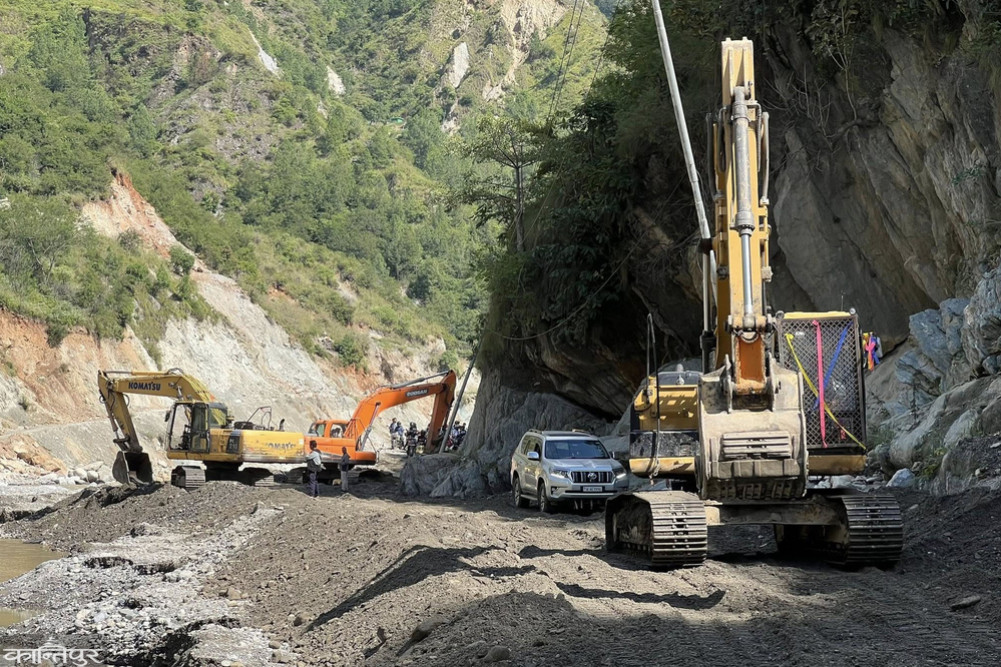
With the monsoon season in mind, work is underway to ensure that within a few days, full vehicular movement will be possible on the reconstructed sections of the track.
We use Google Cloud Translation Services. Google requires we provide the following disclaimer relating to use of this service:
This service may contain translations powered by Google. Google disclaims all warranties related to the translations, expressed or implied, including any warranties of accuracy, reliability, and any implied warranties of merchantability, fitness for a particular purpose, and noninfringement.
Repeated floods and landslides have damaged the BP Highway’s Kavre–Sindhuli section, which is now under reconstruction, and preparations have been made to reopen it within half an hour if it becomes blocked. With the reconstruction, vehicles will be operated on the newly rebuilt track within a few days, according to the Division Road Office Bhaktapur.
This highway, which connects Nepal’s eastern and mid-hill regions to the federal capital Kathmandu via a short route, used to be blocked as soon as it rained. Currently, the office has prepared to ensure the highway is not blocked during the rainy season, and if it does get blocked, to reopen it within half an hour.
“Taking the monsoon into account, full vehicular movement will be allowed on the reconstructed tracks in sections within a few days. Preparations have been made to reopen the road within half an hour if it is blocked due to disasters, and the necessary equipment has been kept ready for this,” said Office Chief Senior Divisional Engineer Suman Yogesh.
According to him, traffic is already operating on most sections that have been reconstructed at their original locations. Previously, temporary diversions were built in the river itself, so when the flow of the Roshi River increased, the diversion would be swept away and the road would be blocked.
According to Senior Divisional Engineer Yogesh, vehicles are being operated on the old track from Chaukidanda to Katunjebesi, Lashkot, Char Sayabesi, Narke, Chiuribas, and Boksi Kuna up to Piple. The office has identified Chaukidanda, Char Sayabesi, Ghumaunebesi, Boksi Kuna, Chiuribas, Kaladhunga, and the Piple–Barkhekhola area as high-risk locations. Gravel work has been done at damaged sites, and in some places, large stones have been placed to prepare the road for the rainy season.
The floods and landslides of Ashoj 2081 (September/October 2024) damaged about 30 kilometers of road from Bhakundebesi to Nepal Thok on the highway. The temporary diversion built in the Roshi River to allow vehicle movement was also swept away by the floods.
Of the four damaged sections, the 3.2-kilometer stretch from Barkhekhola to Piple is being constructed by the Japan International Cooperation Agency (JICA). JICA is filling soil and placing boulders (large stones) on that section. Under the highway, four contract packages have been made—three on the Kavrepalanchok side and one on the Sindhuli side.
“The reconstructed road section will be two lanes. Along with the existing bridge, another new bridge will be constructed,” said Yogesh. According to him, there are plans to convert five bridges into two lanes. Of the total 29.5 kilometers of damaged road, JICA has agreed to provide a grant equivalent to Rs 2.63 billion for the 3.2-kilometer stretch from Barkhekhola to Piple.
With grant assistance from the Government of Japan, construction of the BP Highway (Dhulikhel–Sindhuli–Bardibas 160 km road) began in fiscal year 2053/54 (1996/97).