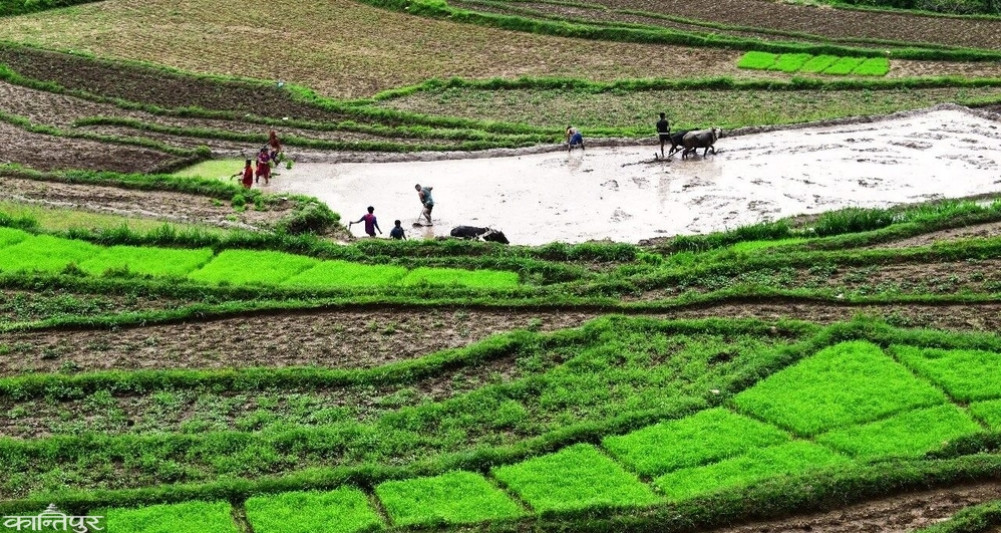
Even though Paddy Day is celebrated on Asad 15, farmers in Ramechhap are anxiously awaiting the rains, fearing that the slow planting will affect production.
We use Google Cloud Translation Services. Google requires we provide the following disclaimer relating to use of this service:
This service may contain translations powered by Google. Google disclaims all warranties related to the translations, expressed or implied, including any warranties of accuracy, reliability, and any implied warranties of merchantability, fitness for a particular purpose, and noninfringement.
Asad 15, which is associated with the belief that rice will grow by planting it, is celebrated as Paddy Day across the country. Amidst the excitement of the festival, which includes playing in the mud, planting rice, and eating curd and chiura, most farmers in the district are still waiting for water.
The 23rd National Paddy Day and Planting Festival, with the main slogan 'Climate-friendly technology, self-reliance in rice and prosperity', has been celebrated in the traditional style by all local levels of the district by planting rice, playing in the mud, organizing cultural programs, and eating curd and chiura.
The Agricultural Development Office, Ramechhap, also officially celebrated Paddy Day. However, the planting situation in farmers' fields has been much slower than expected.
According to Pramod Prasad Dahal, head of the Agricultural Development Office, Ramechhap, only about 20 percent of the area has been planted in the district as of Asad 15. 'Sowing is underway in areas with irrigation facilities,' he said, 'but most of the paddy fields that depend on rain have not yet been planted. We expect that if there is good rain, planting will pick up speed.'
According to the office, 7,889 hectares of paddy should be cultivated in Ramechhap. But due to lack of sufficient rain, most of the fields are barren. 22 percent of the planting was completed by the same period last year. This year, the office's statistics show that there has been even less progress.
A large area in Ramechhap's agricultural system depends on rain. Although farmers are busy planting in the fields of the valleys that have reached irrigation facilities, farmers in the paddy fields are looking at the sky and waiting for water.
According to Raj Shrestha, a farmer from Manthali Municipality-9, there has been no rain since the beginning of Ashar this year. 'In our area, sowing is done until the end of Shrawan,' he said, 'right now all the farmers are waiting for rain to fall and start sowing.'
Although it rained until mid-Jeshtha, he said that there was no rain except for occasional showers after Asard. Farmers in Ramechhap are worried that the drought that lasted until mid-Asard has directly affected their paddy production. Farmers complain that late sowing reduces production, increases the risk of diseases and pests, and delays the ripening of the crop. According to the Agricultural Development Office, the average productivity of paddy in Ramechhap is currently 2.17 metric tons per hectare.