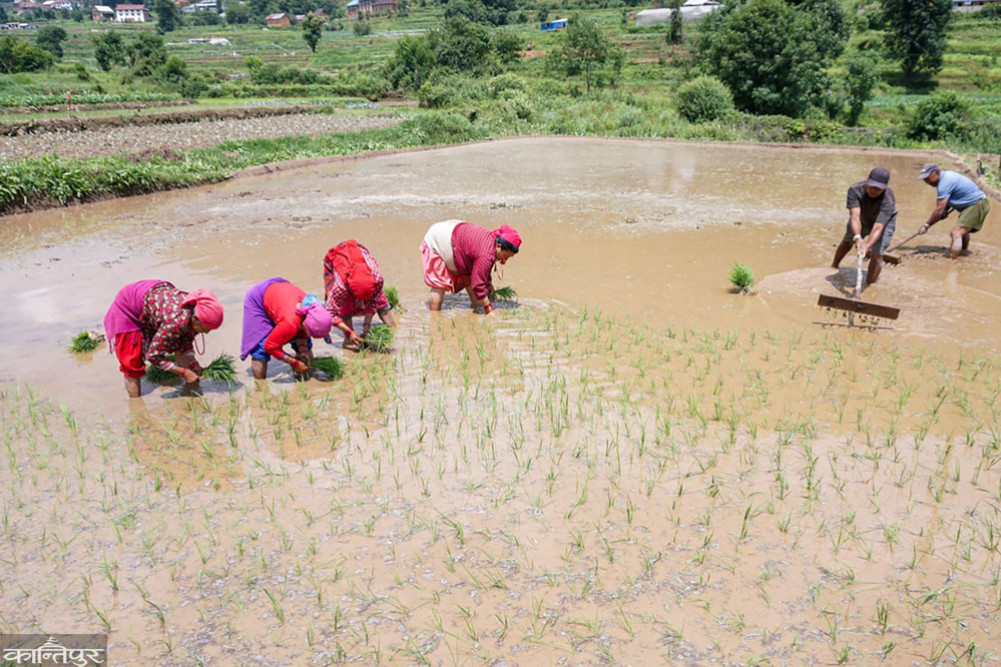
Rice planting has been very slow this year compared to last year, and due to the lack of rain, farmers are finding it difficult to even save their paddy fields.
We use Google Cloud Translation Services. Google requires we provide the following disclaimer relating to use of this service:
This service may contain translations powered by Google. Google disclaims all warranties related to the translations, expressed or implied, including any warranties of accuracy, reliability, and any implied warranties of merchantability, fitness for a particular purpose, and noninfringement.
Paddy sowing in Bagmati Province has become very slow due to the failure of monsoon to become active. Due to insufficient rainfall, farmers are finding it difficult to even save paddy fields in most places.
Till Asad 12, only 3.50 percent of the total cultivable area has been sown in 13 districts of the province. Sowing was completed in more than 16 percent of the area during the same period last year.
Sujan Kandel, spokesperson for the Bagmati Province Ministry of Agriculture and Livestock Development, said that sowing has been significantly affected due to the lack of monsoon rains. He said that sowing has lagged behind last year. According to him, out of the 135,868 hectares under annual paddy cultivation in the province, only 3,654 hectares have been sown as of Friday.
The highest percentage of sowing has been done in Kathmandu, 40 percent. Out of the 5,959 hectares, paddy has been sown in 2,575 hectares, according to the ministry. The situation in Chitwan, which is considered the main area for paddy production, is disappointing. In Chitwan, only 1.3 percent of the 28,680 hectares of rice cultivation area has been sown as of Friday. The situation is even worse in Makawanpur. Only 0.35 percent of the area has been sown here.
Similarly, 3 percent in Nuwakot, 2 percent in Ramechhap, 5 percent in Sindhupalchowk, 16 percent in Kavre, 8 percent in Rasuwa, 10 percent in Lalitpur, 11 percent in Bhaktapur, 0.41 percent in Dhading, 4 percent in Dolakha and 4.2 percent in Sindhuli have been sown. Due to lack of rain, even the sown fields have started to dry up. Farmers have become more worried after the paddy has started to crack in many places.