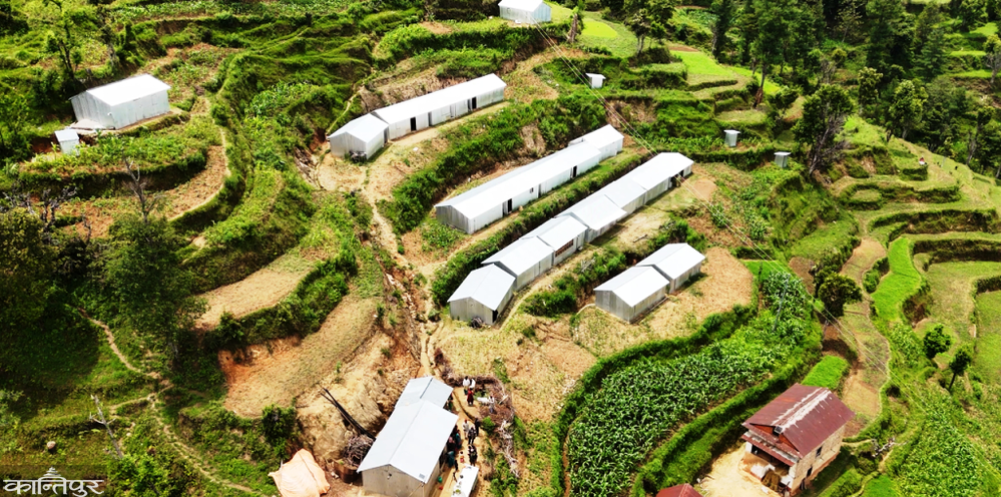
After the landslide of Bhadra 2081, 22 families from the Thami settlement of Pakha Tole have been struggling in tents due to lack of drinking water, electricity, and infrastructure.
We use Google Cloud Translation Services. Google requires we provide the following disclaimer relating to use of this service:
This service may contain translations powered by Google. Google disclaims all warranties related to the translations, expressed or implied, including any warranties of accuracy, reliability, and any implied warranties of merchantability, fitness for a particular purpose, and noninfringement.
There is a small hut made of zinc in a narrow settlement in Lower Majuwa, Doramba Shailung Rural Municipality-1. The same hut is now the home of Meenkumari Thami's family. But this house is not a choice but a necessity imposed by disaster.
With the incessant rains of Bhadra 8, 2081, the risk of landslides increased in the Pakha Tol settlement. The ground began to crack and flow . The settlement became unsafe. The fear that began after that forced Meenkumari's family to live under a tarpaulin for months . Finally, they left the house they had lived in for generations and moved to Lower Majuwa in search of a safer place.
But even the new place could not provide stability. The zinc hut built on a small piece of land bought with loans has now become their temporary shelter. A one-room structure, no electricity, no adequate drinking water . Their daily lives are spent in the absence of basic amenities. More than fatigue, Meenkumari's face reflects the worry about the future of her children 'There is no electricity. There is also insufficient drinking water,' she says, 'In this hut, the concern for the future of the children is more than her own suffering.'
It is a big challenge to take the children to school. According to Meenkumari, the students are forced to walk for about two hours every day to reach school. 'Farming, livestock, goats and household work are in the neighboring village, and it is going on as usual,' she says, 'But the biggest problem is getting the children to school. I don't know how long this will last.'
The story of Pancha Bahadur Thami from the same settlement is no different from that of Meenkumari. Forced to leave his ancestral home due to the increased risk of landslides, he is now living in a small tin hut with his family. It is difficult for a family of more than 10 to fit inside the one-room hut built as a temporary shelter. 'There is nowhere to go,' says Pancha Bahadur, 'We have built a small hut on the land we bought with our own money. I have nine sons and daughters. It is difficult for the family to fit in this small hut.'
According to him, it is difficult to even live and sleep in the cramped hut. The possibility of animal husbandry, which is considered another basis for livelihood, has also been eliminated. 'It is difficult for people to live,' he says, 'let alone raising goats and livestock.'
After the incessant rains of Bhadra 2081, the Pakha Tole settlement of the extremely marginalized Thami community in Doramba Shailung Rural Municipality-1 was at high risk of landslides. The locals became panicked when the settlement itself started to sink. Many families, forced to leave their homes to save their lives, lived a difficult life under tarpaulins for months.
After the disaster, zinc sheets were provided to the landslide-affected families with the help of the local government, government agencies and various NGOs. Similarly, the assistance of about 300,000 rupees received from various individuals and organizations made the rehabilitation efforts somewhat easier. After the affected families raised additional funds from their own resources, the residents of Pakha Tole collectively purchased land in Lower Majuwa for about 2 million rupees. Currently, 22 families displaced from Pakha Tole due to the landslide in Lower Majuwa are living in temporary zinc huts.
After reaching a new place in search of a safe place, they were saved from the direct risk of landslides. But they are still far from basic necessities. The daily life of the displaced families has become difficult due to the lack of drinking water, electricity, roads and other infrastructure. Phulmaya Thami, who is about to turn 50, is torn between hope and despair when she recalls the life she is living in the new settlement. She says that she still expects the government to support her after the disaster. "The hope that the government will build a house, manage a large land to live in, and provide electricity, water, and a road is not dead," she says, "but now there is nothing but a single room." According to her, life in a temporary tent is not easy. They have to spend day and night on the cold ground and struggle a lot for daily necessities.
According to Mangale Thami, a landslide victim who is also a ward member, the Thami community was in confusion at that time of disaster. The whole family was worried about where to go, how to live, and how to secure their future. "At that time, there was a situation of not knowing what to do or not to do," she recalls, "We had to live under a tent for months due to the fear of landslides."
According to her, about three hundred thousand rupees in assistance was received from various individuals and organizations. But that amount was not enough to arrange a safe place to live. Finally, the victim families decided to raise additional funds themselves and purchase new land. 'The affected families collected an additional Rs 1.7 million from the Rs 300,000 that came from the assistance,' says Mangle, 'so we have bought land worth about Rs 200,000 and are living in a tin hut in Lower Majuwa.'
But even after moving to a new place, the relationship with the old settlement has not been broken. The main sources of livelihood are farming, animal husbandry and other assets still in Pakha Tole. Therefore, many families are forced to live in their old houses, which are still at risk. 'Goats, livestock, and livestock are all in Pakha Tole,' he says, 'Many families are still living in their houses, which are at risk. Only when it starts raining do they go down to the hut in Lower Majuwa out of fear.'
Prem Kumar Lama of Daduwa, Doramba Shailung Rural Municipality-1, says that the displaced Thami community of Pakha Tole is now forced to live a divided life between two settlements. According to him, families forced to leave their old settlements due to the risk of landslides have neither been able to completely break ties with their old places nor settle in a new place in an organized manner.
'On one hand, there is the old settlement with the threat of landslides, on the other hand, there is the settlement of tin shacks without even basic facilities,' says Lama. 'The daily life of the people here is still difficult due to the lack of safe and permanent resettlement.'
According to him, the local government is not in a position to solve the problem with its own resources and means. Since the budget and infrastructure required for settlement relocation and organized resettlement are beyond the capacity of the local level, the support of the federal and provincial governments is indispensable. 'We have repeatedly taken the problem to the relevant bodies of the federal and provincial governments,' he said, 'but so far there has been no concrete hearing. Everyone has only responded that they need to understand the situation first.'
According to him, some time ago, a government team had also conducted an on-site study and survey of the settlement. But since then, the locals have not received any information about where the resettlement process has reached. He said that even though the monsoon is approaching again, displaced families are still forced to live in small tin huts built at a cost of about 50,000 rupees.