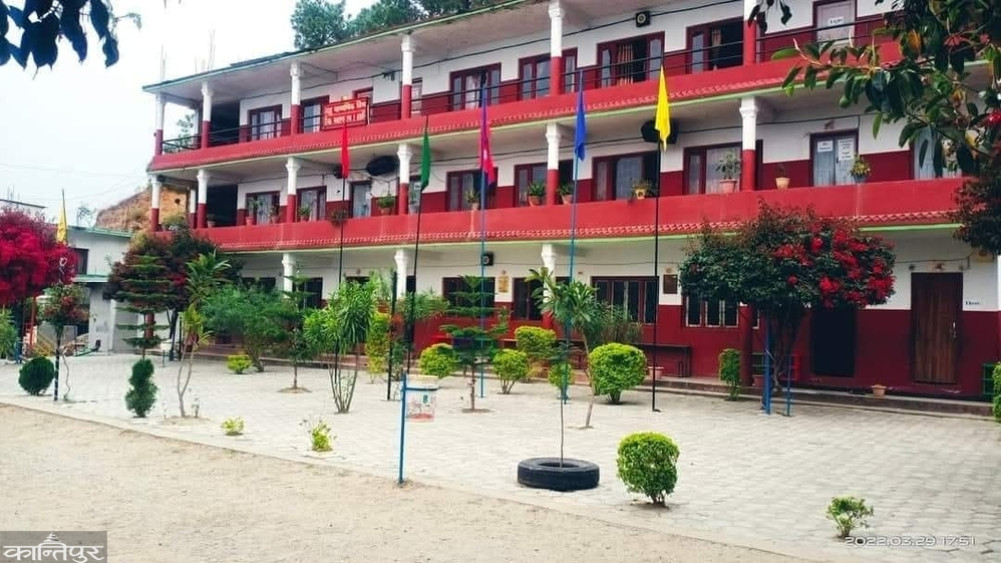
Although the number of students has increased in some schools due to quality education and infrastructure, the number of students in most rural schools is decreasing.
We use Google Cloud Translation Services. Google requires we provide the following disclaimer relating to use of this service:
This service may contain translations powered by Google. Google disclaims all warranties related to the translations, expressed or implied, including any warranties of accuracy, reliability, and any implied warranties of merchantability, fitness for a particular purpose, and noninfringement.
While some schools in the district headquarters are struggling to accommodate students, dozens of schools in rural areas are struggling to survive due to lack of students. Some schools are running classes with two to five students.
More than 600 students from 30 districts are currently studying at Dahu Secondary School in Bethan, Sunapati Rural Municipality-4. According to the school, it has not been possible to accommodate all the students who are coming for admission due to lack of space. Students from different districts of the country come here due to the belief that quality education, disciplined environment and practical learning through English medium will be provided in a rural environment.
According to Principal Dal Bahadur Bal, students from districts including Kavre, Dolakha, Okhaldhunga, Sindhuli, Sindhupalchowk, Bhaktapur, Lalitpur, Rautahat, Mahottari and Jhapa as well as Kathmandu, Makawanpur, Bajhang, Myagdi, Doti, Nawalparasi, Baitadi, Salyan, Saptari, Arghakhanchi, Siraha, Chitwan, Surkhet, Sarlahi and Sunsari are studying in residential schools. 'Parents are increasingly attracted to quality education, but due to various reasons, not everyone has been able to be included,' he said. Dahu Mavi has achieved remarkable results in this year's Secondary Education Examination (SEE) 2082. Out of 66 students who participated in the examination, 11 have scored 4 GPA.
The situation at Manthali Secondary School in the district headquarters Manthali is similar. The school, which is operating up to grade 12, currently has 2,500 students studying. According to the school's principal, Tanka Prasad Dahal, out of 165 students who participated in SEE 2082, 2 scored 4 GPA and 43 scored 3.61 to 3.96 GPA. While the number of students in these two schools in the district is increasing, many community schools in rural areas are becoming deserted due to lack of students. Some schools have already been closed and many schools are being downgraded.
16 schools without even five students
According to the Education Development and Coordination Unit, Ramechhap, 108 basic schools were operating in the district as of the last academic session. Of these, 16 schools have been limited to Early Childhood Development (ECD) classes due to lack of students.
According to the unit, 9 schools operating only ECD have less than five students. Four schools have less than 10 students and two schools have less than 20 children studying.
Similarly, 16 basic schools have only two to five students above grade 1. According to Netra Prasad Gajurel, head of the Education Development and Coordination Unit, the number of students studying above grade 1 in 47 basic schools is only six to ten. There are one to four teachers working in those schools. 'In many schools, only one teacher is teaching all the classes,' he said.
According to him, 22 schools have 11 to 15 students, while four schools have 16-16 students. One school has only 19 students.
According to Gajurel, these figures are based on the details updated by the schools themselves in the Integrated Educational Management Information System (IEMIS) of the Education and Human Resource Development Center and verified by the relevant local level.
Students are concentrating in schools with good results, English medium, residential facilities and a disciplined environment, while schools with remote and weak infrastructure are becoming empty. According to the Education Development and Coordination Unit, Ramechhap, a total of 788 students are studying in 108 basic schools, and more than 132 teachers are working in those schools.
Local level claims that education has improved by 14 times
Due to employment, migration, and increasing attraction towards urban centers, community school students in rural areas of Ramechhap are in crisis. According to the local level, despite the improvement in the quality of community education, the number of students in schools has decreased sharply as families migrate from villages to cities.
In some schools, the number of students has become extremely low, and it has become necessary to combine classes and conduct teaching. While there is talk that the Ministry of Education is working on merging schools with less than 50 students, there is increasing concern about the future of schools in rural areas. Local people's representatives say that if such a decision is implemented, most schools in remote settlements of Ramechhap are at risk of closing.
Khandadevi Rural Municipality Chairman Gyan Kumar Shrestha says that the rural municipality has made significant improvements in community education by facing various challenges. He said that there has been a 14-fold change in SEE. He said that when he was elected, the SEE pass rate was only 4.75 percent, but by the time the results of 2082 BS came, it had reached 65.57 percent. 'Even 5 percent of students could not pass.' Now, about 67 percent of students have reached the point of passing,' he said, 'This is the result of the programs conducted for education reform.' He said that 4 schools in the rural municipality have succeeded in passing 100 percent of students.
Chairman Shrestha claims that the results have improved after the rural municipality prioritized teacher management, regular monitoring, extra classes, student-targeted incentive programs, and coordination with parents. But he said that the continuous decline in the number of students has raised questions about the long-term future of rural education.