Small industries in villages are increasingly closing down due to rising production costs, investment insecurity, economic recession, and various practical difficulties in operating the industry.
We use Google Cloud Translation Services. Google requires we provide the following disclaimer relating to use of this service:
This service may contain translations powered by Google. Google disclaims all warranties related to the translations, expressed or implied, including any warranties of accuracy, reliability, and any implied warranties of merchantability, fitness for a particular purpose, and noninfringement.
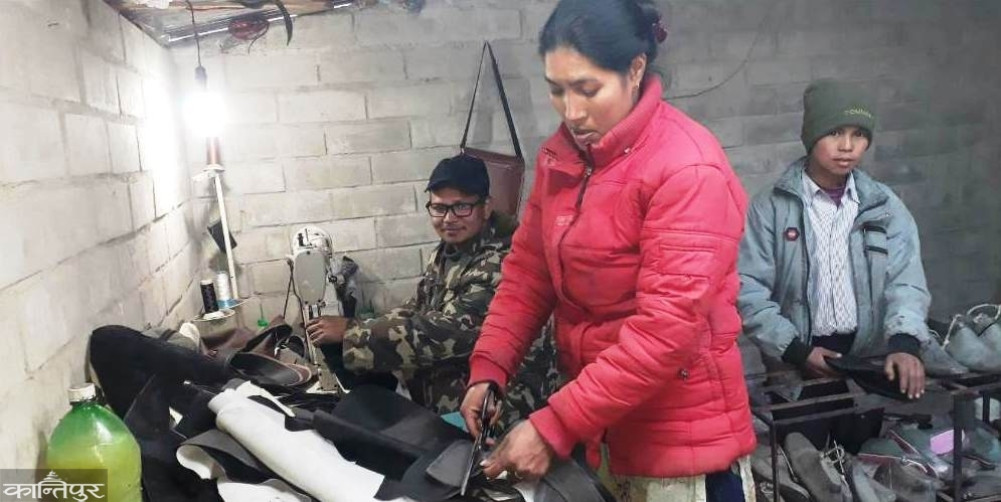
Gunj Bahadur Sarki and Meena Sarki, a couple from Umakunda Rural Municipality-4, Pritika, have been running a leather shoe industry in their village. Their Anugraha leather shoe industry is not as busy as it used to be. 'So far, it has been surviving,' says Gunj Bahadur, 'but now it seems difficult. There are no people in the village.'
This industry, which was started in 2066 BS, has supported their family for years. The industry, which had an investment of more than 3 million rupees, used to earn up to 50,000 rupees per month after deducting expenses. Now it has reduced to about 30,000 rupees.
'Now it has become difficult to run a family,' he said. Earlier, the industry used to produce by hiring workers. The demand for shoes was also good in villages. But in recent years, they have experienced that the local market has been shrinking due to the increase in migration from villages to cities. Since the market has declined, the industry has been run solely by the husband and wife since this year.
When he was learning the trade in Kathmandu, his friends suggested opening an industry in the city. But Gunja Bahadur decided to modernize his ancestral skills and start an industry in his village in Ramechhap. 'It was good at first,' he recalls, 'but now the village is emptying, and the goods are not finding a market.'
The industry now has 10 machines. From designing to cutting, sewing and finishing, the couple does all the work together. In their free time, their sons and daughters also help. Although it is a small industry, leather party and school shoes, sports shoes, women's shoes and slippers of various designs and bags are being produced here. The production reaches not only Umakunda, but also as far as Khiziflate in Okhaldhunga and Gokulganga rural municipality in Ramechhap. The industry has the capacity to produce in large quantities when orders come in. But due to the lack of market certainty, the industry has not been able to operate at full capacity. 'We can produce, we have both the skills and the machines,' says Meena, 'but due to the lack of market, we have had to limit our work.'
Like the Gunja Bahadur-Meena couple, who dreamed of becoming self-reliant by staying in the village, industries operating in villages are in trouble after business has ceased. Many such industries are now in a dilemma whether to stay in the village or move to the city in search of a market, while many industries have already closed. Ran Bahadur Karki, head of the rural municipality's enterprise development branch, said that the local government is supporting the development of industries operating within the municipality. 'There is potential for cottage and small industries to operate in all seven wards of the rural municipality,' said Karki. 'We have put forward a plan to produce entrepreneurs by looking at local resources, skills and market needs.' According to him, the rural municipality has emphasized on the capacity building of old entrepreneurs along with the production of new entrepreneurs. He said that more than 20 entrepreneurs who received training in the last fiscal year were provided with advanced training again this year.
271 industries have been closed down in 6 years
In recent years, the trend of closing down industries has been increasing in Ramechhap rather than operating. According to the Office of Industry and Commerce, Ramechhap, 271 industries have been closed down in the past 6 years from the fiscal year 2077/78 to Chaitra of 2082/83.
According to the head of the office, Khemraj Ghimire, the highest number of industries, 78, have been closed down in the fiscal year 081/82 alone. 'Despite the fact that industry registration and renewal are ongoing, the number of industries being closed down is increasing every year,' he said. He said that 69 industries have been closed down till Chaitra of the current fiscal year 2082/83.
According to the office's statistics, 24 industries have been closed down in the fiscal year 2077/78. Then, 26 industries were closed in 2078/79, 45 in 2079/80 and 29 in 2080/81. But in 2081/82, the number of industry closures suddenly increased to 78.
The situation of industry registration has also been declining in recent years. From the fiscal year 2077/78 to Chaitra in 2082/83,
824 industries have been registered in the district, while 2,566 industries have been renewed. The highest number of 309 industries was registered in the fiscal year 2077/78. Since then, the number of registered industries has continued to decline, according to the office's statistics.
The Office of Industry and Commerce estimates that the number of industries closing may have increased due to market shortages, increased production costs, investment insecurity, economic recession and various practical difficulties seen in industry operations.