Farmers are worried about a drop in production as continuous rains in April have led to the appearance of blight disease on potato plants.
We use Google Cloud Translation Services. Google requires we provide the following disclaimer relating to use of this service:
This service may contain translations powered by Google. Google disclaims all warranties related to the translations, expressed or implied, including any warranties of accuracy, reliability, and any implied warranties of merchantability, fitness for a particular purpose, and noninfringement.
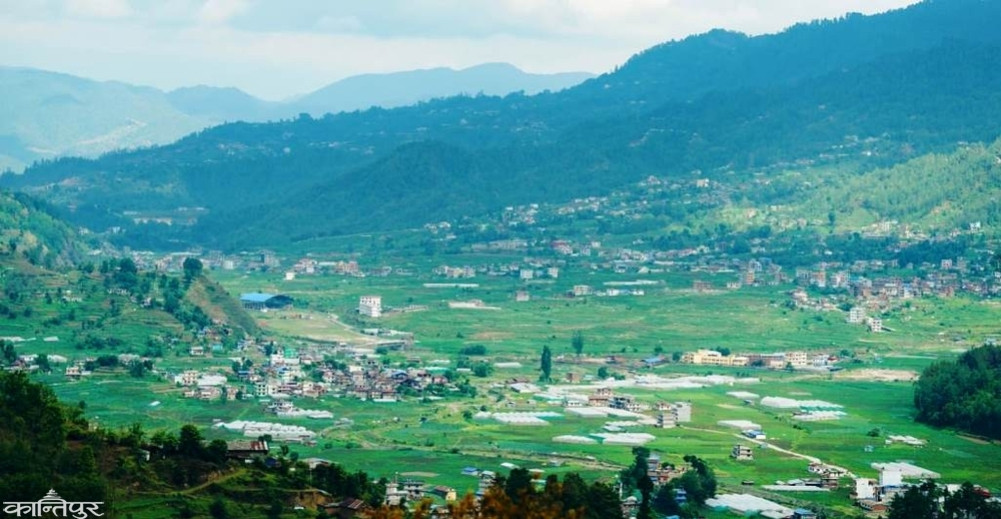
Vegetable farmers in Thaha Municipality, Makawanpur are worried after the daily rains in the month of Baisakh. Due to the daily rains, the potato plants have turned black due to blight disease. The farmers of Thaha are worried that the size of the potato production will also decrease due to the disease in the plants while they are growing.
The farmers here used to dig and sell potatoes since the first week of Jestha. ‘Now the potato plants have turned black due to blight disease. There is no time to dig them,’ said Sudarshan Bista, a farmer from Thaha Municipality-3. ‘Due to the continuous rains in Baisakh, the potato plants have died due to blight disease. The potato seeds have become rotten. What should we dig?’
The main source of income for the residents of Thaha Municipality, which is divided into 12 wards, is vegetable farming. Among them, potato farming accounts for the largest share of income. When potato production declines, the income of the residents of the area is affected. According to the Agriculture Development Branch of Thaha Municipality, potatoes are cultivated on 6,300 ropanis of land in the municipality. Last year, nearly 7,000 tons of potatoes were produced. Last year, potato production in Thaha was good and farmers also received good prices. Balkumari Bhattarai, head of the Agriculture Development Branch of Thaha Municipality, said, "Nowadays, due to daily rains, there is a problem not only in potato production, but also in other vegetable production."
Bhattarai, head of the Agriculture Branch, said that potatoes will be cultivated in all wards of Thaha Municipality, which was formed by including the former Daman, Palung, Agra, Tistung, Chitlang and Bajravarahi VDCs. She said that an average of 15 quintals of potatoes are produced per plantation here. According to her, potatoes worth more than Rs 500 million are exported from Thaha every year. The potatoes produced here are exported to various cities including Kathmandu, Pokhara, Hetauda, Butwal, Bharatpur and others. Thaha has been collecting about 5.7 to 6 million rupees in revenue from potatoes alone. Local tax has been levied on potatoes and other vegetables exported from here for 52 years.
Potato planting starts here from the first week of Magh. Potato planting is completed by the first week of Falgun. Potato digging starts from the first week of Jestha. Since 2031 BS, ‘Thaha’ Rupchandra Bista had started imposing a tax on potatoes in Daman and Palung. The amount collected from the tax was being spent on the educational development and physical infrastructure of the area. The tax is now being determined by the municipality. Locals say that potato farming has been started in this area since 2018 BS.
The lifestyle of the people of this region is linked to potato production. Along with potatoes, other vegetable farming has also started on a commercial basis. Continuous rain has damaged vegetable farming including carrots, cauliflower, and cabbage. Farmers in this region are now planting seeds of Cardinal, Dejure, Khumal Rato, Janakdev, Kukhure Jyoti, and Sajita varieties of potatoes.