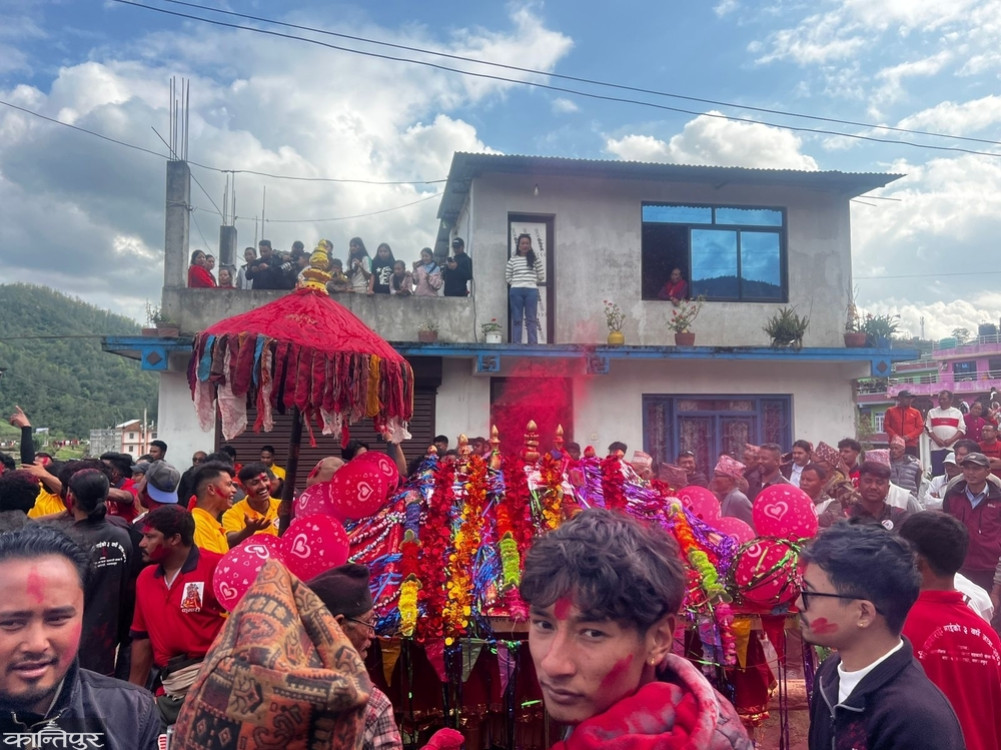
The Bajrabarahi Jatra, held every three years in Thaha Municipality-6, Makawanpur, has begun on Saturday.
We use Google Cloud Translation Services. Google requires we provide the following disclaimer relating to use of this service:
This service may contain translations powered by Google. Google disclaims all warranties related to the translations, expressed or implied, including any warranties of accuracy, reliability, and any implied warranties of merchantability, fitness for a particular purpose, and noninfringement.
The Bajrabarahi Jatra, which lasts for three days every three years, has begun on Saturday in Tishtung Bajrabarahi, Thaha Municipality-6, Makawanpur. The Bajrabarahi Jatra begins on the day of Chandi Purnima, i.e. Baisakh Purnima.
On the first day of the jatra, deities are brought from the village and placed on the Bajrabarahi Peeth in Tishtung. On the Saturday after the Purnima, worship is brought from every house in the settlement here along with offerings and worship is performed throughout the day. On the third day, the deities brought from the village are returned. One of the four Barahis that protect the valley, the temple of Bajrabarahi in Lalitpur has a history of being built by Niwas Malla in Nepal Samvat 786. In Tishtung, Bajrabarahi is considered the mother of Bajrabarahi in Lalitpur.
Here, there is a tradition of starting the festival on the Saturday after Baisakh Purnima every three years. Ward Office No. 6 of Thaha Municipality and the local Guthi Management Committee are managing the festival, said Ward President Rajan Bhakta Shrestha.
It is believed that only by performing puja according to Tantric rituals and worshiping the East God of the Tistung area, Vajrabarahi, will human welfare be achieved. The festival and Guthi have been operating with the income of 204 ropanis of land in the name of the Guthi. Different castes of this region participate in the festival with their own costumes, culture and musical instruments. Thirteen Guthis are also operating for the operation and management of the festival. One Guthi is also operating in the name of the Government of Nepal.
There are Ganesh Guthi, Kumari Guthi, Barahi Guthi, Indrayani Guthi, Bhairav Guthi, Baja Nyavasthapana Guthi and others. During the Jatra, two cows are released in the open for sacrifice at the Barahi Peeth. It is believed that the cows released in this way should not be beaten, chased or confined. Wherever the cows are, the locals feed them with flour and other food.
Before the Jatra starts, the priests go to the temple (peeth) at midnight from Sunday to Friday and worship. Which is called ‘Cha’ Puja. ‘Cha’ means night in Newari language. ‘In this way, those who go to perform ‘Cha Puja’ i.e. night worship should not talk to each other or even look back until both of them return home. Local Maheshwar Maharjan said, ‘The goddess is worshipped the next day.’ After performing the Tantric ritual of Kshama Puja, the local Karmacharya who is chosen by the deity is given the sword. He becomes the K: Dyo. In this way, after the K: Dyo is selected, he wears a white robe and a white belt and goes out trembling, carrying a sword.'
A special puja is performed at midnight on the first day of the festival. Many people get up at night to go to the temple to see this puja. Under this puja, the puja brought by the Deula community is initially performed, which is considered as a government puja. In this puja, snakes, frogs, ducks, sheep, insects, grasshoppers, fish, birds, roosters, goats and cows are sacrificed.
In this way, a male and female pair of each creature is taken to the Peeth (temple) for sacrifice. The male is sacrificed while the female is left at the temple site. Sunday is considered the main day of the festival. On this day, devotees come from far and wide. On the second day of the festival, the sacrifice begins from the early hours of the morning. Those who perform Panchabali also worship on this day.
Goats, ducks, roosters, cows and sheep are sacrificed in Panchabali. Those who have taken vows for three years also worship on this day. Not only animals but also fruits are offered in the temple. After the worship, the hearts of the two cows and the head of the goat sacrificed the previous night are burnt in the yagna. It is customary to perform the yagna while chanting special mantras. After this yagna, the sacrifice is not offered at the Shakti Peeth of Barahi.
On the third or last day of the festival, the heads of the animals that were sacrificed on the Peeth are collected first. Then, the deity is covered with flower petals and covered with meat and rice. The meat and rice are distributed as prasad before returning to the deity.
Since there is a crowd of people who receive prasad, the priests throw it up and far and wide and give prasad. According to religious beliefs and beliefs, it is believed that eating this prasad will bring good health and cure diseases. The Jaand served on this day is first eaten by the Deula community and the same Jutho Jaand is served to the deities, says local Pramod Joshi. He said, 'After that, it is customary to distribute the Jaand to other common people as well.'
During the Jatra, there is a tradition of serving Jaand as prasad in various Guthis. After the worship work is over, the Dhami and Chandra Bahadur Deula of the Deula community sit on the robe of the Bajrabarahi Devi and the symbol of Bajrabarahi Azima sits on the robe of the Deula. The procession concludes by lifting the khat, circling it three times on the pyre, and bringing it back to the Deulatol. The cost of the ward office and the Guthi is around Rs. 1 million. Thousands of devotees participate in the procession.