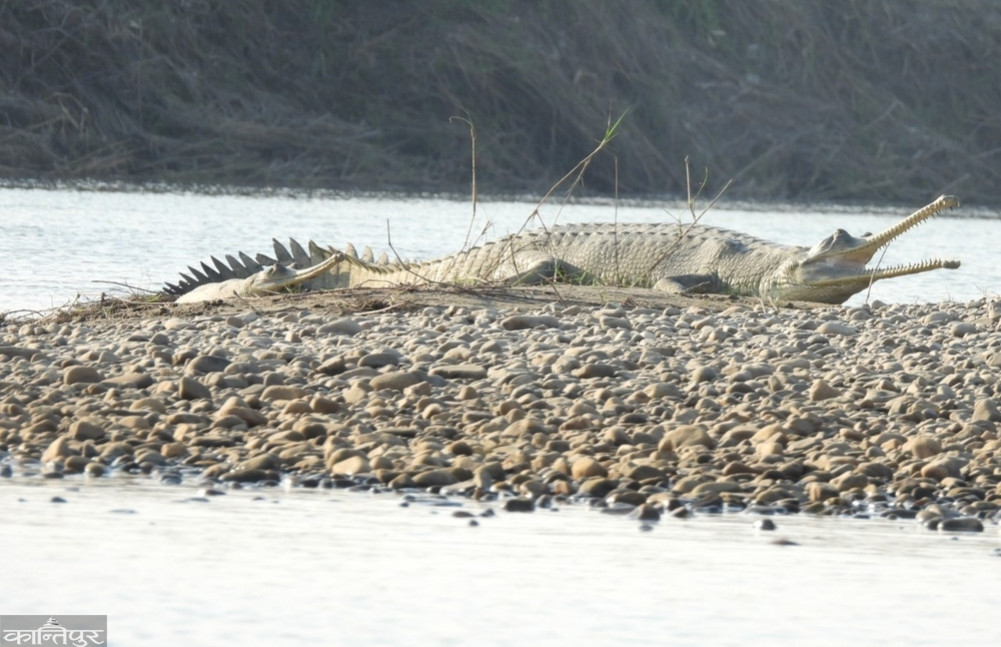
A total of 366 gharials have been found in Narayani and Rapti this year, informed Abinash Thapa Magar, Information Officer and Conservation Officer of Chitwan National Park.
We use Google Cloud Translation Services. Google requires we provide the following disclaimer relating to use of this service:
This service may contain translations powered by Google. Google disclaims all warranties related to the translations, expressed or implied, including any warranties of accuracy, reliability, and any implied warranties of merchantability, fitness for a particular purpose, and noninfringement.
This year's Gharial crocodile census has been completed. While the overall number of Gharials has increased, the number of Gharials has decreased in the Narayani River area, the Chitwan National Park Office informed in a press release on Friday.
A total of 366 gharials were found in Narayani and Rapti this year, informed Abinash Thapa Magar, Information Officer and Conservation Officer of Chitwan National Park.
Last year, a total of 352 gharial crocodiles were found in these two river areas. This time, information officer Thapa Magar, who counted crocodiles through direct observation in the potential area of gharials from Mangsir 21 to 29, said.
This time, the highest number of gharials was found in the Rapti river area, 231. Last year, 206 were found. Similarly, 135 crocodiles were found in the Narayani river area this time. Last year, 146 gharials were found.
There are 11 fewer gharials in Narayani than last year. At one time, gharials were not found in the Rapti river area. But recently, Rapti has become the main habitat of gharials. Gharials have started decreasing in the Narayani river area.
This time, seven in Rapti and two in Narayani Information Officer Avinash Thapa Magar also said that nine male gharial crocodiles were found. Gharials live in clean flowing water and eat only fish. This is an indicator of clean water. But recently, gharials are in danger due to river pollution and lack of food.
This is a rare animal that has reached a critical state. For its conservation, a gharial breeding center was opened in 1978 near Kasara, the headquarters of Chitwan National Park. At the center, eggs are taken from the natural nests of gharials and hatched. After the babies grow up, they are released into rivers and streams. Only a few gharials released in this way have survived.
This time, during the gharial monitoring, a dolphin was also found in the Golaghat area where the Rapti and Narayani rivers meet, said Information Officer Thapa Magar. Dolphins have also become very rare in the river area.