According to the experts, if the sexuality education is not given to the teenagers at the right time, they will fall into the wrong addiction by abusing the Internet
We use Google Cloud Translation Services. Google requires we provide the following disclaimer relating to use of this service:
This service may contain translations powered by Google. Google disclaims all warranties related to the translations, expressed or implied, including any warranties of accuracy, reliability, and any implied warranties of merchantability, fitness for a particular purpose, and noninfringement.
Sarika (name changed), a student at Trinagar Secondary School in Dhangadhi, does not know much about sexuality education. Although she studied health subjects from the 6th grade, she did not understand sexuality well, nor could she question the teacher about anything she did not understand.
As soon as the teacher said 'sexuality education' in the classroom, the atmosphere would change. Boys used to laugh, girls were shy,' says Sarika.
He wanted to understand this matter openly . But that atmosphere never happened in the class . She studied in Doti till 10th standard and came to Kailali for studies after SEE. She didn't learn anything from Doti about sexuality education at school. According to Sarika, when she was studying in 6th grade, there was a lesson on health and population with pictures of female and male genitals. But the teacher did not teach that lesson instead of explaining it. She says, "We didn't understand at that time." As it is now, sir, you should explain this matter to us. We used to tell you to study.'
She had her period for the first time in 14 years and had no idea what to do or not to do during her period. She didn't tell anyone until three times. For the fourth time, when sister found out, she had to stay away from home for ten days to get her period. Even though my mother let me use a cloth instead of a pad, she told me to dry it in a place where no one could see it . "At that time I never dried the pad in the sun ." "I used to use the same cloth that didn't dry properly," she says, "now I understand how much it will affect my health through mobile and internet." She says that while teaching sexuality education at school, she also taught about menstruation so that other teenagers like her don't get confused.
Priya's experience at Panchodaya Secondary School in Dhangadhi is no different from Sarika's. She says that the teachers' thinking about sexuality education in school is not open. Being a member of the Nagar Children's Network, she got the chance to learn about this from the training given by the association and the municipality rather than the school. "Subjects related to our lives are laughed at in school," says Priya.
Not only Sarika and Priya, but other public schools in Kailali have the same experience. "Sexuality education is in books, but not in practice." This serious issue is being avoided quietly,' said a teenager studying in Sharda Madhyamik Vidyaya in Dhangadhi.
15-year-old Suresh (name changed), a student of Durgalakshmi Model Secondary School in Attaria, said that he and his friend were secretly searching for information on the Internet about adolescence. He says that sometimes when searching on Google, he reaches the wrong site . Suresh also says that he did not learn anything related to sexuality education in school.
In the experiences of all the teenagers mentioned above, it is clear that the school has not effectively given them information about sexuality. The subject of sexual and gender minorities is in a critical situation. Ganga Awasthi, a health teacher at Panchodaya Secondary School in Dhangadhi, says that there is nothing but the definition of sexuality and minority in the
curriculum. "There is nothing else in the curriculum except that sexual and gender minorities are this," says Awasthi, "What are their problems?" What are the challenges they face? This thing is not included in it . We have to search and teach. According to him, there is only one lesson about sexuality education in the curriculum. He believes that
does not understand broad sexuality. He has experienced that it is also a challenge for teachers to teach sexuality education in schools. She says, "Students don't listen when they talk about this matter, they make more noise and shy away". No matter how much we try to remind them, they don't accept it. No matter how well the teacher teaches, sexuality education will not be effective unless the students want to learn.
Efforts of the local government
The Godavari Municipality of Kailali is preparing to publish the local curriculum 'Our Godavari'. Praygaraj Joshi, officer of education, youth and sports branch of the municipality, says that sexuality education is also included in the different subjects of the municipality. He says, "Although we cannot cover many things, we have kept some amount of sexuality education". In which there is information about right touching, wrong touching and other information.
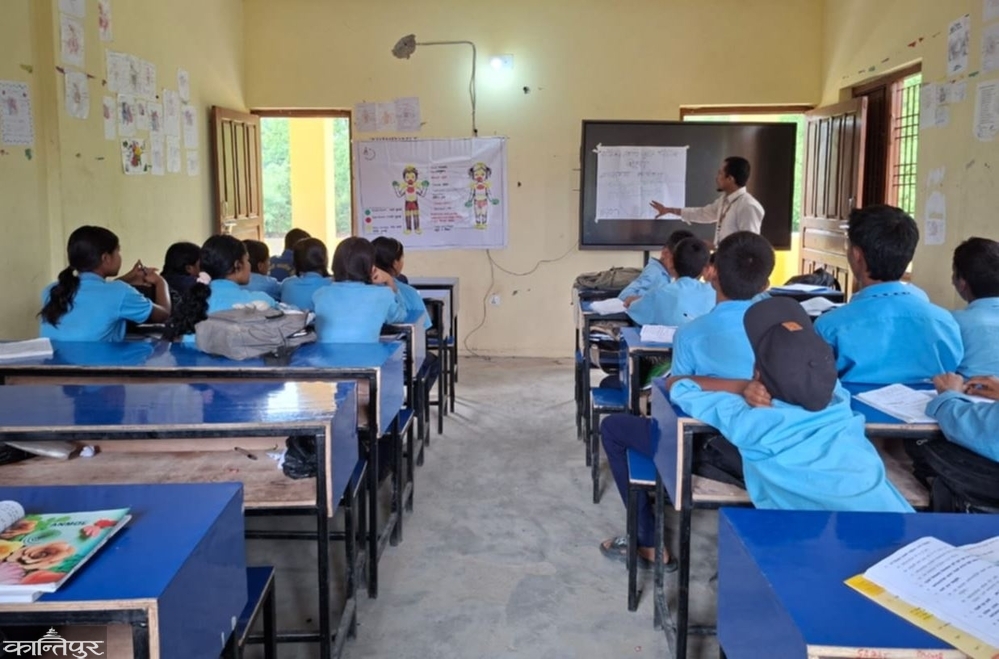
Although he admits that sexuality education in schools is not effective. According to him, although there is no separate policy and plan for sexuality education in Godavari, a program will be introduced in the future with priority given to teenagers. On the other hand, Dhangadhi sub-metropolitan city has not made a separate policy and program on sexuality education. But the local curriculum 'Our Dhangadhi' includes a unit on sexuality education.
Comprehensive sexuality education should address relationships, values, rights, culture and sexuality, understanding of gender, violence and safety, skills for health and wellness, human body and development, sexuality and sexual behavior, sexual and reproductive health . But Nirmala Joshi, a health teacher at Trinagar Secondary School in Dhangadhi, says that the contents of the school level curriculum cannot fully teach comprehensive sexuality education to the students.
According to him, the lack of training for teachers, the lack of content in the curriculum, and the lack of an open discussion environment are the main challenges of comprehensive sexuality education. He believes that sexuality education can be made effective if parents, schools, local and state governments work together.
There is no separate curriculum on comprehensive sexuality education at the school level in Nepal. Some of these concepts are covered in our Serofero curriculum from grades one to three. In class four and five, the topic of menstruation is covered to some extent . 6, 7 and 8 have a comprehensive sexuality education unit within compulsory health, physical and creative arts. In which the subject of sexuality including sexual and gender minorities is covered.
In class 9, 10, 11 and 12, health, environment and population, which were previously mandatory subjects, have been removed . Now health and physical education is kept as an optional subject . Which includes comprehensive sexuality education . Teachers complain that there is not as much content as it should be. When it comes to university level courses, the subject is included in the faculties of health, education, nursing and medicine at undergraduate level . There is also a separate course of comprehensive sexuality education in postgraduate.
There has not been a separate study or research related to widespread sexuality in Nepal. But UNESCO, Save the Children, UNFPA, Yuva and other non-governmental organizations have selected some areas and worked.
According to the National Census 2078, 58 lakh 76 thousand 269 people are in the age group of 10 to 19 years. Which is 20.15 percent of the total population . Similarly, the population of disabled children and adolescents in the age group of 0-19 years is 167,429. Dr. Khagendraraj Bhatt, Gynecologist and Obstetrician of Seti Regional Hospital in Dhagadi, says that because teenagers of this age group are subject to physical changes, violence and abuse, they need comprehensive sexuality education. According to Bhatt, due to the lack of sexuality education, they commit child marriages, have unprotected sex, become mothers at a young age and have unsafe abortions.
According to a study conducted by Human Rights Watch and WVIN in 2023, 37 percent of girls in Nepal are married before the age of 18 and 10 percent before the age of 15. Similarly, according to the 2023 data of the National Statistics Office, although the legal age of marriage in Nepal is 20 years, 41.09 percent of women are married between the ages of 10 and 18 and 76.95 percent are married at the age of 20.
According to the data of the Ministry of Health and Population in 2023, 14 percent of teenage girls in the age group of 15 to 19 years are mothers or pregnant in Nepal. Comprehensive sexuality education has been shown to promote later sexual intercourse and increased use of other contraceptives . According to a study conducted by UNAIDS in 2006, it has been found that due to this education, there has been a reduction in drug use and an increase in the number of referrals to health services, as well as a reduction in gender violence, bullying and discrimination.
According to the study of the effect of sexuality education on sexual behavior in the year 2008-09 in Nesco's activities, the effect of this education has been shown to increase by 37 percent in starting sexual intercourse at a late age, 31 percent in reducing the number of sexual intercourse, 44 percent in reducing the number of sexual partners, 40 percent in the adoption of condoms and contraceptives, and 53 percent in the number of those who do not want to take any risk related to sexuality.
According to UNESCO's 2016 Global Review, most countries prioritize the concept of comprehensive sexuality education and emphasize its active implementation. The government of Nepal has not made a separate policy and program for comprehensive sexuality education. But in 1994, after signing the strategy of the Conference on "Population and Development" in Egypt, it made a commitment to sexual and reproductive health issues. As a result, the Ministry of Health adopted the National Reproductive Health Strategy in 1998 to emphasize access to quality sexual and reproductive health services and preventive information and education.
The Government of Nepal has prepared and implemented National Action Plan 2070/71-074/75 and National Adolescent Health and Development Strategy 2075 to address the issues necessary for overall development of adolescents. Which includes comprehensive sexuality education . This topic is also included in the National Education Policy 2076. In the
policy, in article 11 of 2 of 1, education-related plans, programs, administration, management, regulation and education-related laws at the provincial level should be under the authority of the national policy and standards of education. According to Article 11 of 2 of 12, the province should carry out and monitor the curriculum, curriculum development, training, and training related to the professional development and training of school level teachers.
But the education policy to be made by the province in the Far West has not been made yet. According to Jaidev Mahara, senior education officer of the Ministry of Social Development, the draft of the state government's education policy has reached its final stage. He says that the province has not done anything about comprehensive sexuality education for schools. We will make a policy and facilitate it. The local level should implement it and work at the school level," he said.
Senior education officer Mahara says that to make sexuality education effective in schools, subject teachers, teacher training arrangements and a learning-friendly environment should be made. Various international treaties and agreements have also been made to ensure comprehensive sexuality education of youth and adolescents as a right. These include the Convention on the Rights of the Child (CRC), Declaration on Economic, Social and Cultural Rights (ICESCR), International Declaration on Civil and Political Rights (ICPR), Convention on the Elimination of All Forms of Discrimination against Women (CED), 2006 International Convention on the Rights of Persons with Disabilities (CRPD) and the International Conference on Population and Development (ICPD), Action Plan 1994.
The Sustainable Development Goals 2015 also use the aforementioned international agreement as a basis for achieving all 17 of their goals by 2030. In which Goal 3 (Healthy and Prosperous Life), Goal 4 (Quality Education) and Goal 5 (Gender Equality) emphasize that comprehensive sexuality education should be given to all youth, children and adolescents (Netrahin Yuva Sangh Nepal 2023).
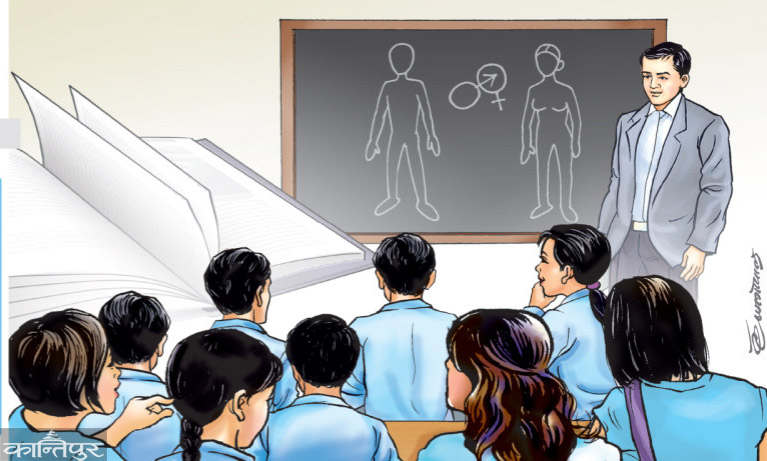
Sharmila Pokharel, who is an associate professor of Tribhuvan University and is studying sexuality education, says that sexuality education at the school level is not as effective as it should be. The main reason for which is not the lack of content in the curriculum but the lack of teachers with thematic knowledge . It is necessary to have a separate manpower for comprehensive education, but that is not the case. "Teachers who teach social or health are teaching this subject," says Pokharel, "First of all, the teachers themselves do not have full knowledge and confidence to teach this subject." For which the government needs to provide different types of teacher training. Still for Tribhuvance University Health and Development Health Received to make
-Breastiness Education Education, UND cooperation, and population violence. God says & nbsp;.
s that this teaching is not given by the right way to teenagers, he can get rid of the internet and nbsp;... Which need to understand sexual education in the school to understand, the child needs sexual education. For this, Dr. Training of teaching, students, parents and communities level, Dr. Aryal states & nbsp; 5

