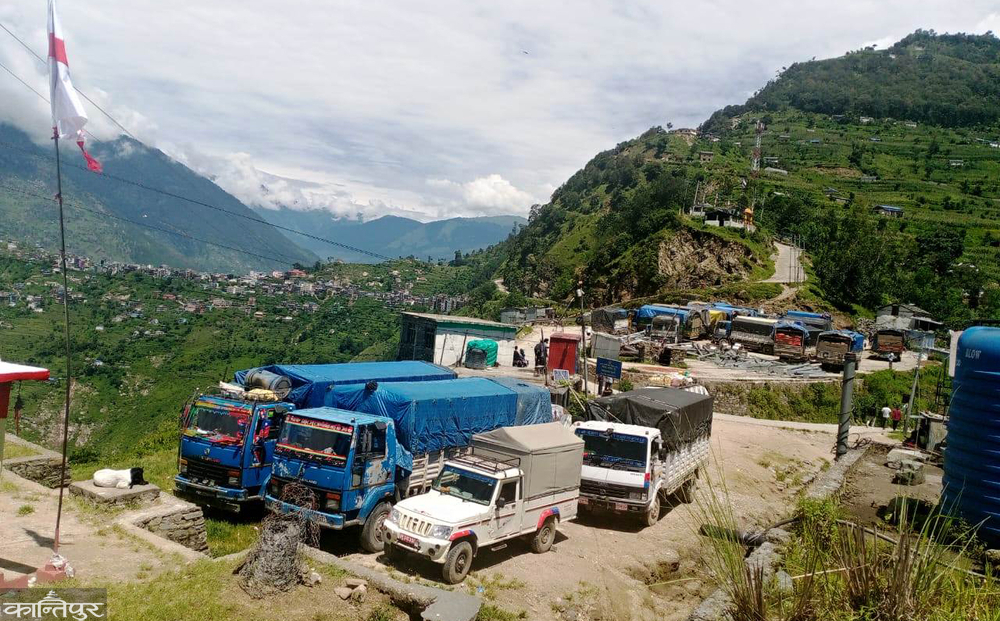
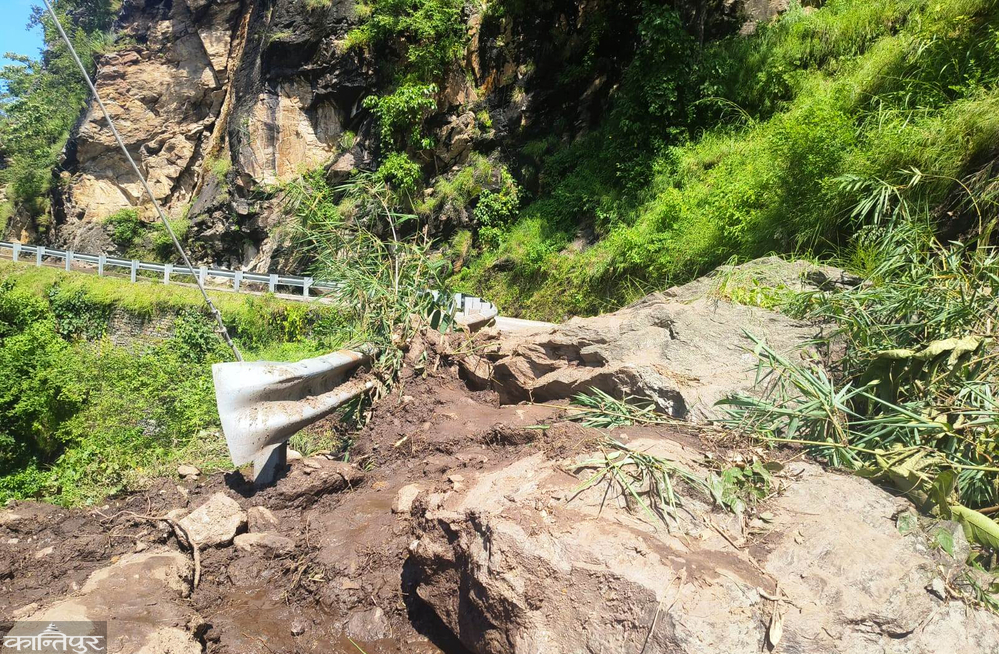
When roads are blocked by landslides, daily necessities are stranded for weeks, while agricultural produce rots on the way.
We use Google Cloud Translation Services. Google requires we provide the following disclaimer relating to use of this service:
This service may contain translations powered by Google. Google disclaims all warranties related to the translations, expressed or implied, including any warranties of accuracy, reliability, and any implied warranties of merchantability, fitness for a particular purpose, and noninfringement.
Gopal Rokaya of Hima rural municipality-3 in Jumla is worried that he will not be able to send apples out this year because of the road. Last year, he was cultivating apples on about 10 plants. A truckload of apples he was going to send to Surkhet was lost when the Karnali highway was closed. This year too, there are plans to send out about 10,000 cartons of apples.
He said, ``What can we do by growing apples, the Karnali highway is closed every year when apples are sent out,'' he said, ``During the rainy season, there are landslides everywhere, if the road is not open for a week, there is always a risk of apples rotting on the road.''
According to Ratan Rawat of Chandannath Municipality-8, there is a danger of landslides on the Surkhet-Jumla road under the Karnali highway. "As soon as there is normal rain, the rocks of Bademan stand on the road, no matter how big equipment is used, they cannot be moved in 1/2 day, the road will be opened only after weeks," he said, "The Karnali highway is not only becoming a death road, it is becoming a road leading to famine and starvation in Karnali". Due to landslides, daily consumables are left stranded on the road for weeks, and the agricultural produce rots on the road.' He said that every Karnali resident is afraid of landslides on the highway as soon as it rains. According to him, due to landslides on the highway, there is food shortage in most of the villages.
Surkhet-Jumla road under Karnali highway was blocked 135 times due to landslides last year. According to the police, there were 5 landslides in one place last year. According to Road Division Office Jumla, there is a risk of landslides at 15 places in the 168 km from Dahikhola in Dailekh to Khalanga, Jumla headquarters. Dipendra Kumar Choudhary, the head of the division said that there is a high risk of landslides in Dahikhola, Gaganekhola, Esmod, Hulme, Serighat, Sunarkhola, Galli, Molfa, Serabada, Takulla, Bhaisingowda, Timure, Galje, Ranchuli and Dhanada this year. "They sent the vehicle away from the landslide, and within 1/2 hour there is news that another landslide occurred," he said.
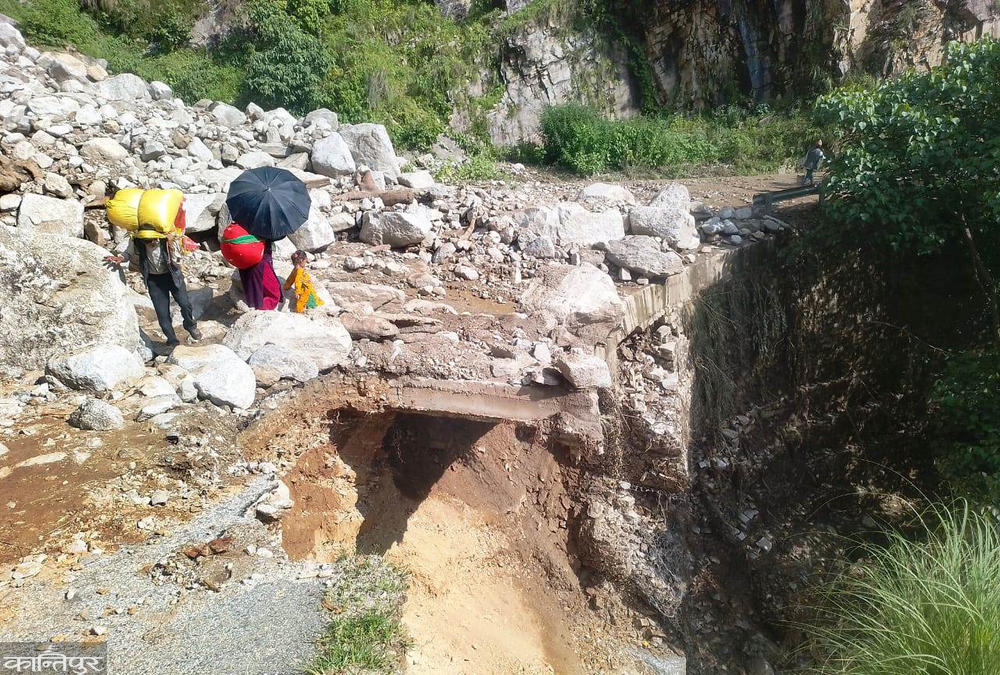
He complains that due to lack of budget, other structures could not be built in places prone to landslides except for normal maintenance. He informed that works such as putting up walls in dangerous places, filling wire mesh, and improving roads have been done from the contingency budget of 90 lakh rupees released by the road board this year. According to the road division office, last year, Gagnekhola had washed away the gabion built at a cost of 6 million rupees. He said that equipment including wheelloads and backhoe loaders have been kept ready in Pili, Hulme and Galje to remove landslides.
According to the road division office, widening and blackening of the road sections from Dahikhola to Khulalu, Serighat to Manm, Bihanikhola to Nagm, Raralihi to Sridhuska are also being done this year from the budget of 24 million rupees on Karnali Highway. The road department has spent 1.13 billion rupees on the construction of 14 different bridges on this 232-kilometer highway, which has been in operation since March 30, 2063, while the World Bank has spent about 2 billion rupees for the construction of walls with Otasil technology black sheets and safety bars.
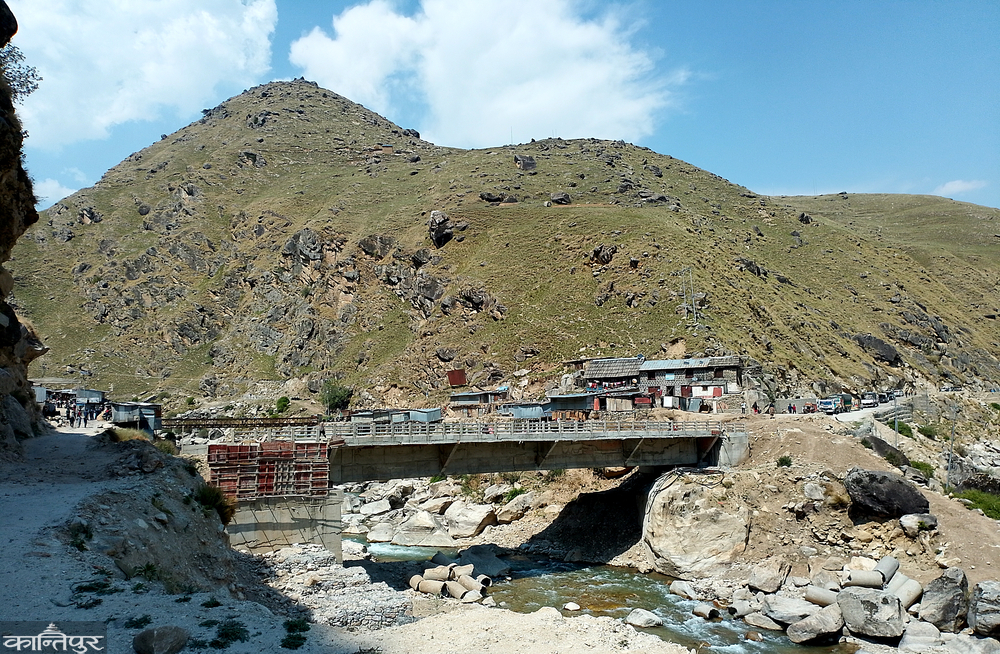
With the help of the World Bank, in the year 2072, through the road sector development project of the federal government, the highway was paved at a cost of 1 billion rupees. In the last 3 years alone, nearly 700 million has been spent on this road, according to the Road Division Office, Surkhet and Jumla. Ratan Shahi of Virendra Nagar Municipality-4 of Surkhet said that those who have traveled once on the highway, which gets muddy when it rains and gets muddy when the sun shines, are afraid to go back the next time. "The road is broken, all sections are one way," he said, "even if there is a small mistake on the narrow road, the car will fall in Karnali."
The bus driver Galg Bahadur KC says that it is very difficult to drive on the highway. According to him, when the road is 'one way' in most places, the vehicle has to back up and give way to cross. He said that although the reserve vehicle reached Jumla from Surkhet in one day, the passenger vehicle had to stay in Kalikot for one day. "In most places, if there is only 5 meters of road, the vehicle has to be backed up because there are no turns," he said, who has been driving on the Karnali highway for almost 5 years, "Trying to avoid potholes on roads with potholes and poor terrain is a danger of accidents. When taking a Jumla vehicle from Surkhet, there is not a day that the belt is not broken and the tire is not punctured."
The risk of accidents on the highway is the same . According to the provincial police office, 911 people died in accidents on the highway during a decade. 1 thousand 527 people were injured in that accident. In the period of 3 years alone, 301 people have lost their lives on this road and nearly 800 have been injured. Karnali Province Police Chief DIG Madhav Shrestha said that accidents on highways are increasing due to narrow and difficult roads, more than capacity passengers, old vehicles, neglect of traffic rules etc. "Accidents are also increasing due to excessive speed," he said, "Difficult geography of Karnali also poses a challenge to prevent accidents due to dilapidated roads." "In the initial stage, the highway should be two-lane," he said, "The standard may not have been reached because the army worked in a hurry, but no matter how hard we tried later, the standard could not be met." But passengers are now forced to travel for up to 24 hours.
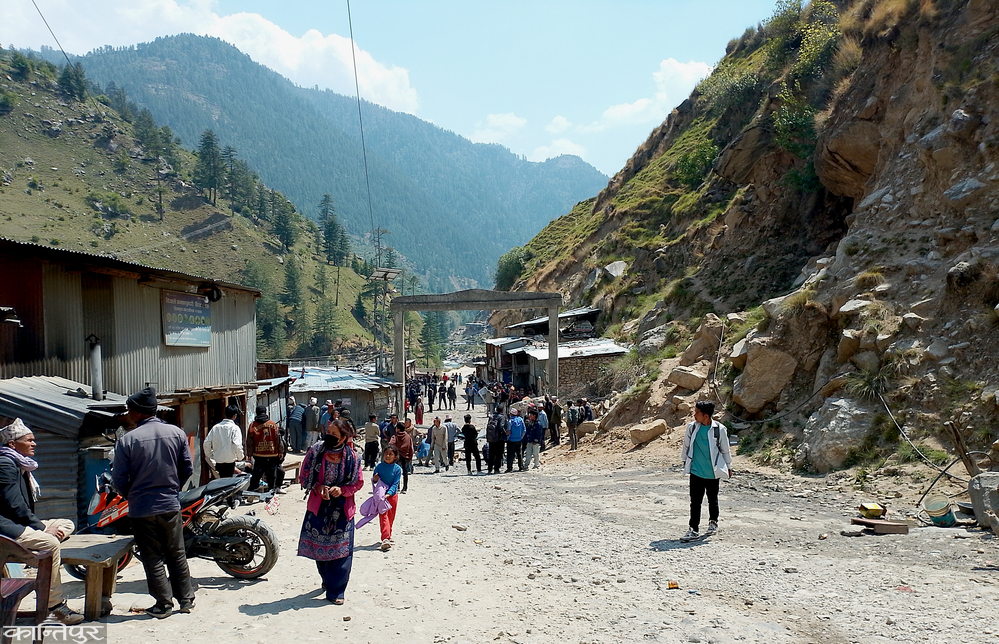
The Karnali Highway, which was laid the foundation stone by the then Prime Minister Girija Prasad Koirala in the year 2048, was completed only after 15 years due to armed conflict and lack of budget. The government handed over the road to the Nepali Army after there was a problem in the construction due to rocks.
Lal Bahadur Malla of Khandachakra-8 said that the political parties of Jumla, Mugu and Calikot who made the election slogan of upgrading the Karnali highway ignored it after winning the election. "They always raise the slogan of making the highway a two-lane highway," he said, "but they never care after winning." He complained that he had to travel on the highway always trusting God.
Kantika Sejuwal, a member of the House of Representatives, said that the government seems to be apathetic even though she has repeatedly asked for the removal of landslides on the Karnali highway and the upgradation of the road. "The government does not consider the people's representatives of Karnali as people's representatives, they do not consider the people of Karnali as citizens," she said, "the result of which we are suffering every year."