Government and Parliament blaming each other for not moving forward with the bill
We use Google Cloud Translation Services. Google requires we provide the following disclaimer relating to use of this service:
This service may contain translations powered by Google. Google disclaims all warranties related to the translations, expressed or implied, including any warranties of accuracy, reliability, and any implied warranties of merchantability, fitness for a particular purpose, and noninfringement.
Prime Minister KP Sharma Oli, pointing to the delay in law making, said in the House of Representatives meeting on January 18, 'Why are we taking half a decade to make a single law?' He commented that even though the government brought the bill out of necessity, the parliament did not fulfill its obligations. He added, "If the House does not feel desperate, where will good governance come from?"
As Prime Minister Oli said, the Prevention of Corruption (First Amendment) Bill, which was registered in the National Assembly on January 6, 2076, was passed by the Parliament only after five years. This bill was approved by the President on March 3. It is not certain when the Commission for Investigation of Abuse of Authority (Third Amendment) Bill, which was registered in the Parliament on the same day, will be passed by the Parliament. It took 4 years to pass the Public Service Broadcasting, Food Hygiene and Quality, Security Printing and Records Protection (First Amendment) Bill. As Prime Minister Oli said that it took a long time to pass the
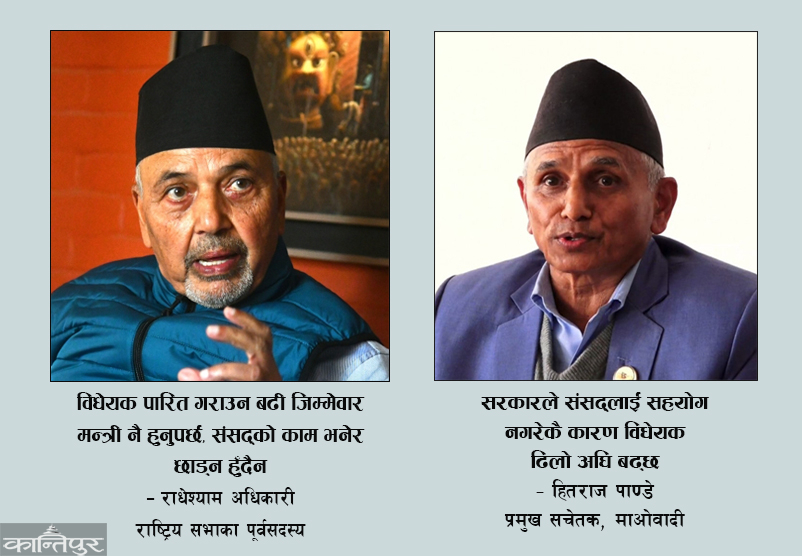
bill, is it only the parliament's fault? The chief whip of the main opposition party Maoist Hitraj Pandey says that the government cannot get immunity by blaming the parliament for the delay in passing the bill. He says that the government and the ruling party are the main culprits for the delay in the legislative process. He mentioned that there is a rule that the committee will discuss the bill only in the presence of the concerned minister. "The tendency of the relevant minister not to give time to the committee and withdrawing from the discussion process is delaying the progress of the bill," he said.
Pandey, who is a member of the sub-committee formed by the State Order and Good Governance Committee under the leadership of MP Dilendra Badu, gave the example of the sub-committee meeting being postponed several times due to the absence of the minister. He says that although the sub-committee agreed on the bill on the Commission for Investigation of Abuse of Authority, it could not move forward because of the government. Pandey said, "After extensive discussion, the sub-committee agreed on the bill, but the bill has been stopped because of the government." "The reason for that is the government," he said, "The government does big things to blame the parliament." The reality is that the government is not cooperating with the parliament and the bill is being delayed.
Pandey said that the bill did not move forward quickly even when there was a Maoist-led government. "There are also problems such as parliamentarians not being responsible for the work of the legislature and showing a tendency to delay it when things do not go as they say," he said.
Senior advocate Radheshyam Adhikari, a former member of the National Assembly, says that the constitution only sets a time limit for the return of a bill that originates in the House of Representatives and is sent to the National Assembly.
The tenure of the House of Representatives is 5 years. But the National Assembly is considered permanent. If the House of Representatives does not pass it within the term, the existence of the bill will cease.
The official says that the time limit should be determined for the bill going from the National Assembly to the House of Representatives. He said that it should be discussed when the discussion of constitutional amendment is going on. He said that the reason for the delay of the bill cannot be considered as the only reason for not having a binding deadline. "The problem is that there is no more responsibility in bringing the bill," he said, "Ministers should be more responsible to get the bill passed by them." It should not be left as it is the work of the Parliament.' There is a constitutional provision that the Parliament must give a decision on the acceptance or rejection of the
ordinance within 60 days of the sitting of the House. But the time limit for finalizing the bill is not specified in the constitution or law. It is only said that the bill passed by one house will be sent to the other house as soon as possible . Although it is intended to finish the bill process quickly, it is not being taken seriously. Regarding the bill passed by the House of Representatives and sent, the time taken by the National Assembly is fixed in the constitution.
It is mentioned in the constitution that the National Assembly must return the money bill passed by the House of Representatives to the House of Representatives within 15 days . Other bills are passed by the House of Representatives and sent to the National Assembly within two months of being passed or sent back with suggestions. It is said that if the National Assembly does not withdraw it during that period, the House of Representatives can submit the bill to the President for verification by the decision of the majority of the existing members.
There is a provision in the National Assembly Regulations that the legislative committee under the National Assembly must finalize the bill received for discussion by the Assembly within 6 months. But such a limit has not been set for the House of Representatives. If the House of Representatives fails to pass the bill by the end of the term, the work done before it will be wasted. When the tenure of the previous House of Representatives ended on 1 October 2079, 21 bills were inactive.
The government submitted such bills to the House of Representatives that was formed after the 2079 election, which became inactive after much discussion in the parliament and could not be passed on time. There is a tendency for the government to withdraw some bills from the parliament and bring them to the parliament or bring them in the form of ordinances after checking compatibility.
The bill related to civil service was registered by the government on 27 Jan 2075 in the House of Representatives. During the previous term of the House of Representatives, it was discussed for a long time . But the government withdrew the bill on 20 October 2078 after the parliament and the government could not reach an agreement on some issues. The bill was again registered on 21 February 2080 in the next House of Representatives formed after the election. This bill is currently under consideration in the State Order and Good Governance Committee.

