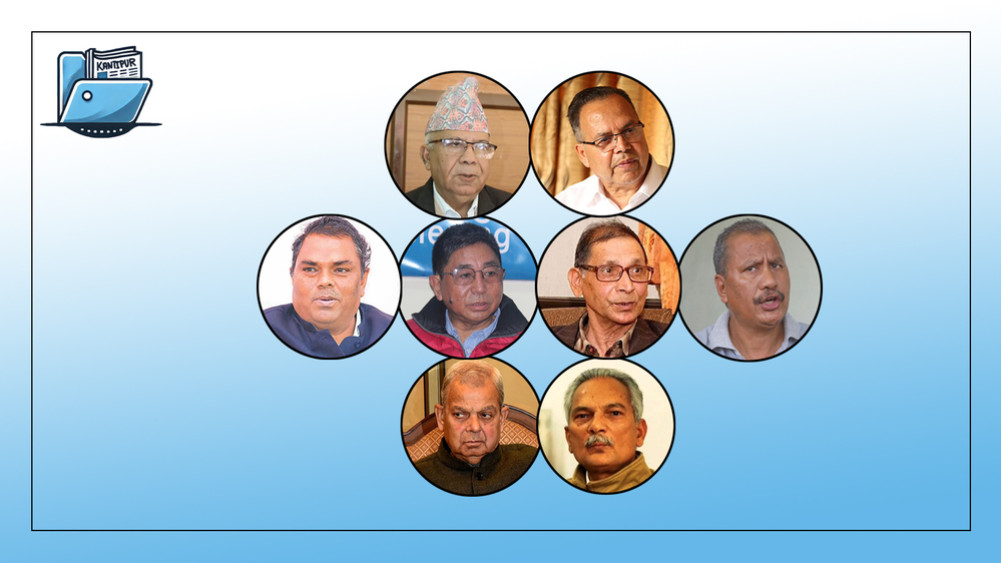
Not only in the integrated socialists, but also in the Madhesh-centric and small left-wing parties, there is a conflict between them, and the situation is not to meet or break.
We use Google Cloud Translation Services. Google requires we provide the following disclaimer relating to use of this service:
This service may contain translations powered by Google. Google disclaims all warranties related to the translations, expressed or implied, including any warranties of accuracy, reliability, and any implied warranties of merchantability, fitness for a particular purpose, and noninfringement.
CPN United Samajwadi (S) President Madhav Kumar Nepal and respected leader Jhalnath Khanal have not had cordial relations since the formation of the party. Nepal and Khanal, who formed a new party rejecting the leadership of UML president KP Sharma Oli, could not reach a consensus in the central committee meeting that ended last Saturday.
There is a power struggle between the two leaders who are also ex-prime ministers. Although the Central Committee agreed to resolve the dispute, students from Nepal and Khanal sides met separately on Monday. Aarti Lama, who was the president of Aneraswaviyu earlier in the party central committee, objected that she was removed from the responsibility without informing her .
Khanal objected to the meeting saying that the political report passed by the party's convention held last June and the constitution were published differently. The Nepal side said that even the issues that Khanal himself had agreed to were presented in a different way.
'The party constitution is not in accordance with the spirit of the convention . The report also does not include suggestions. This is not an acceptable position. If the legislation and the report are true, it can be accepted, if not, it cannot be accepted," said Khanal .
He said that although he had agreed to cover the subject of 'proceeding on the path of scientific socialism', it was not included . He said that he was dissatisfied with the removal of the President of the Student and Youth Union.
'There is a dispute between students and youth organizations . He said, "It is difficult to move forward without solving the problem." Aarti Lama and Yuva Sangh president Krishna BC were removed from the president of the student organization and nominated to the central committee.
Vice President Beduram Bhusal said that the issues raised by Khanal came in the form of suggestions and complaints. "The respected leader should work to create enthusiasm in the party," he said, "it has been decided to address the issues raised by JN (Jhalnath) in a secretariat meeting."
"There are no documents and statutes beyond what was passed by the convention," he said, "if there are any problems, the secretariat has decided to solve them." If we want to develop the people's movement, we have to develop party guidelines, policies, and principles. That consciousness should be prepared," he said, "the party and the people's organization should be unified. Problems have arisen over the documents passed by the party convention. It should be solved.' He mentioned that the problem appeared during the publication of the document and informed that he had a different opinion in the Central Committee for the solution.
According to an official, even though the congress amended the constitution and created the post of respected leader for Khanal, President Nepal is dissatisfied with the fact that he did not present a respected style. "President Madhav Nepal can ignore Jhalnath Khanal or not, nor will he address him," said the official, "Madhav Nepal listens to Khanal's words with one ear and ignores them with the other". In June 2075, UML and Maoists united in CPN, and two leaders were united. After the CPN was split and the UML and Maoist Center woke up, Nepal and Khanal went against Oli . After the split of UML in August 2078, Nepal and Khanal, who formed CPN Unified Socialists, have recently had a cold relationship.
United Samajwadi Party, which has 10 seats in the House of Representatives, has decided to start party building to justify its separation from UML. But since UML does not bring new and different tactics and programs, the leaders and workers are more repulsed than attractive. MPs Prem Ale, Krishna Kumar Shrestha and other MPs are dissatisfied.
The Madhesh-centric party is also fragmented
Not only in the Unified Socialist Party of CPN, but also in other small parties, there is a strong power struggle.
Janata Samajwadi Party Nepal split last year when the government was led by the Chairman of the Maoist Center Pushpa Kamal Dahal. While in the government, 2081 Baisakh 13 Jaspa split and became two parties . When Upendra Yadav was the president of Jaspa Nepal, Vice President Ashok Rai formed another party called Jaspa and registered it with the Election Commission. Out of the 12 JSP MPs in the House of Representatives, 7 MPs participated in the new JSP and 5 MPs were in favor of Yadav.
Both parties have supported the government. But Pradeep Yadav of Jaspa led by Rai and Navalkishore Sah Sudi are women, children and senior citizen ministers .
Similarly, the Democratic Socialist Party also split in October 2081. Leader Rajendra Mahato, who is also a former minister, has split the LOSPA and formed the Rashtriya Mukti Party and registered it with the Election Commission.
In June 2079, Jaspa President Upendra Yadav and National Council President Baburam Bhattarai separated due to power struggle. He formed the Nepal Samajwadi Party saying that Yadav was running a single party. A few months ago, he registered with the Election Commission under the name Nepal Samajwadi Party (New Power).
Bhattarai allied with the Maoist and picked a candidate on his election symbol. Two union and two seat provincial members were also elected . Maoist Chairman Pushpa Kamal Dahal and Bhattarai could not get along, so the unity was falling apart . Instead, Mahindra Rai Yadav, Chairman of the National Council of NESP, decided to form another NESP and unite with the Maoist Center.
In the Sangh, Mahindra Rai Yadav was elected from Sarlahi-2, Ganganarayan Shrestha from Sindhuli 2 (2) and Fanindra Devkota from Gorkha 2 (2) in Bagmati Pradesh. Umrawati Devi was elected as a proportion of the union. currently Devkota is towards Bhattarai's Nespa (New Power). He is the Minister of Gandaki State Government.
In March 2080, Baburam Bhattarai's party broke up and Mahindra Rai Yadav separated. After four years of separation from the Maoists, Bhattarai's New Shakti and the Federal Samajwadi Party headed by Upendra Yadav united and named the Nepal Samajwadi Party in 2076.
In May 2077, the Rashtriya Janata Party (RJP) united with the Janata Samajjadi Party (JSP) and renamed it as JSP. A year later, in June 2078, JSP split. Bhattarai and Yadav continued the JSP while Mahanth Thakur, Rajendra Mahato and others revived the LOSPA. The collaboration between Bhattarai and Yadav did not last long. In June 2079, Jaspa also split.
2077 At midnight on the 10th of Baisakh, the then Rashtriya Janata Party (RJP) and the Samajwadi Party merged to form Jaspa Nepal.
The same disease in small leftist parties
In June 2069 Mohan Vaidya separated from Maoist and formed revolutionary Maoist . President Pushpa Kamal Dahal and the then Vice President Baburam Bhattarai formed the revolutionary Maoists saying that they had agreed on the peace process and military adjustment.
Even though another Maoist was formed taking the policy of people's rebellion, the struggle started in that party too . The conflict between President Vaidya and leader Netra Vikram Chand escalated . Then in November 2071, Vaidya and Chand separated. Chand formed a new party saying that he would make a unified revolution.
Ram Bahadur Thapa, who was the vice-president who came to UML through the Maoist center with Vaidya, Maoists, vice-president Pampha Bhusal, general secretary Dev Gurung also separated from Vaidya in June 2073 . After some time he united with the Maoists .
UML and Maoists united in May 2075 and formed CPN. Three years later, after the Supreme Court ruled on a case and decided to separate the UML and the Maoists, Thapa remained in the UML while Bhusal and Gurung joined the Maoists .
Dhamendra Bastola, who was in the revolutionary Maoist led by Vaidya, separated in July 2081 after a dispute over whether the party's direction of action should be scientific socialist or not.
CPN General Secretary Netra Vikram Chand and Hemant Prakash Oli, who carried out armed activities under the name of unified revolution, also clashed. In May 2079, Oli separated from CPN. He, who formed the majority of the CPN, has now united with the revolutionary Maoists led by Vaidya.
Professor of Political Science of Prithvi Narayan Campus Pokhara Thana Bahadur Chhetri said that conflicts and divisions occur between senior leaders of political parties due to power and position. "It seems that there is a struggle for power and position in the parties rather than an ideological debate," he said.