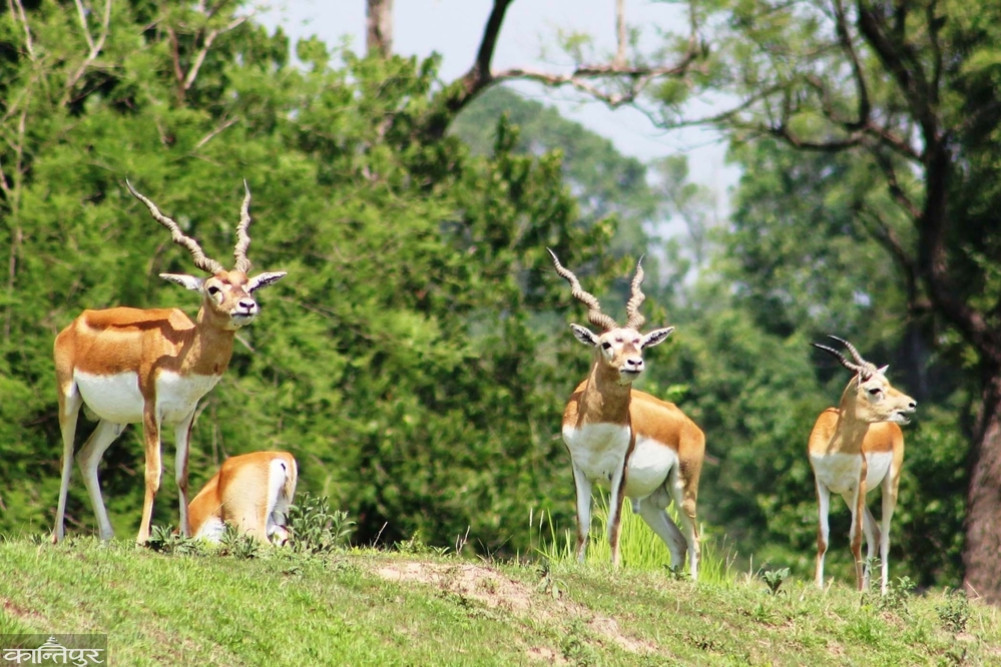
A decade and a half after the conservation program began, the number of rare wild animals, blackbucks, has reached 313 in the Hirapur Conservation Area of Shuklaphanta National Park.
We use Google Cloud Translation Services. Google requires we provide the following disclaimer relating to use of this service:
This service may contain translations powered by Google. Google disclaims all warranties related to the translations, expressed or implied, including any warranties of accuracy, reliability, and any implied warranties of merchantability, fitness for a particular purpose, and noninfringement.
Concerns over blackbuck management in Shuklaphanta after successful conservation The number of blackbucks, a rare wildlife species protected in the Hirapur Conservation Area of Shuklaphanta National Park, has increased to 313. After about a decade and a half since the conservation program began, the management has become challenging as the number of blackbucks has increased significantly.
According to the latest data from the park, there are 81 adult males, 20 semi-adult males, 102 adult females, 26 semi-adult females, and 84 offspring whose sex is yet to be identified, said Purushottam Wagle, information officer of the park. According to him, the number of blackbucks is continuously increasing with the success of the conservation program.
'The main challenge now is management,' said Information Officer Wagle, 'Since the risk of disease increases when there are too many in one area, the department is studying the option of releasing them in the open in their natural habitat or relocating them to other suitable areas.'
As per the decision of the Ministry of Forest and Environment, preparations are underway to rehabilitate the black antelope in Chitwan by adjusting the male-female ratio from Shuklaphanta and Khairapur conservation areas of Bardiya. 'This is also necessary to maintain genetic diversity,' Wagle said, 'Rather than keeping them in one enclosure, it is more effective in the long term to spread them out and protect them in different areas as per the breeding management plan, and the new generation will improve.'
The black antelope is currently protected by fencing an area of 58.8 hectares in Hirapur Phata of the park. The conservation area, which initially started with an area of 7.5 hectares in 2012, has been expanded in stages to its current size.
Since the black antelope likes open grasslands, it is seen that it will be challenging to protect them from leopards, wild dogs and poachers when released into their natural habitat. Along with this, infectious diseases transmitted from stray animals are also a major challenge to conservation, said Information Officer Wagle.
The park has been working on conservation of grazing areas, management of grasslands and management of food by planting crops such as corn and lentils. Information Officer Wagle said that due to lack of regular budget, there has been difficulty in resource management in recent times.
In 2012, 22 black antelopes, including two adult males, four semi-adult males, 12 adult females and four semi-adult females, were brought from the Nepalgunj Mini Zoo in Shuklaphanta for conservation.
In the same year, six black antelopes, including three adult males, two adult females and one whose gender has not been determined, were transferred from the Lalitpur Central Zoo for rehabilitation. In 2015, 14 blackbucks, including three adult males, one semi-adult male and 10 semi-adult females, were translocated from the Khairapur Conservation Area in Bardiya.
A total of 42 blackbucks, including eight adult males, five semi-adult males, 24 adult females, four semi-adult females and one whose sex was not determined, were translocated from all three areas. The number of 42 blackbucks that were translocated has increased to 313 in about a decade and a half, which is an increase of about seven times, according to the park's data.
To protect the health of blackbucks, they are regularly fed with grain, bran, dhuto, maize and gram. Information Officer Wagle says that medicated feed is also provided from time to time to prevent infection with parasites including worms and ticks.
According to the National Parks and Wildlife Conservation Act, 2029, blackbucks are one of the protected wildlife animals of Nepal. This species, which was once abundant in the open grasslands of Nepal, India and Bangladesh, had become endangered due to habitat destruction, poaching and natural disasters.
Hirapur Conservation Area is now also becoming a center of attraction for domestic tourists. Domestic tourists visit daily to observe the black rhinoceros. The main food of the rare and attractive wildlife is grass, dubo, siru, and kas.
Bharat Bahadur Bista, Chairman of Sundevi Consumers' Committee, said that the black rhinoceros conservation area should be further developed as a well-organized tourist destination. According to him, a homestay program has been started in the Simalphanta settlement near the black rhinoceros conservation area.
Vinay Kumar Jha, Assistant Chief Conservation Officer of the park, said that along with black rhinoceros conservation, eco-tourism promotion is also a priority and informed that the conservation area is being further managed by maintaining a balance between local community participation and conservation.