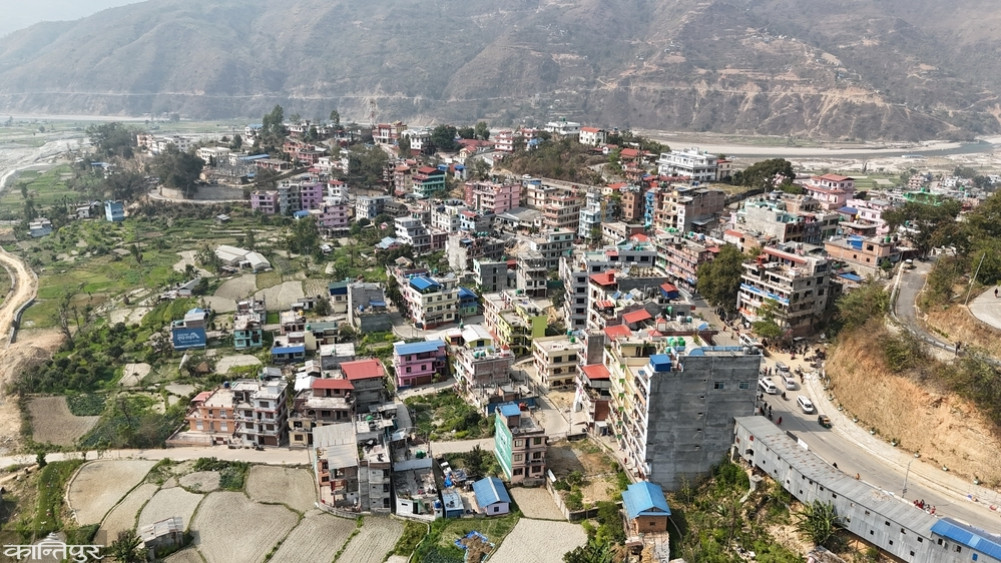
A study conducted among 260 households in Manthali and Ramechhap municipalities of Ramechhap in Bhadra last year found that 24 percent of family members are in foreign employment and a large portion of remittances are being spent on purchasing food.
We use Google Cloud Translation Services. Google requires we provide the following disclaimer relating to use of this service:
This service may contain translations powered by Google. Google disclaims all warranties related to the translations, expressed or implied, including any warranties of accuracy, reliability, and any implied warranties of merchantability, fitness for a particular purpose, and noninfringement.
Foreign employment is having a profound impact on the rural society and economy of Ramechhap. According to a study conducted in Manthali and Ramechhap municipalities of the district, at least 24 percent of households in these places are involved in foreign employment. A study has shown that foreign employment has become an important source of income for rural families due to limited local employment opportunities, near-zero industrial development, and limited agricultural production due to drought.
Researcher Chetnath Adhikari, while researching his thesis for the Philosophy (MPhil) at the Central Department of Population Studies (CDPS) under Tribhuvan University, has highlighted the relationship between labor migration, remittance use, and household welfare in Ramechhap district.
Although remittances contribute about 28 percent to Nepal's gross domestic product (GDP), Adhikari said that a micro-level study is needed to understand the real impact they have on the standard of living of households. To understand the same topic, he visited Manthali and Ramechhap municipalities. And in Ramechhap Municipality, a study was conducted with 31 questionnaires in 260 households in last Bhadra. According to the
official, on average, a household among those who have gone abroad in Nepal receives 32,338 rupees in remittances. But in Ramechhap, the number of families receiving remittances is large. According to which, 70.8 percent of Manthali Municipality and 86.9 percent of Ramechhap receive remittances less than the average. But 29.2 percent of Manthali and 13.1 percent of Ramechhap remittance receivers are receiving more than the national average. In terms of caste, 62 households in the Bahun district are receiving remittances less than the national average and 22 households are receiving more than the national average. Similarly, 119 households of the tribal communities are receiving remittances less than the average and 30 households are receiving remittances more than the average.
According to the official, the remittances sent by daily wage earners before going for foreign employment are higher than those of other professions. 33.3 percent of them send remittances home more than the national average. Only 18.4 percent of those involved in agriculture send remittances more than the national average. 29.4 percent of those involved in trade before going for foreign employment also send remittances more than the national average.
According to the research, remittances have become like a financial 'lifeline' for rural families. 59.6 percent of households participating in the study receive remittances monthly. 66.9 percent spend on education and other service expenses.
Of the remittances received, 73.5 percent, or 191 families, spend them on daily consumption. Of the respondents, 35.8 percent, or 93 households, said they had also used remittances to purchase real estate. The use of remittances in the productive sector is very low. Only 13 households said they had started a new business with the money received from remittances. 43.5 percent said they had used remittances to pay off loans they had taken while traveling abroad. The number of families using remittances for health insurance is also significant. According to which 45.8 percent use remittances for this purpose. 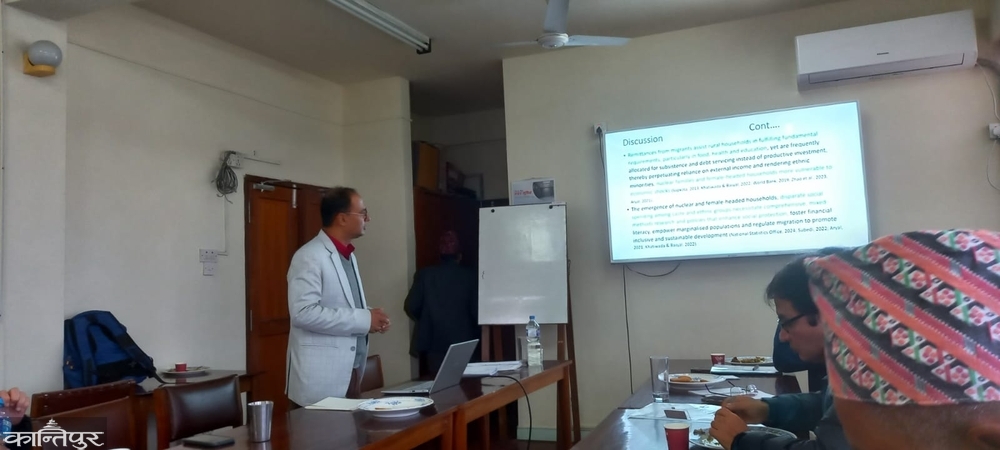
68 percent use remittances as savings. ‘Remittances have been seen as a source of regular income in the absence of other sources of income,’ says the official. ‘This has not only helped the household meet its financial needs but has also become an economic lifeline in the village.’ He said that since remittances are a temporary source of income, it should be converted from its proper use to a permanent source. For this, he suggests that the local government should have a policy on the proper use of remittances in the productive sector.
Middle East is the main destination
At least one member of all the households included in the study is working abroad. Most of them are male migrants, 61.2 percent. The Middle East is the most important destination, 47.7 percent, followed by Japan (23.7 percent) and South Korea (6 percent).
The study showed that the presence of female migrants is particularly significant towards Japan. Before migration, most of the youth (58.5 percent) were involved in agricultural occupations.
Economic improvement but social challenges
The study showed that the economic situation of most households has improved after foreign employment. 73.1 percent of the families participating in the survey said that their standard of living has improved in the past five years. But the social impact of foreign migration has also been seen. About 38.1 percent said that separation of family members is a big problem.
Especially, wives of those employed abroad feel lonely, children feel insecure, and the responsibility of women and the elderly in the agricultural sector has increased. According to the study, the dependence on remittances has increased when young people who can work at home migrate abroad. Due to which, agricultural production has decreased in 54.6 percent of households.
Foreign employment has been seen to increase women's access to the decision-making process of the household. However, although men make financial decisions in 49.6 percent of households, 43.1 percent of women have started making decisions about the use of remittances.