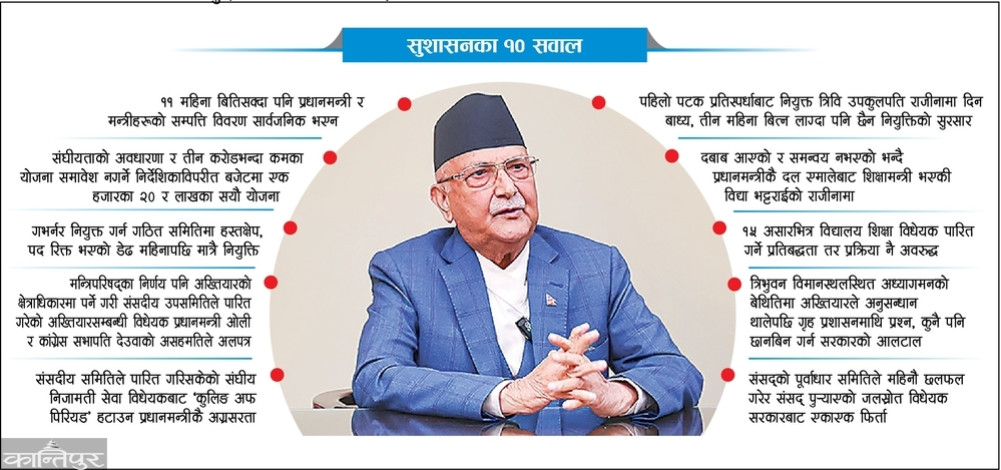
Prime Minister Oli, who formed a powerful government reform commission under his own leadership for good governance, held the first meeting only after two months.
We use Google Cloud Translation Services. Google requires we provide the following disclaimer relating to use of this service:
This service may contain translations powered by Google. Google disclaims all warranties related to the translations, expressed or implied, including any warranties of accuracy, reliability, and any implied warranties of merchantability, fitness for a particular purpose, and noninfringement.
There is a contradiction between Prime Minister KP Sharma Oli's theoretical commitment and behavior towards good governance. The citizens' trust in the state is waning as the weakness in law enforcement and the problems of transparency and accountability remain the same.
Prime Minister Oli, who formed a powerful governance commission under his own leadership with the proclamation of making the public service agile, held the first meeting of that commission only after two months, and that too was limited to formalities. The first meeting of the 15-member high-level government reform commission formed by the Council of Ministers on 8 Baisakh was held last Wednesday. Prime Minister Oli has yet to nominate 6 members to the commission. The commission has not been able to address the citizens' questions about good governance, such questions have increased.
The government has introduced extreme chaos in the budget by including hundreds of schemes of one lakh and one thousand against the concept of federalism. Contrary to the government's decision not to include projects worth less than three crores in the budget, the allocation has been made at the rate of thousands and lakhs. The budget has been allocated in the name of the leader to build the fraternal organizations of the party. On the other hand, the prime minister and powerful ministers have prioritized only their constituencies in budget allocation. Prime Minister Oli's home district Jhapa said that more budget than other districts of Koshi
is being criticized in Parliament. Amar Bahadur Thapa, MP of United Samajwadi in the Parliament, tore up the budget book of the Ministry of Physical Infrastructure and Transport last Thursday, saying that the ministers focused the budget only on their own areas.
The issue of human smuggling on visit visas by arranging 'setting' with the immigration office at Tribhuvan Airport has been heating up the Parliament for a month. After the Abuse of Authority Investigation Commission arrested the then immigration chief of the airport and the joint secretary of the home ministry, Tirtha Bhattarai, the opposition parties are demanding a separate investigation. Even though the main opposition Maoists backed down from the obstruction of parliament by agreeing on two points with the ruling Congress and UML, the RSVP and RPP are demanding a parliamentary inquiry committee.
Important bills in the final stage in the parliament are stuck because of Prime Minister Oli. The Prime Minister himself has been active in removing the provision of 'cooling-off period' placed in the Federal Civil Service Bill to prevent appointment to political and diplomatic posts for two years after retirement or resignation. Chief Secretary Eknarayan Aryal and secretaries have been lobbying against it ever since the issue of 'cooling-off period' was raised in the sub-committee under the State Order and Good Governance Committee of the House of Representatives.
The bill with provisions regarding 'cooling-off period' was unanimously passed by the committee and sent to the House. Officials of the Parliament Secretariat say that the bill, which has been on the agenda of the Parliament, has been put on hold because of Prime Minister Oli. Prime Minister Oli is discussing with the top leaders of the power partner Congress with the aim of removing the provision of 'cooling-off period' from the bill.
The Council of Ministers has decided to withdraw the water resources bill which was unanimously passed by the Parliament's Infrastructure Development Committee and passed to the Parliament in an opaque manner. The important authority bill needed to control corruption and maintain good governance has been stuck in the State Order and Good Governance Committee for 6 months. The sub-committee formed under the leadership of MP Hridayram Thani under the
committee passed the report of the bill unanimously in the first week of January and submitted it to the committee. Prime Minister Oli and Congress President Deuba disagreed with the definition of political corruption mentioned in the report, so the bill was not moved forward. The sub-committee made a new definition of policy decision by making a 'policy' decision from the Council of Ministers to stop the trend of corruption.
According to the agreement reached between the Federation of Teachers and the government in the third week of Baisakh, the school education bill should be passed on June 15. A month after the sub-committee prepared its report, the bill is still in the Education, Health and Technology Committee. MPs have been protesting saying that the government is trying to reverse the arrangement made by the sub-committee in the bill.
The government has not made public the reports of several commissions related to impunity and good governance. The government ignored the need to form a commission to investigate the killings, arson, vandalism and looting that took place during the demonstration by the royalist group in Tinkune area of Kathmandu on March 15.
The then Vice-Chancellor of Tribhuvan University, Kesharjung Baral, resigned on March 15 due to the non-cooperation of the Prime Minister and Chancellor Oli. Since then, the University has been running under the Vice-Chancellor of the University. Due to the lack of executive leadership in the university, the ruling party's student body activists are running amok. Student activists have resorted to vandalism and lockouts because they did not do what they said.
An example of the greatest contrast between the prime minister's commitment to good governance and his practice is the secrecy surrounding the assets of cabinet members. The Prime Minister, Minister, Minister of State and Assistant Minister must submit the details of their assets to the Office of the Prime Minister and Council of Ministers within two months. Although not legally binding, it was a practice to make public details from cabinet decisions. It has been more than eleven months since the government was formed under the leadership of Oli from the combination of Congress and UML, but the property details have been kept hidden in the office of the Prime Minister and Council of Ministers.
A few months ago, the government amended Acts 11 on economic and business environment improvement and investment promotion and 13 on good governance promotion and public services through an ordinance to remove legal obstacles to make public services agile. In order to provide procedural clarity in the Economic Procedures and Financial Responsibility Act, 2076 and the Privatization Act, 2050, some provisions were also amended through the Ordinance. According to the Ordinance on Promotion of Good Governance and Public Service, if the date is fixed by the law, the official should make the decision accordingly and in all other cases within seven days at the most. In case of non-compliance, the provision of action is also kept in the law. According to the amendment made to the law by the ordinance, the guarantee of improvement is not done by ordinary citizens.
Prime Minister Oli formed a separate commission two months ago to focus on improving public services by making the state's established mechanisms/bodies effective. Administrative experts say that since the prime minister himself is the leader of good governance as the executive head, there is no need for a separate commission to maintain good governance. They say that good governance will be maintained only if the law is implemented correctly. Why is there a need for other structures when the Prime Minister is the one to make decisions from the Cabinet? Former Chief Election Commissioner Bhojraj Pokharel says, "If you don't do what you have to do, you won't get results if you do it yourself." I can say that I have done this by creating a structure, but what will be done if the citizens do not feel the results? What is needed here is not structure, nor law. The Good Governance Act is being passed. The lack is of willpower and honesty.
There are powerful agencies such as Revenue Investigation Department, National Vigilance Center, and Money Laundering Investigation Department under the Office of the Prime Minister and Council of Ministers to maintain good governance by eliminating corruption, procrastination, and corruption. There are dozens of branches under the Office of the Prime Minister and Council of Ministers. There is a National Development Problems Commission chaired by the Prime Minister to solve problems. "If any advice is needed, a commission consisting of outside experts can be formed," says former Chief Election Commissioner Pokharel.
Khemraj Regmi, an administrative expert, former Home Secretary and former president of Transparency International Nepal, also says that a separate commission is not necessary for good governance. He said that the ministries and departments that maintain good governance should be made effective. We have many laws, regulations and structures formed from them for government reform. Adding structure on top of structure will not help in good governance. In that too, a disaster management meeting should be held under the chairmanship of the Prime Minister. In more than 50 agencies, the prime minister is the chairman. The secretaries in the Prime Minister's Office will do such work," he said. "If all the work is done by the Prime Minister, what is the work of the structures set up by the state? The structure to see government reforms is in the Prime Minister's office.'
Suryanath Upadhyay, the former chief commissioner of the Commission for Investigation of Abuse of Authority, says that if the intention is to maintain good governance by forming the commission, then the Prime Minister's initiative should be considered good. "All agencies have worked, but if they try to do more effective work after listening to everyone, it is positive," he said.
Ministers say that they are suffering from the problem of not being able to have a double dialogue with the Prime Minister about some of the ministry's work, not being able to meet with the Prime Minister on time, even after waiting for hours, the discussion is not going well. The instructions and decisions of the Prime Minister have not been implemented by the secretaries since last year. The commission formed under the leadership of the Prime Minister will suggest whether to work in the field of good governance, that is also not clear," said a minister, "Initially, all the ministers were asked to make a one-month action plan. We used to make an action plan accordingly. The prime minister has stopped asking for action plan after not implementing it within the specified time limit.'
The minister said that he has to wait for five/six hours even when he goes to see the prime minister for urgent work. After having to wait for hours even in the Cabinet meeting, the ministers went only after getting the information that Prime Minister Oli had left for the meeting. "Even in the meeting, the Prime Minister does not want to listen, he only gives instructions to each other," he said, "Procrastination is also mismanagement." This work should be started first in Baluwatar and then in Singha Durbar, he said.
Former administrator Kashiraj Dahal argues that due to lack of constitutional and legal arrangements to punish employees who do 'improper actions', good governance has not been maintained in the administrative sector. The high-level administration reform implementation and monitoring committee formed under the leadership of Dahal, while submitting its report in 2016, suggested that the vigilance center or any agency under the prime minister should be empowered to take action against those who do 'improper actions' for administrative reform.
'In the previous constitution, the authority was given authority to take action by considering unfair action as a crime. This arrangement was removed in the 072 constitution. Now it is in the void. At present, the authority can only take action on corruption,'' he says, 'but action is not taken on unfair actions such as not doing what should be done, being late, being careless, and being sloppy. This has hindered administrative reforms.'
Chief Secretary Eknarayan Aryal says that the commission was formed under the leadership of the Prime Minister according to the concept of frugal administration. According to him, the Commission will do the work of maintaining good governance through the use of technology, removing political difficulties, providing citizen-friendly services, merging or abolishing unnecessary offices and agencies. The jurisdiction of the commission is already fixed. In the first meeting held on Wednesday, strategic issues were discussed, he said.
10 questions of good governance