A report was prepared by the parliamentary sub-committee to enact a law to provide pension even if an employee is convicted of crimes such as corruption, crimes against the state, drug dealing, kidnapping and extortion after retirement.
We use Google Cloud Translation Services. Google requires we provide the following disclaimer relating to use of this service:
This service may contain translations powered by Google. Google disclaims all warranties related to the translations, expressed or implied, including any warranties of accuracy, reliability, and any implied warranties of merchantability, fitness for a particular purpose, and noninfringement.
Retired civil servants are going to get pension benefits even if they are found guilty of corruption and moral corruption. The parliamentary sub-committee has prepared a report to draft a law to provide pension even if an employee is found guilty of crimes such as corruption, crimes against the state, drug dealing, kidnapping and extortion after retirement.
The sub-committee under the State System and Good Governance Committee of the House of Representatives has removed the clause of the original bill that states that those found guilty of moral corruption including corruption will not receive a pension from the state. Section 68 of the Federal Civil Service Bill submitted to the House of Representatives by the then Federal Affairs and General Administration Minister Anita Devi on February 21, 2080 contained provisions related to 'non-receipt of pension'.
Subsection 1 stated, "A person who has retired and is receiving a family pension after the commencement of this Act shall not receive such pension if he is found guilty by the court of corruption, forgery of government or public documents, crimes against the state, drug dealing, money laundering, sale of antiquities, human trafficking, kidnapping and hostage-taking, extortion, polygamy or other criminal offenses showing moral turpitude." The sub-committee removed section 68 of the original bill and put a provision in it that 'no double benefit' should be taken.
There is a provision in the prevailing Civil Service Act that if a person is found guilty by the court after being suspended, he will not get pension. But there is no mention of whether pension will be given/not given to national servants who have been found guilty of moral turpitude after retirement.
Because the law does not mention what to do in such cases, many employees and security personnel are taking pension benefits despite being convicted of various crimes after retirement. The then Inspector General of Nepal Police Om Vikram Rana and Hem Bahadur Gurung who were convicted in the Sudan scam case are enjoying pension benefits. Rameshchand Thakuri, another inspector general at the time, has not received the pension facility due to the fact that he was convicted of the same offence.
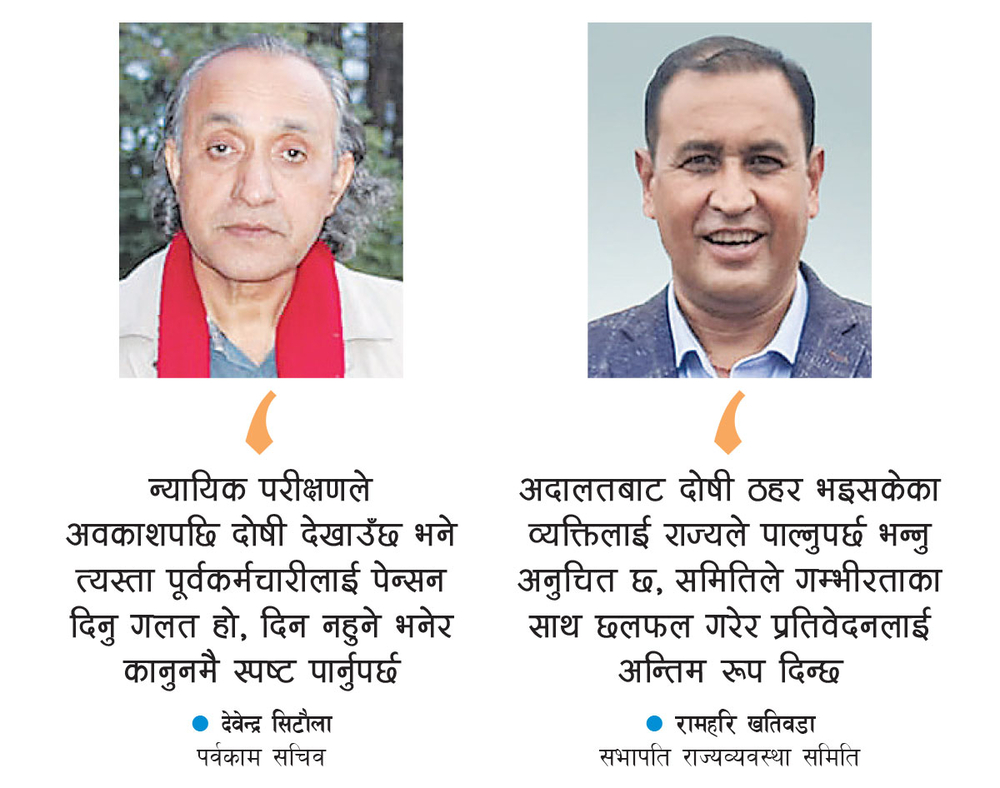
The committee started discussing the report prepared by the sub-committee led by Congress MP Dilendra Prasad Badu on Friday. Committee chairman Ramhari Khatiwada said that the report of the sub-committee will be discussed in the committee. "There was a provision in the original bill that ex-employees who were convicted of crimes of moral turpitude would not get pension. In the report from the sub-committee, this has been removed," he said. The committee will discuss this matter seriously and finalize the report.'
Former Secretary Devendra Sitaula says that it is not appropriate to give pension facilities to retirees who have been found guilty of a criminal offense or moral turpitude. "If the judicial examination proves guilty after retirement, it should be made clear in the law that it is wrong to give pension to such ex-employees," he said.
Similarly, the sub-committee has amended the original bill so that the employees who are facing a case in the court for offenses other than automatic suspension do not have to be suspended. In Section 103 (4) of the original bill, it was said that "if any civil servant is prosecuted for corruption, government or public documents, crimes against the national interest, drug dealing, money laundering, sale of antiquities, human trafficking, kidnapping, body hostage, coercion, polygamy or other criminal charges that appear morally corrupt, such an employee shall be automatically suspended."
sub-committee has added a restrictive phrase in section 103 (4) and added provision that such employees who miss bond, surety and date will not be suspended after filing a case in court for an offence. In the restrictive phrase, it is said, "However, if a civil servant is released from the relevant court on bond, surety or ordinary date, if a case has been filed for an offense other than the offense which is automatically suspended after the case is filed according to the prevailing law, he will not remain under suspension."
The State System Committee formed a sub-committee under the leadership of Congress MP Badu on 9 February 2081 to study the bill and submit a report. The members of the committee are Ishwari Neupane of Congress, Leelanath Shrestha and Raghuji Pant of UML, Hitraj Pandey of Maoist, Chanda Karki of RSVP, Budhishan Tamang of RPP, Rajendra Pandey of United Socialist Party, Ashok Rai of JSP, Prakash Adhikari of JSP Nepal and Sarvendranath Shukla of LOSPA.
The employees demanded that the sub-committee meeting be held in a closed room for the quarterly discussion of the Civil Bill. Committee chairman Khatiwada said that as per the request of the employees, the sub-committee meeting was held in a closed room, but the committee meeting will discuss the report openly. The sub-committee studied the bill through 20 different meetings.

