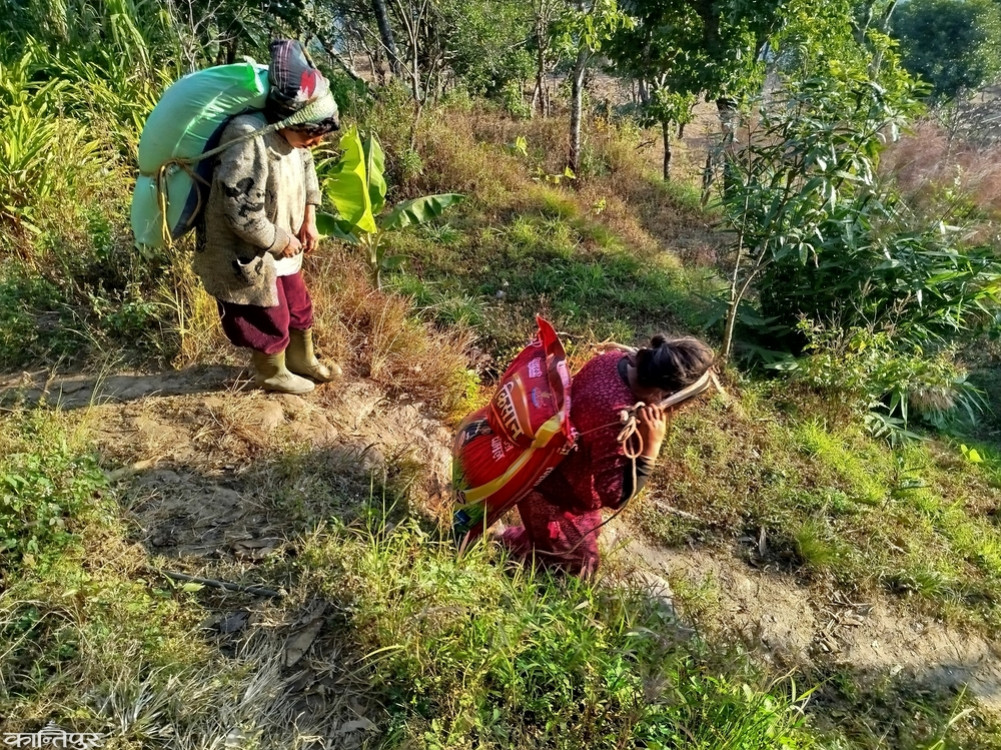
79.51 percent of the 3,866 households in Hatuwagadhi Rural Municipality, located in the southern region of Bhojpur, have enough food for only 6 months with the food they grow.
We use Google Cloud Translation Services. Google requires we provide the following disclaimer relating to use of this service:
This service may contain translations powered by Google. Google disclaims all warranties related to the translations, expressed or implied, including any warranties of accuracy, reliability, and any implied warranties of merchantability, fitness for a particular purpose, and noninfringement.
One recent morning, Anita Rai, a local, came down from Katike Bisouni Chowk, carrying a bag of rice on her back. Until a decade ago, his family used to carry sacks of paddy from their farm. At this intersection, which is located on the road section from Ghodetar Bazaar, the main administrative and commercial center of Hatuwagadhi Rural Municipality, to Bhojpur headquarters, traders transport the daily consumable goods ordered by the surrounding locals on tractors. Locals carry it from house to house. Most rice is transported in this square. Anita carried three sacks of rice in two batches. She delivered the first shipment herself. The second batch was helped by the neighbor's daughter-in-law.
"Earlier, I used to make a living from the produce of my own farm," she remembered, "I used to grow rice, corn, millet, beans, pulses, vegetables according to the season, keep cows and milk milk and run the kitchen". Salt, oil, sugar, meat and some amount of rice was bought during festivals.'
Kattike and Ahale in southern Hatuwagadhi-2 of eastern hilly district Bhojpur, the life of the village was based on traditional farming like Anita's family. All the family members were at home. There was harmony in the neighborhood, there was intimacy and harmony. The view of the Kanchenjunga Himal, which is visible from the mountains nearby, and enjoying the seasonal climate gave the locals a wonderful satisfaction.
The normal life here has suddenly started to fall apart . After the change in the rainfall pattern and the wave of drought started, the production of grain crops started to decrease . In this village, which is about 1350/1450 meters above sea level, the traditional agricultural cycle of corn sowing by Baisakh 15 and paddy planting by June has been disrupted by the changing climate and weather. In the beginning, the paddy cultivation that had to be planted under sky water was affected.
When the paddy was to be planted, it stopped raining enough . From the seeds that were sown, more chaff started to grow than rice. The local people started to gradually abandon rice cultivation from 2070 after it stopped growing according to their efforts. One house or two houses left to plant the fields. After the Sandhiyars left, the monkeys started harassing those who were planting the water in the garden. And the fields across the village were left barren. The fields that used to grow rice are now covered with bushes and forests.
The main crop of Hatuwagadi, which needs less water than rice, has started to be covered by drought. According to local 61-year-old Ram Prasad Rai, after sowing corn, there was drought, insects ate from the leaves to the roots of the corn, and the seeds did not grow properly. "It has started to have a lot of impact in the last four to five years," he said, "We have to buy 40,000 worth of rice every year." The local Geeta Rai said that due to the increased problem of pests even in every fruit and vegetable, the need to use pesticides in every product has increased.
This problem is not limited to this village. According to the 'National Climate Change Survey-2022' published by the National Statistics Office last year, drought has emerged as the main impact of climate change on agriculture-based people's lives. Through direct interviews, 65.4 percent of the 6,508 households participating in the survey across the country said that they are suffering from drought. 54.3 percent of the survey participants said that they are facing new disease outbreaks in the crops and 87 percent are feeling the change in rainfall patterns every season. Residents aged 45 or more who have been living in the same area for 25 years were asked to participate in the survey.
The survey reveals that drought and diseases have caused a decline in cultivation and production across the country. However, the locals are continuing the farming that they have been doing for centuries. But there is not enough food to eat all year round. 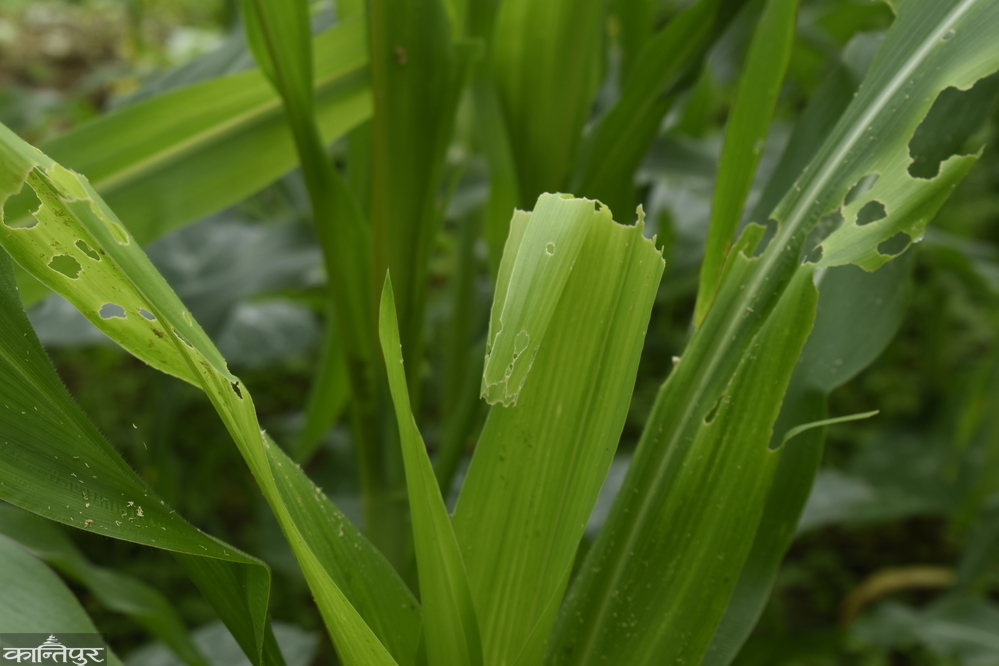 Maize plants affected by the disease
Anita's family grows corn every year even though the paddy fields are barren. But a family of four has to buy food to meet their daily needs . She said, ``We buy one to one and a half lakhs a year, by making rice and corn.'' Cultivating season and other times except for festivals are in India.
On the other hand, the wife has to buy and bring rice, feed the children, send them to school, do the household chores, and cultivate the fields alone . This has been a daily routine for him since 6/7 years from the time he wakes up in the morning till he sleeps.
It illustrates the doubling and tripling of women's workloads due to climate-related disasters and food insecurity. Men and young generation are rarely found in the village as family members from every house have to go to work abroad to avoid morning-evening chores and to cover the family's expenses. "Nowadays, there is a trend in the village to go abroad and earn there," says Bichari Thapa, the ward president of Hatuwagadhi-2, "but no matter how hard we farm, we cannot grow enough to eat all year round, so it has become a necessity for one member of the family to migrate abroad, be it a man or a woman."
Since the 1960s, roads and electrification have expanded in the village. It seems that development is coming into the village. But due to drought and lack of drinking water sources, living in the village has become difficult and the process of leaving that place has also increased, said Thapa, Ward President. The one-crop fields have turned into forests . "The village started to be divided in such a way that earlier people from one village were not known, now people from six/seven villages can be counted sitting at home," said Dipendra Thapa, another resident of Hatuwagadi.
"Not only to do the pruning in the farm, but also the people who go to Malami when they are sick and ill," said local Ramkumar Rai.
According to the 'electrical picture 2078' of Hatuwagadhi rural municipality, 72.22 percent of the 3 thousand 866 households of this municipality which are made up of Ranibas, Sindrang, Khairang, Homtang, Patlepani and Hasanpur VDCs depend on farming for their daily livelihood. However, it is not enough to eat throughout the year. 79.51 percent of the households have consumed the crops grown by them within 6 months. They have no food storage from the first day of the seventh month every year . In the village, the families who could buy rice and eat it were considered upper class . Now even those who earn by working all day do not get rice.
Manish Raj Pandey, Head of Climate Change Division at National Nature Conservation Fund, says that in the eastern hills, there is a long drought, no rain, floods and landslides, unseasonal rains, temperature rise and other unexpected weather events due to climate change are increasing. "This has directly affected the livelihood of the farming families, mainly due to the decrease in the fertility of the soil and the increase in the incidence of diseases and the decrease in food production," he said.
"Despite the onset of monsoon, heavy rains in a short period of time have started causing landslides in the mountains and floods in the plains," another climate change expert Madhukar Upadhya said, "This is the third consecutive year of drought across the country without an average amount of winter rainfall."
Even the winter rains entering from western Nepal pass through the far west and emanate in the hilly parts of Karnali, so the eastern hills have stopped reaching Bhojpur.
After the road network is connected with Terai, the trees growing in barren fields are being cut and sold in Hatuwagadi. The middleman buys the plot by paying lakhs from the landowner . They use dozers to dig roads that can be driven by tractors. For the time being, although the sale and purchase of wood has created employment and income, it seems that the challenge will increase with the expansion of roads everywhere. "After the arrival of the local government, there are hardly any villages where the roads have not been completed. When the drought is getting longer, the water source has dried up due to random road expansion," he said.
In the first week of June, during the onset of monsoon, the neighboring district of Bhojpur, Sankhuwasabha, was hit by a flash flood.